Interesting Facts about the Rise Me Up From Down Below – Doerflinger
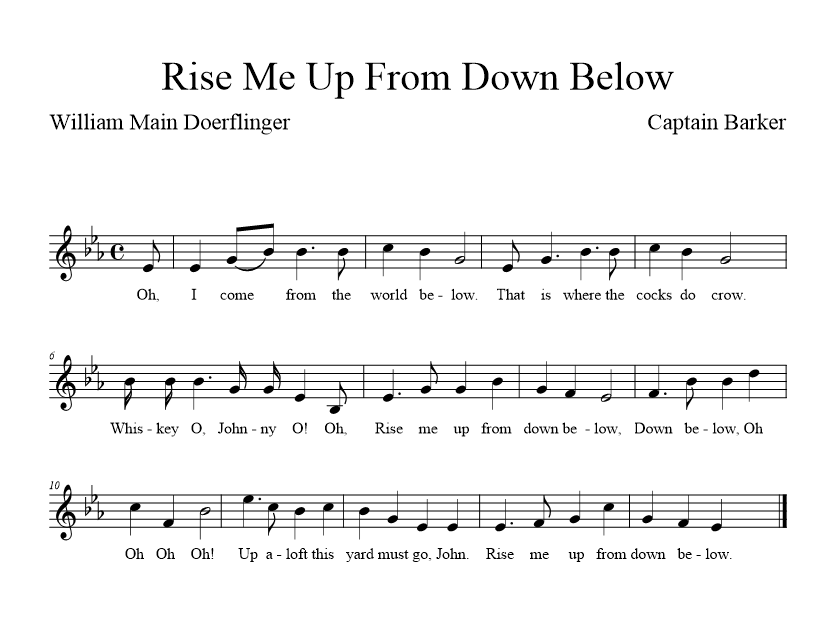
“Rise Me Up From Down Below”, stamp-‘n’-go shanty. Doerflinger took this song from “Lemon” Curtis, and says it is one of his favored songs. Negro origin shanty which combined the functions of a regular halyard shanty and a “walk away (stamp-‘n’-go)” song. In hoisting topgallants to this shanty, the men would first take two “drags” on the rope and then “walk away” with it. The pulls came on “WHISKEY Oh, JOHNny Oh,” while the rest of the chorus was sung as the men stamped along the deck gripping the halyard.
The source of this sea shanty
The music: “Shantymen And Shantyboys” by William Main Doerflinger (1951). The lyrics: “Shantymen And Shantyboys” by William Main Doerflinger (1951). Mentioned in: “Shanties from the Seven Seas” by Stan Hugill (1st ed p 281, 282).
The Record of the Rise Me Up From Down Below – Doerflinger
You also can find this record on my YouTube channel here or directly listen below. Additionally, if you want to share your opinion about the record or share your opinion you can do it in my Facebook forum here, or leave a comment at the bottom of this blog article.
The musical notation
The full lyrics
Rise Me Up From Down Below – Doerflinger
Oh, I come from the world below. That is where the cocks do crow.
– Whisky O, Johnny O! – Oh, Rise me up from down below, – Down below, Oh Oh Oh Oh! – Up aloft this yard must go, John. – Rise me up from down below.
* 2 *
I come from the world below! That is where the fires do roar.
Interesting Facts about the John Dameray (Silsbee)
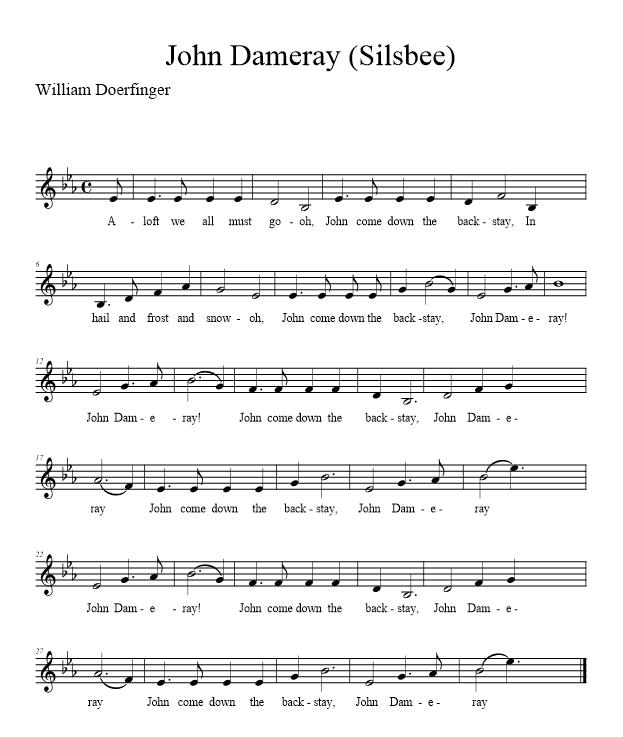
This shanty is known as “Johnny, Come Down the Backstay” or “John Dameray”. Stan Hugill claims it was a stamp-‘n’-go shanty, and a favorite in Yankee ships according to his shipmate Harding Barbadian, the Barbarian. This particular version comes from William Main Doerflinger in his “Shantymen And Shantyboys” (1951). William Doerflinger mentioned this song was sung at the braces, on American vessels, according to a manuscript by the late Nathaniel Silsbee of Cohasset, Massachusetts. Mr. Silsbee learned this shanty at sea in the 1880s and set down the words in 1893. Song refers to the sailor stunt of sliding down the backstays – a quick way of getting on deck from high aloft.
The source of this sea shanty
The music: “Shantymen And Shantyboys” by William Main Doerflinger (1951). The lyrics: “Shantymen And Shantyboys” by William Main Doerflinger (1951). Mentioned in: “Shanties from the Seven Seas” by Stan Hugill (1st ed: p 272).
The Record of the John Dameray (Silsbee)
My reconstruction will imitate “stamp-n-go” shanty.
You also can find this record on my YouTube channel here or directly listen below. Additionally, if you want to share your opinion about the record or share your opinion you can do it in my Facebook forum here, or leave a comment at the bottom of this blog article.
The musical notation
The full lyrics
John Dameray (Silsbee)
Aloft we all must go-oh, – John come down the backstay, In hail and frost and snow-oh, – John come down the backstay, – John Dameray!
– John-Dameray! – John come down the backstay, – John-Dameray! – John come down the backstay, – John-Dameray!
– John-Dameray! – John come down the backstay, – John-Dameray! – John come down the backstay, – John–Dameray!
* 2 *
My ma she wrote to me, “My son, come home from sea.”
* 3 *
Got no monay and no clo’es, Am knocking out of doors.
* 4 *
My home I soon will be in, And then we’ll have some gin.
* 5 *
From sea I will keep clear, And live by selling beer.
Interesting Facts about the Reuben Ranzo II – Doerflinger
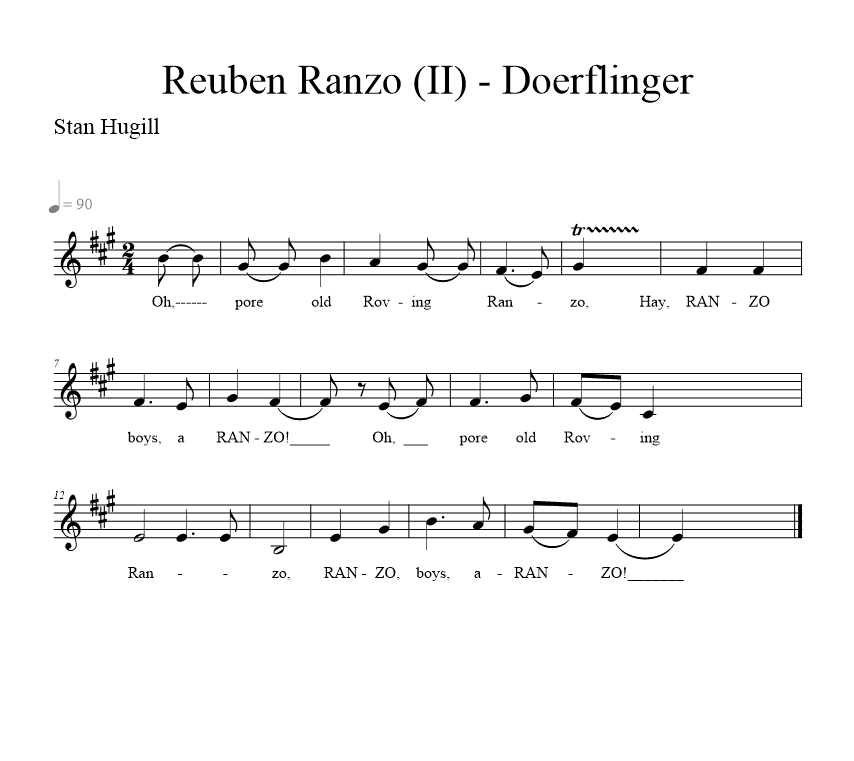
Now, Reuben Ranzo II – Doerflinger is a shanty built around the dirtiest “sailor” who ever shipped – Reuben Ranzo. This Halyard shanty was one of the most rousing of all of the halyard shanties. This shanty due to the some of the themes was very popular amongst whalers. Here is the Doerflinger version, his Shantyman sends him to South Georgia, which Stan Hugill think is an anachronism since Antarctic whaling didn’t commence until between the two World Wars after the South Sea cachalot became nearly extinct and new-fangled whalers began to search for a blue whale. The song that Stan Hugill mentioned is the “Reuben Ranzo (II)” on page 24 of the Doerflingers – “Shantymen And Shantyboys” (1951).
The song will be reconstructed by myself as the halyard shanty.
The source of this sea shanty
The music: “Shantymen And Shantyboys” by William Main Doerflinger (1951).
The lyrics: “Shantymen And Shantyboys” by William Main Doerflinger (1951).
Mentioned in: “Shanties from the Seven Seas” by Stan Hugill (1st ed p 242).
The Record of the Reuben Ranzo II – Doerflinger
You also can find this record on my YouTube channel here or directly listen below. Additionally, if you want to share your opinion about the record or share your opinion you can do it in my Facebook forum here, or leave a comment at the bottom of this blog article.
The musical notation
The full lyrics
Reuben Ranzo (II) – Doerflinger
Oh, pore old Roving Ranzo, – Hay, RANZO, boys, a RANZO! Oh, pore old Roving Ranzo, – RANZO, boys, a RANZO!
* 2 *
Now, Ranzo he was no sailor. Now, Ranzo he was no sailor.
* 3 *
So pore old Roving Ranzo, So pore old Roving Ranzo,
* 4 *
Now they shipped him on board of a whaler! Now they shipped him on board of a whaler!
* 5 *
Now the captain he liked Ranzo. Now the captain he liked Ranzo.
* 6 *
So the captain taugh him how to read and write. So the captain taugh him how to read and write.
* 7 *
He taught him navigation. He taught him navigation.
* 8 *
When he got his first mate’s papers, When he got his first mate’s papers,
* 9 *
He became a terror to whalers! He became a terror to whalers!
* 10 *
He was known all over the world as He was known all over the world as
* 11 *
As the worst old bastard on the seas! As the worst old bastard on the seas!
* 12 *
He would take his ship to Georgiay, He would take his ship to Georgiay,
* 13 *
And there he’d drag for sperm whale. And there he’d drag for sperm whale.
* 14 *
He lost the only ship he had. His first and last and only ship
* 15 *
Was the “Morgan”, and she’s known everywhere. Was the “Morgan”, and she’s known everywhere.
* 16 *
Now, he’s gone to hell and we’re all glad! Now, he’s gone to hell and we’re all glad!
* 17 *
Now, I’ve told you he was no sailor. Now, I’ve told you he was no sailor.
* 18 *
He was a New York tailor. He was a New York tailor.
* 19 *
Whether a tailor or a sailor, Whether a tailor or a sailor,
Interesting Facts about the Blow The Man Down (V – Doerflinger)
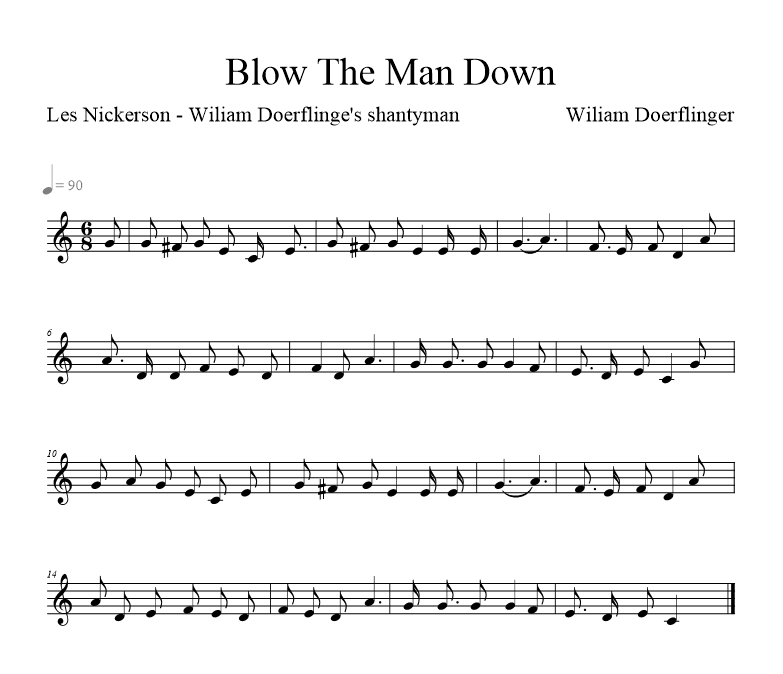
Here is one of the most favorite shanties is the tops’l halyard shanty “Blow The Man Down (V – Doerflinger)”. This version comes from William Doerflinger’s “Shantymen And Shantyboys” (1951). In Doerflinger’s book, we can read, is that Les Nickerson also used “The Sailor’s Grace”, that old forecastle rhyme inspired by “salt horse” rations. I would also like to thank Artur Pietrzykowski for the wonderful illustration that you can find at the beginning of the record.
The song will be reconstructed by myself as the halyard shanty.
The source of this sea shanty
The music: “Shantymen And Shantyboys” by William Main Doerflinger (1951).
The lyrics: “Shantymen And Shantyboys” by William Main Doerflinger (1951).
Mentioned in: “Shanties from the Seven Seas” by Stan Hugill (1st ed p 212).
The Record of the Blow The Man Down (V – Doerflinger)
You also can find this record on my YouTube channel here or directly listen below. Additionally, if you want to share your opinion about the record or share your opinion you can do it in my Facebook forum here, or leave a comment at the bottom of this blog article.
The full lyrics
Blow The Man Down (V – Doerflinger)
Old horse, old horse, what brought you here, – WAY, hay, BLOW the man down! After ploughing the turf for many a year, – GIMME some time to BLOW the man down!
* 2 *
With kicks and cuffs and sad abuse, We’re salted down for sailors’ use
* 3 *
Between the mainmast and the pump, We’re salted down in great big chunks.
* 4 *
And when the mate comes from the rudder He takes a piece of this old blubber.
Interesting Facts about the Blow The Man Down (IV – Doerflinger)
Here it is one of the most favorite shanties is the tops’l halyard shanty “Blow The Man Down(IV – Doerflinger)”. This version comes from William Doerflinger’s “Shantymen And Shantyboys” (1951). Doerflinger says that almost any simple song could be adapted to “Blow The Man Down”. Les Nickerson (Doerflinger’s shantyman), a Nova Scotian, uses verses from the ancient Anglo-Scottish ballad of “The Three Crowns”, or “The Twa Corbies”. I would also like to thank Artur Pietrzykowski for the wonderful illustration that you can find at the beginning of the record.
The song will be reconstructed by myself as the halyard shanty.
The source of this sea shanty
The music: “Shantymen And Shantyboys” by William Main Doerflinger (1951).
The lyrics: “Shantymen And Shantyboys” by William Main Doerflinger (1951).
Mentioned in: “Shanties from the Seven Seas” by Stan Hugill (1st ed p 212).
The Record of the Blow The Man Down (IV – Doerflinger)
You also can find this record on my YouTube channel here or directly listen below. Additionally, if you want to share your opinion about the record or share your opinion you can do it in my Facebook forum here, or leave a comment at the bottom of this blog article.
The musical notation
The full lyrics
Blow The Man Down (IV – Doerflinger)
There was there crows sat on a tree, – WAY, hay, BLOW the man down! And they was black as black could be. – GIMME some time to BLOW the man down!
* 2 *
Says one old crow unto his mate, “Where shall we go for somethin’ to eat?”
* 3 *
“There is an old horse on yonder hill, And there we can go and eat our fill.
* 4 *
“There is an old horse on yonder mound. We’ll light upon to his jaw-bone.”
* 5 *
Says one old crow unto the other, “We’ll pick his eyes out one by one”.
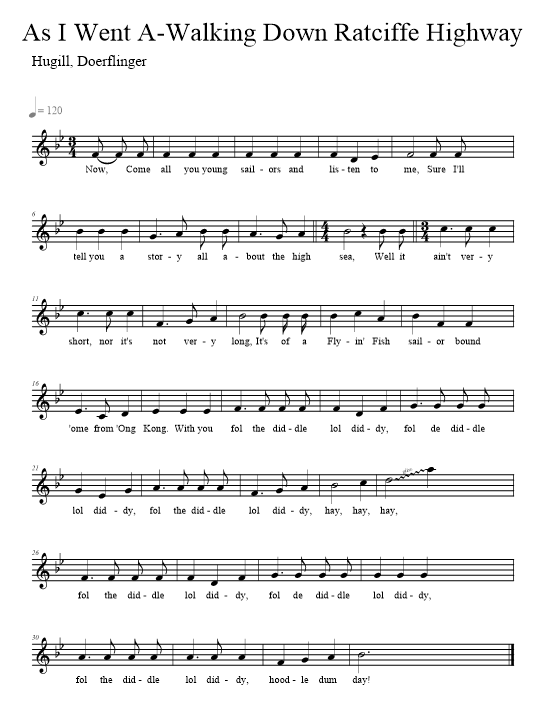
Interesting Facts about As I Went A-Walking Down Ratcliffe Highway
Here is the old forebitter “Ratcliffe Highway”; which was sometimes sung at the pumps and the capstan. This version mentioned by Stan Hugill comes from William Doerflinger’s “Shantymen and Shantyboys” (1951). Doerflinger mentions about is that the same stanza words; were sung in the halyard shanty “Blow the Man Down”. Captain Tayluer believed this song; was composed about 1840; by an East India trader. In Doerflinger’s book, we can find this song in the chapter “Deep-Water Songs”. I would also like to thank Artur Pietrzykowski for the wonderful illustration that you can find at the beginning of the record.
The song will be reconstructed by myself as the capstan shanty.
The source of this sea shanty
The music: “Shantymen And Shantyboys” by William Main Doerflinger (1951).
The lyrics: “Shantymen And Shantyboys” by William Main Doerflinger (1951).
Mentioned in: “Shanties from the Seven Seas” by Stan Hugill (1st ed p 201).
The Record of As I Went A-Walking Down Ratcliffe Highway
You also can find this record on my YouTube channel here or directly listen below. Additionally, if you want to share your opinion about the record or share your opinion you can do it in my Facebook forum here, or leave a comment at the bottom of this blog article.
The musical notation
The full lyrics
As I Went A-Walking Down Ratcliffe Highway
*introductory verse*
Now, Come all you young sailors and listen to me, Sure I’ll tell you a story all about the high sea, Well it ain’t very short, nor it’s not very long, It’s of a Flyin’ Fish sailor bound ‘ome from ‘Ong Kong.
– With you fol the did-dle lol did-dy, fol de did-dle lol did-dy, – fol-the did-dle lol did-dy, hay, hay, hay, – fol-the did-dle lol did-dy, fol de did-dle lol did-dy, – fol the did-dle lol did-dy, hood-le dum day!
* 2 *
Now as we went a-walking down Rat’liffe Highway, Well, a flash-lookin’ packet we chanced for to see, She was bowling along with the waind blowing free, And she clewed up her courses and waited for me.
* 3 *
Now, she ‘ad up no flags did she show; She was round in the counter and bluff in the bow. Were she did ‘ail from I could not tell, But I threw out my flipper and we’re both bound to hell!
* 4 *
Now, into a snug little corner, oh soon we did moor, Just be’ind the little table around the door. We eat there and drank till we nearly did bust, Then she let out first with her Irishman’s roar, etc…
* 5 *
I’ll bring you silk dresses and all that I know, Fine gold rings and stones from the islands, you know. I’ll bring you home plenty of money to spend, If you’ll only wait till I do return,
Interesting Facts about the What is in the Pot A-boiling
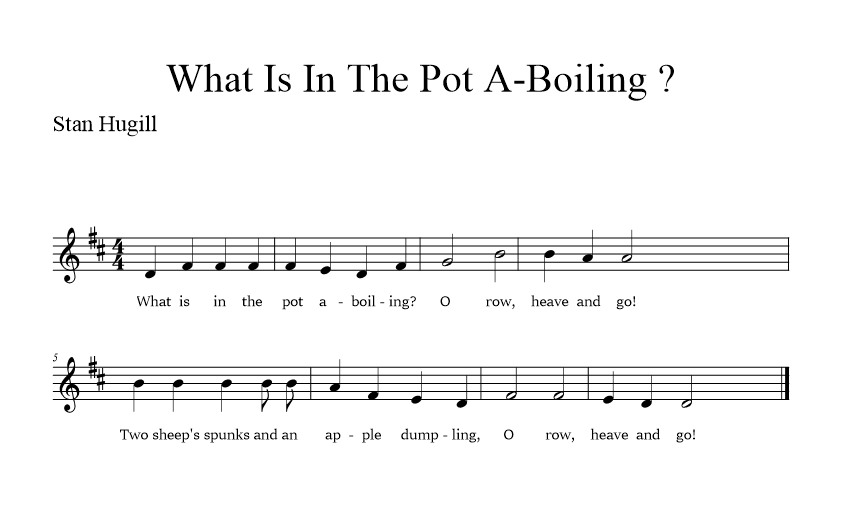
What is in the Pot A-boiling, in my opinion, definitely is the pulling shanty, the construction verses, and choruses clearly show it, however, Stan Hugill did not specify this clearly, but he left underscored words on choruses in music notation. According to this notation, we can be sure this song is a halyard shanty. Stan Hugill took this song from Cecil J. Sharp’s “Folk Song Society Journal (England Folk Song and Dance Society)” 1916: Vol 5 Iss 20. From Cecil Sharp’s description, this song was sung by Mr. H. C. Alison (Of Perth Scotland), at Stratford-On-Avon, on Aug. 29th, 1914.
The song will be reconstructed by myself as the halyard shanty.
The source of this sea shanty
The music: “Shantymen And Shantyboys” by William Main Doerflinger (1951).
The lyrics: “Shantymen And Shantyboys” by William Main Doerflinger (1951).
Mentioned in: “Shanties from the Seven Seas” by Stan Hugill (1st ed p 166).
The Record of the What is in the Pot A-boiling
You also can find this record on my YouTube channel here or directly listen below. Additionally, if you want to share your opinion about the record or share your opinion you can do it in my Facebook forum here, or leave a comment at the bottom of this blog article.
The musical notation of the What is in the Pot A-boiling
The full lyrics
What is in the Pot A-boiling
What is in the pot a-boiling? – O row, HEAVE and go! Two sheep’s spunks and an apple dumpling, – O row, HEAVE and go!
Interesting Facts about Sally Brown (A – Dick Maitland version)
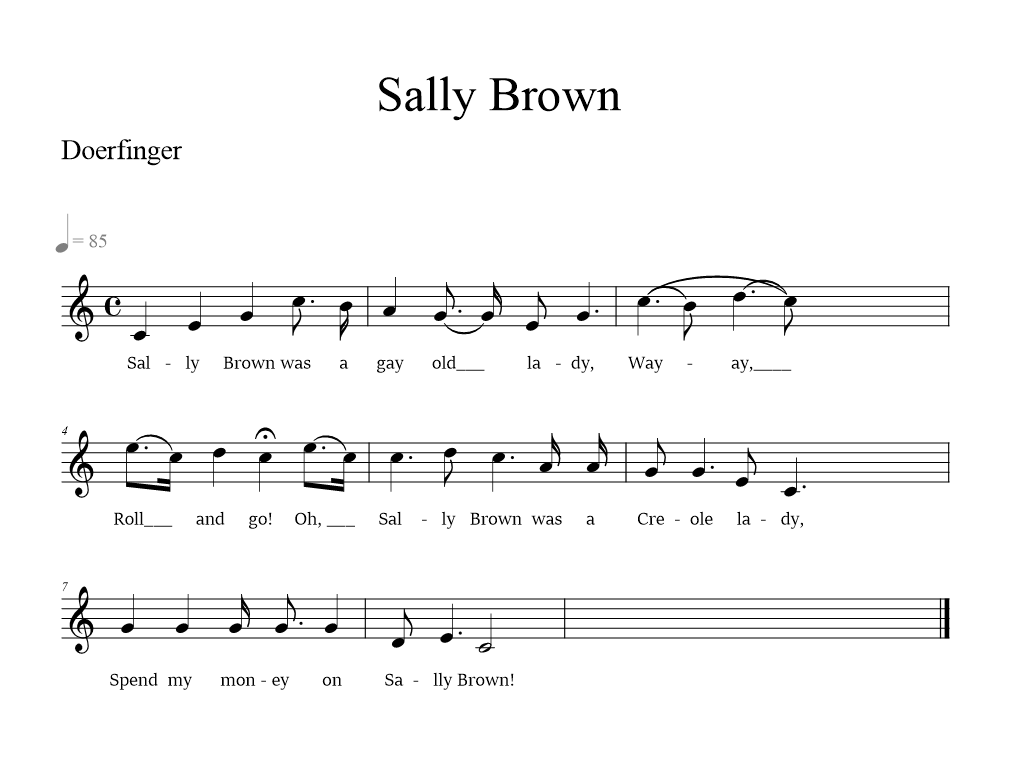
This Sally Brown (A – Dick Maitland version), was sung by Dick Maitland, a shantyman whose shanties were the core of the collection of William Main Doerflinger. Here is how this shanty was commented by Doerflinger: Favorite heroine of shanty lore was the beguiling, rum-drinking, fickle Sally Brown. “Some people might think Sally Brown was rather immoral,” Dick Maitland philosophized, “but it was the way of the world in the days!” This I another “roll” shanty, the most famous “Roll an’ Go!”, also known as “Sally Brown”. This is a capstan shanty, as Stan Hugill mentions it is only one theme of this song, and it is – all about Sally and her daughter. As the author of “Shanties from The Seven Seas” mentioned – there existed many obscene verses, which accounts partly for the fact that popularity never waned!
The song will be reconstructed by myself as the capstan shanty.
The source of this sea shanty
The music: “Shantymen And Shantyboys” by William Main Doerflinger (1951).
The lyrics: “Shantymen And Shantyboys” by William Main Doerflinger (1951).
Mentioned in: “Shanties from the Seven Seas” by Stan Hugill (1st ed p 164).
The Record of the Sally Brown (A – Dick Maitland version)
You also can find this record on my YouTube channel here or directly listen below. Additionally, if you want to share your opinion about the record or share your opinion you can do it in my Facebook forum here, or leave a comment at the bottom of this blog article.
The musical notation
The full lyrics
Sally Brown (A – Dick Maitland version)
Saly Brown was a gay old lady, – Way-ay, Roll and go! Oh, Saly Brown was a Creole lady, – Spend my money on Sally Brown!
* 2 *
She had a farm in the isle of Jamaica, Where she raised sugarcane, rum an, terbacker.
* 3 *
Also she had a fine young daughter, And that’s the gal that I was after,
* 4 *
Seven long years I courted the daughter, And when I asked her if she’d marry,
* 5 *
She would not have a tarry sailor! She would not have a tarry sailor!
* 6 *
“Those lily-white hands and slender waist? A tarry sailor I’ll ne’er embrace!”
* 7 *
But now my troubles they’re almost over, Sally got married to a creol solider.
* 8 *
He beat and abused her and stole her money, And left her with creol baby.
* 9 *
One night she was taken with a pain in her belly, And they sent for a doctor and his name was kelly.
* 10 *
He rode a horse with a ropeyarn bridle, And he laid young Sally on the table
* 11 *
And from her took a little tar baby. Oh, Sally dear, why didn’t you have me?
This version of the “Roll, Alabama, Roll”, Alabama II Stan Hugill mentioned, is the version from William Main Doerflinger’s “Shantymen And Shantyboys”(1951), and instead of the halyard shanty this time is sang as pump shanty. Here full version of this song from Doerflinger’s book, indexed as The “Alabama (II)”, in his book.
The song will be reconstructed by myself as the pump shanty.
The source of this sea shanty
The music: “Shantymen And Shantyboys” by William Main Doerflinger (1951).
The lyrics: “Shantymen And Shantyboys” by William Main Doerflinger (1951).
Mentioned in: “Shanties from the Seven Seas” by Stan Hugill (1st ed p 160).
The Record of the Alabama II
You also can find this record on my YouTube channel here or directly listen below. Additionally, if you want to share your opinion about the record or share your opinion you can do it in my Facebook forum here, or leave a comment at the bottom of this blog article.
And the full lyrics of the Alabama II
Alabama II
Oh, in eighteen hundread an’ sixty-one, – Roll, alabama, roll! The Alabama’s keel was laid, – And roll, Alabama, roll!
* 2 *
‘Twas laid in the yard of Jonathan Laird At the town of Birkenhead.
* 3 *
At first she was called the “Two-Ninety-Two,” For the merchants of the city of Liverpool
* 4 *
Put up the money to build the ship, In the hopes of driving the commerce from the sea.
* 5 *
Down the Mersey she sailed one day To the port of Fayal in the Western Isles.
* 6 *
There she refitted with men and guns, And sailed across the Western Sea,
* 7 *
With orders to sink, burn and destroy All ships belonging to the North.
* 8 *
Till one day in the harbor of Cherbourgh she laid, And the little Kearsage was waiting there.
* 9 *
And the Kersage with Winslow was waiting there, And Winslow challenged them to fight at sea.
* 10 *
Outside the three-mile limit they fought, Outside the three-mile limit they fought
* 11 *
Till a shot from the forward pivot that day Took the Alabama’s steering gear away,
* 12 *
And at the kearsage’s mercy she lay, And Semms escaped on a British yacht.
To provide the best experiences, we use technologies like cookies to store and/or access device information. Consenting to these technologies will allow us to process data such as browsing behavior or unique IDs on this site. Not consenting or withdrawing consent, may adversely affect certain features and functions.
Functional
Always active
The technical storage or access is strictly necessary for the legitimate purpose of enabling the use of a specific service explicitly requested by the subscriber or user, or for the sole purpose of carrying out the transmission of a communication over an electronic communications network.
Preferences
The technical storage or access is necessary for the legitimate purpose of storing preferences that are not requested by the subscriber or user.
Statistics
The technical storage or access that is used exclusively for statistical purposes.The technical storage or access that is used exclusively for anonymous statistical purposes. Without a subpoena, voluntary compliance on the part of your Internet Service Provider, or additional records from a third party, information stored or retrieved for this purpose alone cannot usually be used to identify you.
Marketing
The technical storage or access is required to create user profiles to send advertising, or to track the user on a website or across several websites for similar marketing purposes.