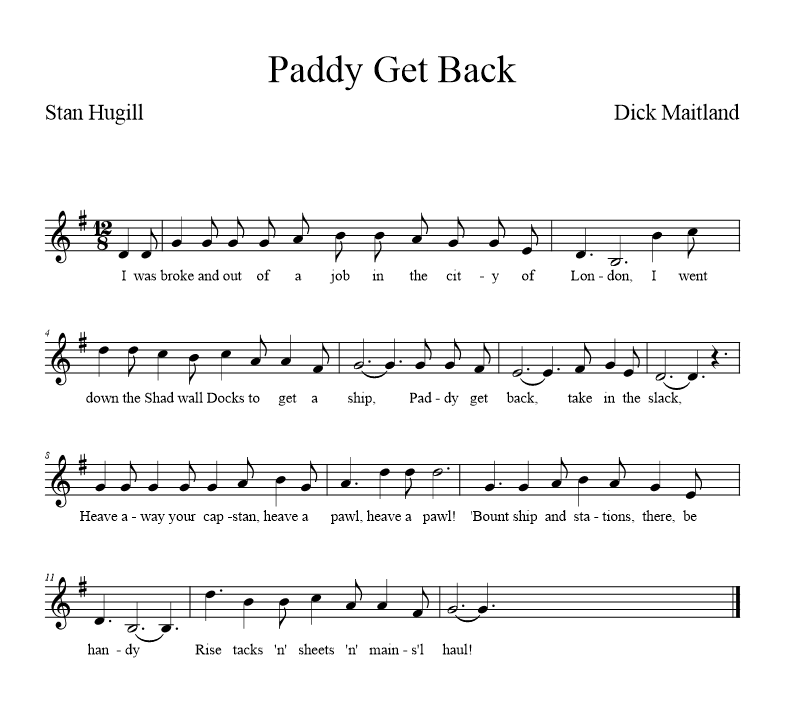
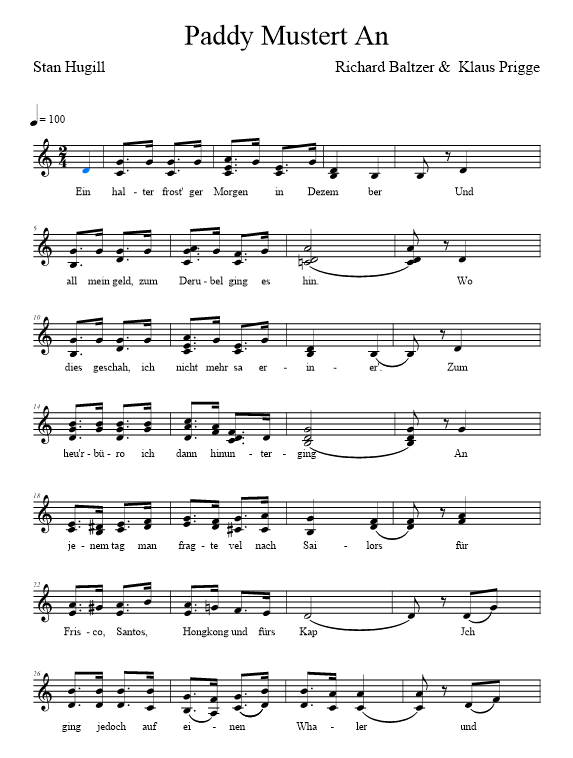
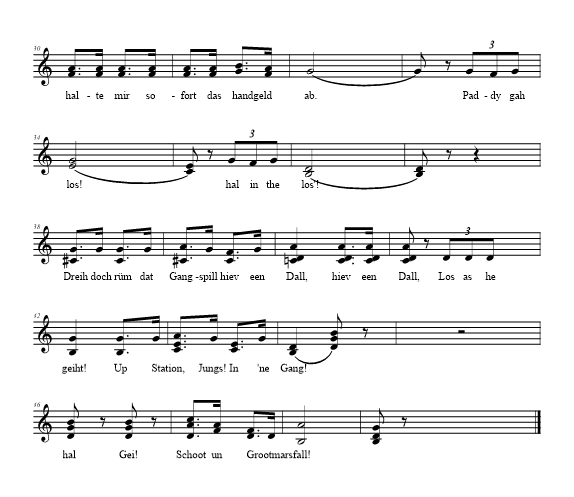
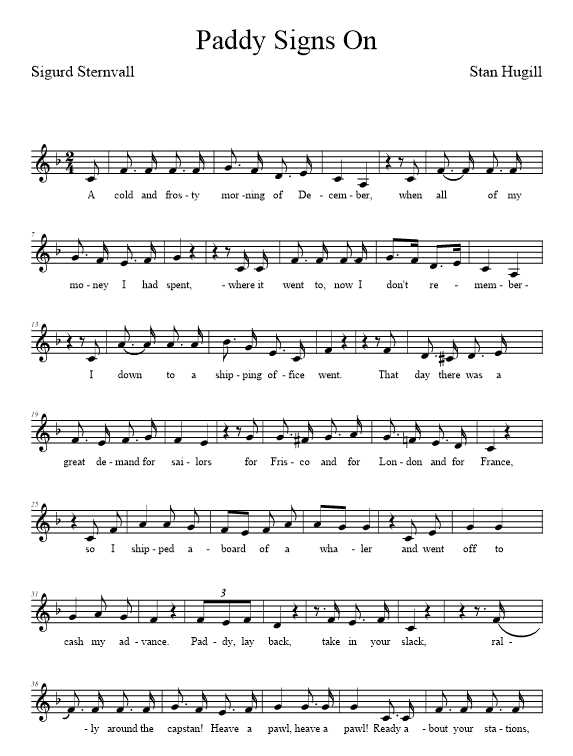
“Paddy Signs On”, as Stan Hugill mentioned, comes from “Sang Under Segel” by Sigurd Sternvall (1935) (1st ed p 372, 373). As Sternvall says his version of the song is the capstan shanty (gångspelsshanty). According to Sternvall, the text recorded by sea captain A. M. Säfström on board the bark ship “Trio” of Tvedestrand in 1913. Sung by captain N. A. Knafe. In this somewhat altered and polished form, it is known from the 1890s. This song will be reconstructed as the capstan shanty.
The source of this sea shanty
The music: “Sang Under Segel” by Sigurd Sternvall (1935) (1st ed p 372, 373). The lyrics: “Sang Under Segel” by Sigurd Sternvall (1935 (1st ed p 372 – 374). Mentioned in: “Shanties from the Seven Seas” by Stan Hugill (1st ed p 324).
The Record of the Paddy Signs On
You also can find this record on my YouTube channel here or directly listen below. Additionally, if you want to share your opinion about the record or share your opinion you can do it in my Facebook forum here, or leave a comment at the bottom of this blog article.
The musical notation
And the full lyrics
Paddy Signs On
A cold and frosty morning of December, when all of my money I had spent, where it went to, now I don’t remember – I down to a shippingoffice went.
That day there was a great demand for sailors for Frisco and for London and for France, so I shipped aboard of a whaler and went off to cash my advance.
– Paddy, lay back, – take in your slack, – rally around the capstan! – Heave a pawl, heave a pawl! – Ready about your stations, boys, be handy, – raise tacks, sheets and mainsail haul!
* 2 *
Next morning I came aboard the vessel, afeeling very heavy on the booze. I sat upon my chest aquitely thinking, I turned in my bunk to have a snooze.
Just then I thought I heard a voice calling. I listened and I heard it again. It was the mate, a louding hauling: “Say boys, answer to your names!”
Interesting Facts about the Mainsail Haul – Sampson
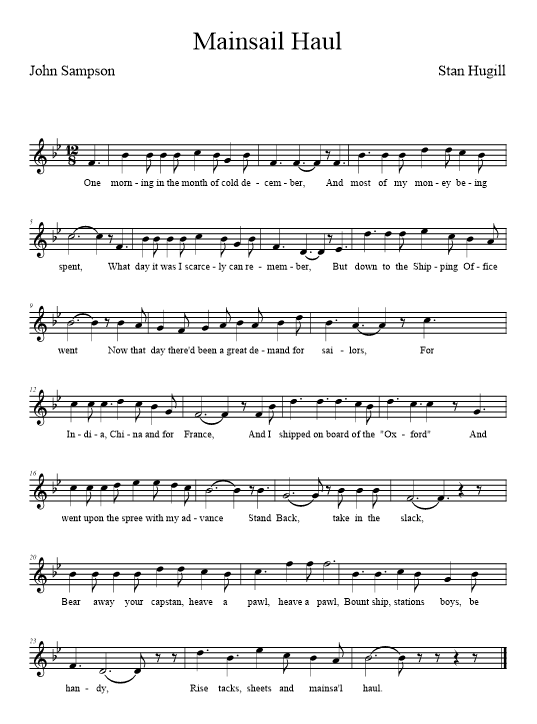
“Mainsail Haul – Sampson”, comes from “The Seven Seas Shanty Book” by John Sampson (1927 p 66, 67). According to John Sampson, it was a fairly modern sea song well known to old sailing ship men, although the words will vary considerably, as is usual with all songs that are not learned from and sung from a printed edition. Sampson says it is not of the music hall type of sea song but bears the mark of its nautical origin on every line.
The source of this sea shanty
The music: “The Seven Seas Shanty Book” by John Sampson (1927 p 66, 67). The lyrics: “The Seven Seas Shanty Book” by John Sampson (1927 p 66, 67). Mentioned in: “Shanties from the Seven Seas” by Stan Hugill (1st ed p 324).
The Record of the Mainsail Haul – Sampson
You also can find this record on my YouTube channel here or directly listen below. Additionally, if you want to share your opinion about the record or share your opinion you can do it in my Facebook forum here, or leave a comment at the bottom of this blog article.
The musical notation
The full lyrics
Mainsail Haul – Sampson
One morning in the month of cold december, And most of my money being spent, What day it was I scarcely can remember, But down to the Shipping Office went
Now that day there’d been a great demand for sailors, For India, China and for France, And I shipped on board of the “Oxford” And went upon the spree with my advance
– Stand Back, take in the slack, – Bear away your capstan, heave a pawl, heave a pawl, – ‘Bount ship, stations boys, be handy, – Rise tacks, sheets and mainsa’l haul.
* 2 *
Now most of our sailors had been drinking, And Some had been heavy on the boose, So I sat upon my chest a-quietly thinking, Whether to turn in and have a snooze,
When I heard a voice above me loudly calling, I listened and I heard the voice again, ‘Twas the chief mate at the fo’c’sle door a-bawling, “All hands lay aft and answer to your name”.
* 3 *
Now when I arrived upon the quarter-deck, Such a sight I’d never seen before, There were scally wages from every tribe and nation, It made my poor heart both sick and sore,
Than I wished that I was back at the “Jolly Sailors”, Along with Irish Kate a-drinking beer, Oh Kitty, my poor heart is breaking, I went for’ard for to shed a pitful tear.
* 4 *
Now in my chest I knew I had a bottle, For I saw the boarding master put it there, So I thought I would go and wet my throttle, Just to drive away my sorrow and my care,
Then I fell down on my knees like thunder, A groping like a pig around a trough, When to my astonishment and wonder, It was bottle of medicine for a cough.
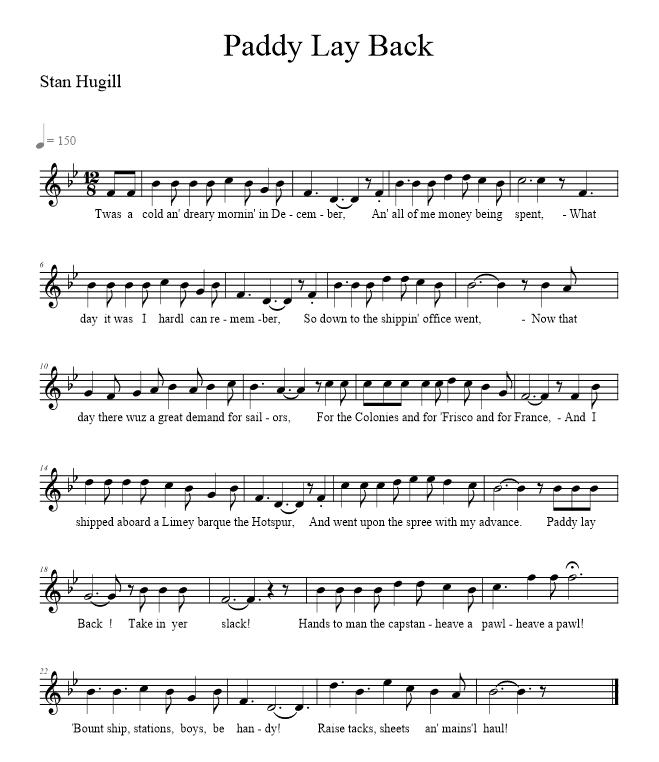
“Paddy Lay Back”, also called “Mainsail Haul”, was both capstan shanty and forebitter, according to Stan Hugill very popular, especially in Liverpool ships. Stan Hugill knows this song directly from two people, his father and John Connolly (Liverpool-Irish sailing-ship man), whose last line sang in fashion you can find in the lyrics. Stan Hugill tells us also that this song has two forms, the eight-line verse (forebitter form), and four-line verse (shanty pattern). This song will be reconstructed as the capstan shanty.
The source of this sea shanty
The music: “Shanties from the Seven Seas” by Stan Hugill (1st ed: p 321). The lyrics: “Shanties from the Seven Seas” by Stan Hugill (1st ed: p 321 – 323).
The Record of the Yeo Heave Ho!
You also can find this record on my YouTube channel here or directly listen below. Additionally, if you want to share your opinion about the record or share your opinion you can do it in my Facebook forum here, or leave a comment at the bottom of this blog article.
The musical notation
And the full lyrics
Paddy, Lay Back
Twas a cold an’ dreary mornin’ in December, (December), An’ all of me money it wuz spent, (it wuz spent) Where it went to Lord I can’t remember, (remember), So down to the shippin’ of fice went, (went, went),
– Paddy, lay Back (Paddy, lay Back)! – Take in yer slack (take in yer slack)! – Take a turn around the capstan – heave a pawl – heave a pawl! – ‘Bount ship, stations, boys, be handy (be handy)! – For we’re bound for Valaparaiser ’round the Horn!
* 2 *
That day there wuz a great demand for sailors (for sailors), For the Colonies and for ‘Frisco and for France (an’ for France), So I shipped aboard a Limey barque the Hotspur (Hotspur), An’ got paralitic drunk on my advance (‘vance, ‘vance),
* 3 *
Now I joined her on a cold December mornin’, A-frappin’ o’ me flippers to keep me warm. With the south cone a-hoisted as a warnin’, To stand by comin’ o’ a storm.
* 4 *
Now some of out fellers had bin drinkin’, An’ I mmeself wuz heavy on the booze; An’ I wuz on me ol’ sea-chest a-thinkin’ I’d turn into me bunk an’ have a snooze.
* 5 *
I woke up in the mornin’ sick an’ sore, An’ knew I wuz outward bound again; When I heard a voice a-bawlin’ at the door, ‘Lay aft, men, an’ answer to yer names!’
* 6 *
‘Twas on the quarterdeck where first I saw ’em, Such an ugly bunch I’d niver seen afore; For there wuz a bum an’ stiff from every quarter, An’ it made me poor ol’ heart fell sick an’ sore.
* 7 *
There wuz Spaniards an’ Dutchmen an ‘Roosians, An’ Johnny Crappos jist across from France; An’ most o’ ’em couldn’t speak a word o’ English, But answered to the name of ‘Minth’s Advance’.
* 8 *
I wist I wuz in the ‘Jolly Sailor’, Along with Irish Kate a-drinkin’ beer; An’ then I thought what jolly chaps were sailors, An’ with me flipper I wiped away a tear.
* 9 *
I knew in me box I had a bottle, By the boardin’-master ’twas put there; An’ I wanted something for to wet me throttle, Somethin’ for to drive away dull care.
* 10 *
So down upon me knees I went like thunder, Put me hand into the bottom o’ the box, An, what wuz me great surprise an’ wonder’ Found only a bottle o’ medicine for the pox.
* 11 *
I felt that I should skip an’ join another, ‘Twas plain that I had joined a lousy bitch; But the chances wuz that I might join a worser, An, we might git through the voyage without a hitch.
* 12 *
I axed the mate a-which a-watch wuz mine-O, Sez he, ‘I’ll soon pick out a-which is which’; An’ he blowed me down an’ kicked me hard a-stern-O, Callin’ me a lousy, dirty son-o’-a-bitch.
* 13 *
Now we singled upan’ got the tugs alongside, They towed us through the locks an’ out to sea; With half the crew a-pukin’ o’er the ship’s side, An’ the bloody fun that started sickened me.
* 14 *
Although me poor ol’ head wuz all a-jumpin’, We had to loose her rags the followin’ morn; I dreamt the boardin’-master I wuz thumpin’, When I found out he’d sent me around the Horn.
* 15 *
I swore I would become a beachie-comber, An, niver go to sea no ruddy more; For niver did I want to be a roamer, I’d shanghai the boardin’-master an’ stay ashore.
* 16 *
But when we got to bully ol’ Vallapariser, In the Bay we dropped our mudhook far from shore; The Ol’ Man he refused ter let us raise ‘er, An’ he stopped the boardin’-master comin’ aboard.
* 17 *
I quickly made me mind up that I’d jump ‘er, I’d leave the beggar an’ git a job ashore; I swum across the Bay an’ left ‘er, An’ in the English Bar I found a whore.
* 18 *
But Jimmy Wop he knew a thing or two, boys, An, soon he’d shipped me outward bound again; On a Limey to the Chinchas for guanner, boys, An’ soon wuz I a-roarin’ this refrain.
* 19*
So there wuz I once more again at sea, boys, The same ol’ ruddy business over again; Oh, stamp the caps’n tound an’ make some noise, boys, An’ sing again this dear ol’ sweet refrain.
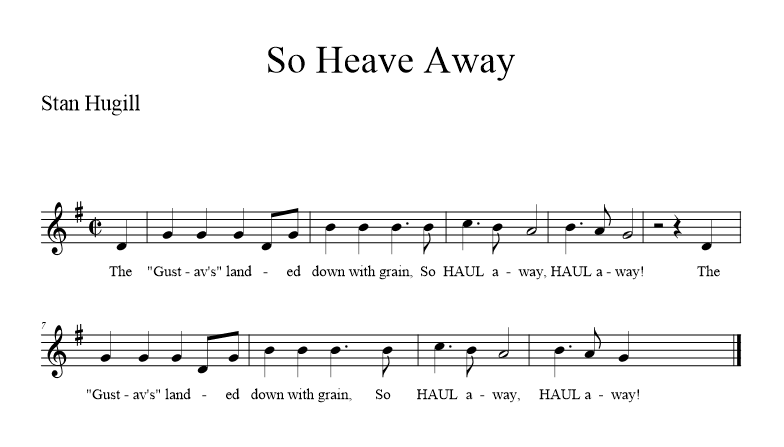
“Yeo Heave Ho!” is the shanty with a really extraordinary story. According to Stan Hugill, his shipmate G. Biemer, engaged in the West Coast of South America Nitrate Trade, the crew took a well-known Salvation Army hymn “Shine the Light” and altered it for use as a shanty. On hearing this story, the mixed crew of the German four-masted barque “Gustaw” (where Stan Hugill worked), altering Biemer’s version slightly, used it for both capstan and halyards. This song will be reconstructed as the halyard shanty.
The source of this sea shanty
The music: “Shanties from the Seven Seas” by Stan Hugill (1st ed: p 318). The lyrics: “Shanties from the Seven Seas” by Stan Hugill (1st ed: p 318).
The Record of the So Heave Away
You also can find this record on my YouTube channel here or directly listen below. Additionally, if you want to share your opinion about the record or share your opinion you can do it in my Facebook forum here, or leave a comment at the bottom of this blog article.
The musical notation
The full lyrics
So Heave Away
The “Gustav’s” landed down with grain, So HAUL away, HAUL away! The “Gustav’s” landed down with grain, So HAUL away, HAUL away!
* 2 *
The “Gustav” is a fine big ship, We’re bound away on a damn long trip,
* 3 *
We’ll get schnapps today if we haul away, We’ll stand all hands when we get our pay.
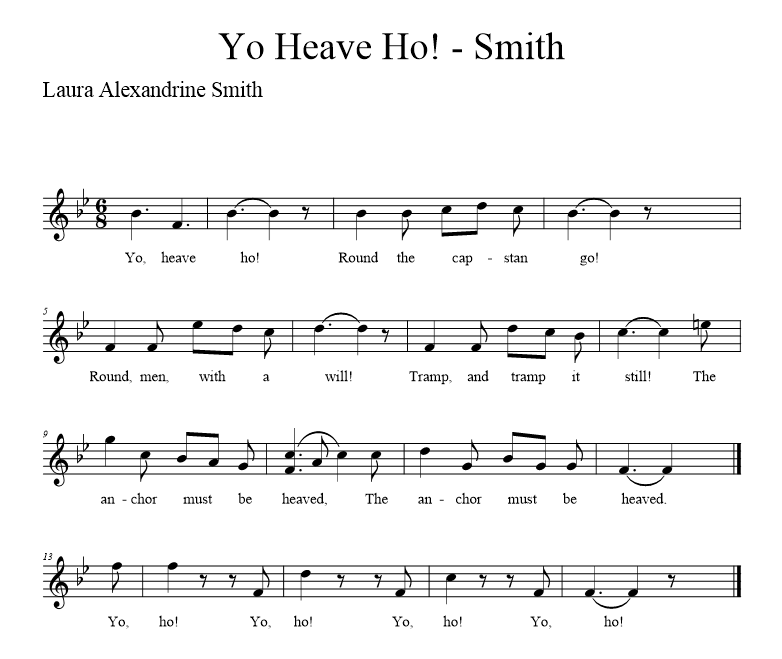
“Yeo Heave Ho!” capstan shanty in Stan Hugill classification belonging to the group of shanties with the word “heave”. This version comes from “The Music of The Waters” by Laura Alexandrine Smith (1888) (1st ed p 9). Alexandrine Smith on the occasion of this shanty Alexandrine Smith describes the capstan shanties, she says: “In the capstan chanties the metre is generally long, and they are of a more pathetic nature than the hauling ones. To those who have heard it as the men run round the capstan, bringing up the anchor from the English mud of a ship outward bound for a two or three years’ trip, perhaps never to return, what can be more sad or touching, although sung with a hearty good-will, than ” Yo, heave ho!”. I will reconstruct this song as the capstan shanty.
The source of this sea shanty
The music: “The Music of The Waters” by Laura Alexandrine Smith (1888) (1st ed p 9). The lyrics: “The Music of The Waters” by Laura Alexandrine Smith (1888) (1st ed p 9). Mentioned in: “Shanties from the Seven Seas” by Stan Hugill (1st ed p 318).
The Record of the Yo Heave Ho! – Smith
You also can find this record on my YouTube channel here or directly listen below. Additionally, if you want to share your opinion about the record or share your opinion you can do it in my Facebook forum here, or leave a comment at the bottom of this blog article.
The musical notation
And the full lyrics
Yo Heave Ho! – Smith
Yo, heave ho! Round the capstan go! Round, men, with a will! Tramp, and tramp it still! The anchor must be heaved, The anchor must be heaved. – Yo, ho ! Yo, ho! Yo, ho! Yo, ho!
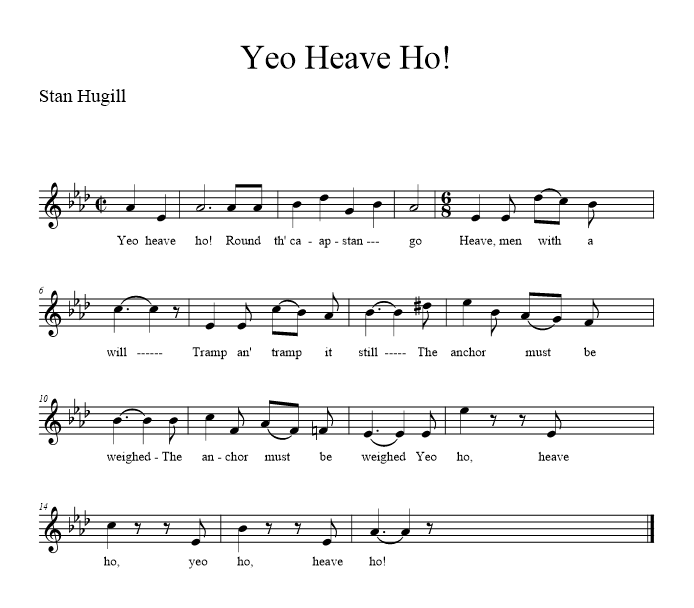
“Yeo Heave Ho!” capstan shanty in Stan Hugill classification belonging to the group of shanties with the word “heave”. This song is also given by Davis & Tozer, and L. A. Smith. Stan Hugill thinks that by form and music, it must rank as one of the earliest of the capstan shanties. He also has some unconfirmed theory, that the song is one referred to in Chapter 36 of Richard Dana’s book “Two Years Before Mast”. I will reconstruct this song as the capstan shanty.
The source of this sea shanty
The music: “Shanties from the Seven Seas” by Stan Hugill (1st ed: p 318). The lyrics: “Shanties from the Seven Seas” by Stan Hugill (1st ed: p 318).
The Record of the Yeo Heave Ho!
You also can find this record on my YouTube channel here or directly listen below. Additionally, if you want to share your opinion about the record or share your opinion you can do it in my Facebook forum here, or leave a comment at the bottom of this blog article.
The musical notation
And the full lyrics
Yeo Heave Ho!
Yeo heave hoo! Round th’ capstan go Heave men with a will, Tramp and tramp it still, The anchor must be weighed – The anchor must be weighed – Yeo hoo, he-ave hoo, yeo hoo, he-ave ho!
* 2 *
Yeo heave hoo! cheerily wy go Heave men with a will, Tramp and tramp it still, The anchor grips the ground – The anchor grips the ground – Yeo hoo, he-ave hoo, yeo hoo, he-ave ho!
* 3 *
Yeo heave hoo! raise her from below, Heave men with a will, Tramp and tramp it still, The anchor off the ground – The anchor off the ground – Yeo hoo, he-ave hoo, yeo hoo, he-ave ho!
* 4 *
Yeo heave hoo! round the capstan go, Heave men with a will, Tramp and tramp it still, The anchor now is weighed – The anchor now is weighed – Yeo hoo, he-ave hoo, yeo hoo, he-ave ho!
“Haul Er Away! B” it is the halyard song (long drag) shanty very close to “Cheerily Man”. The tune of this song according to Stan Hugill have common elements with the Jamaican song “Missy Ramgoat”, and “Hill an’ Gully Rider”. Both those songs have been featured in the film “Moby Dick”, and later spliced into the West Indian work song “Banana Boat” and turned into a “Pop” song. This version, also West Indies, part of this song appears in the Francis Allyn Olmsted book “Incidents of a Whaling Voyage” – 1840, so it appears to be fairly old. This song will be reconstructed as the halyard (long drag) shanty.
The source of this sea shanty
The music: “Shanties from the Seven Seas” by Stan Hugill (1st ed: p 317). The lyrics: “Shanties from the Seven Seas” by Stan Hugill (1st ed: p 317).
The Record of the Haul Er Away! B
You also can find this record on my YouTube channel here or directly listen below. Additionally, if you want to share your opinion about the record or share your opinion you can do it in my Facebook forum here, or leave a comment at the bottom of this blog article.
The musical notation
The full lyrics
Haul Er Away! B
Young Sally Rackett, she shipped in a packet, – HAUL ‘er away, oh, HAUL ‘er away! Horraw, hooraw for ol’ Sally Racket, – HAUL ‘er away, oh, HAUL ‘er away!
* 2 *
Miss Nancy Dawson, she’s got flannel drawers on! Hooraw, horraw for ol’ Nancy Dawson,
* 3 *
Little Miss Muffet, she sat on a tuffet. Hooraw, horraw for ol’ Miss Muffet,
* 4 *
Nancy Fernaner, she married a barber. Hooraw, horraw for ol’ Nancy Fernaner,
* 5 *
Sussy Skinner, she sure is a winner. Hooraw, horraw for ol’ Sussy Skinner,
* 6 *
Young Kitty Carson ran off with a parson. Hooraw, horraw for ol’ Kitty Carson,
* 7 *
Ol’ Missus Ducket, she lived in a bucket. Hooraw, horraw for ol’ Missus Ducket,
* 8 *
Betsy Baker, she married a Quaker. Hooraw, horraw for ol’ Betsy Baker,
* 9 *
Polly Riddle, she broke her new fiddle. Hooraw, horraw for ol’ Polly Riddle,
* 10 *
Little Miss Walker’s a hell o’ a talker. Hooraw, horraw for ol’ Miss Walker,
* 11 *
We all love the gals, oh, rouse an’ shake ‘er, Hooraw, horraw for the gals o’ Jamaicker!
“Haul Er Away! A” it is the halyard song (long drag) shanty very close to “Cheerily Man”. Under the title of “Sally Rackett” was well served as a cargo-working song among the timber stowers of Quebec and elsewhere. This song is of West Indian origin, hailing either from Barbados or Jamaica. Stan Hugill learned this beautiful song from Harding Barbadian from Barbados. This song will be reconstructed as the halyard (long drag) shanty.
The source of this sea shanty
The music: “Shanties from the Seven Seas” by Stan Hugill (1st ed: p 316). The lyrics: “Shanties from the Seven Seas” by Stan Hugill (1st ed: p 316, 317).
The Record of the Haul Er Away! A
You also can find this record on my YouTube channel here or directly listen below. Additionally, if you want to share your opinion about the record or share your opinion you can do it in my Facebook forum here, or leave a comment at the bottom of this blog article.
The musical notation
The full lyrics
Haul Er Away! A
Little Nancy Dawson, – Haul’ er away! She’s got flannel drawers on, – Haul’ er away! So sez our ol’ Bosun, – Haul’ er away! Wid a hauley high-O! – Haul’ er away!
* 2 *
Little Sally Rackett, She shipped in a packet, An’she never did regret it, Wid a Hauley high-O!
* 3 *
Little Betty Baker Ran off wid a Quaker, Guess her Mum could shake ‘er, Wid a hauley …
* 4 *
Little Susie Skinner Sez she’s a beginner, But prefers it to ‘er dinner.
* 5 *
Little Flo Fanana Slipped on a banana, Now she can’t play the pianner.
* 6 *
Little Rose Riddle Broke her brand new fiddle, Got a hole right in the middle.
* 7 *
Little Polly Walker Ran offf with a hawker, Oh, he was a corker.
* 8 *
Little Kitty Karson Ran off with a parson, Now sh’s got a little parson.
* 9 *
Little Dolly Duckett Washes in a bucket, She’s tart but doesn’t look it.
“Cheerily Man – Sharp” version from “English Folk Chanteys” by Cecil Sharp, and it is a halyard shanty (originally in Sharp’s book “Pulling Chantey”), it is probably the most primitive, and one of the oldest of all these heaving and hauling songs of the sea. This Sharp version is interesting in terms of having only three solos and three refrains. Unfortunately Sharp gives us only one verse of this beautiful song. Song was sung to Cecil Sharp by Mr. John Short, at Watched. Mr. Short says to Sharp, that was the first chantey he learned and he thought it must have been the “first chantey ever invented”. This song will be reconstructed as the halyard long haul shanty.
The source of this sea shanty
The music: “English Folk Chanteys” by Cecil Sharp (1914) (1st ed: p 50). The lyrics: English Folk Chanteys” by Cecil Sharp (1914) (1st ed: p 50). Mentioned in: “Shanties from the Seven Seas” by Stan Hugill (1st ed: p 315).
The Record of the Cheerily Man – Sharp
You also can find this record on my YouTube channel here or directly listen below. Additionally, if you want to share your opinion about the record or share your opinion you can do it in my Facebook forum here, or leave a comment at the bottom of this blog article.
The musical notation
The full lyrics
Cheerily Man
O………. o ly i o – Cheerily man! Walk him up o…………, – Cheerily man! O………. o ly i o, O………. o ly i o, – Cheerily man!
Interesting Facts about the Cheerily Man – Catting the anchor shanty
“Cheerily Man” is probably the most primitive, and one of the oldest of all these heaving and hauling songs of the sea. This song was really obscene, so most of the verses were camouflaged. This particular version is described by Stan Hugill in the description of the “Cheerily Man”, but the description tells us that this song can be used for more jobs than only halyards, namely can be also used for cutting the anchor. Cutting an anchor is the job that happened when the anchor was about the water line beside the board, so sailors connected a line (tackle blocks) between the ring on the head of the anchor and the cat head, and catting started when they start pulling the rope, and at the same time loose bit the anchor chain used for raise anchor up to the board. This heavy job required long steady pulls, so this shanty is a perfect fit for this job. The word “cheerily” means “quickly” and was often used at capstan and halyards when exhorting the men to harder efforts. “Cheerily” when used in shanties has to mean that heave or haul is slow and steady. This song will be reconstructed as the “Catting the anchor shanty” (this work is definitely a long-haul shanty). For this reconstruction, I will use only additional six verses from page 314 of the “Shanties from the Seven Seas”, which according to Stan Hugill sang specifically only for catting the anchor.
The source of this sea shanty
The music: “Shanties from the Seven Seas” by Stan Hugill (1st ed: p 313). The lyrics: “Shanties from the Seven Seas” by Stan Hugill (1st ed: p 314).
The Record of the Cheerily Man – Catting the anchor shanty
You also can find this record on my YouTube channel here or directly listen below. Additionally, if you want to share your opinion about the record or share your opinion you can do it in my Facebook forum here, or leave a comment at the bottom of this blog article.
The musical notation
And the full lyrics
Cheerily Man – Catting the anchor Shanty
Haul all together, aye yeo, – Cheerily man! Haul for good weather, aye yeo – o, – Cheerily man! She’s light as a feather, aye yeo – o, – Cheerily man! Oh, hauley aye yeo! – Cheerily man!
* 2 *
To the cathead, We’ll shift the dead, She’s heavy as lead. Oh, hauley …
* 3 *
We’ll haul again, With might an’ main, Pay out more chain.
* 4 *
Chain stopper bring, Pass through the ring, Oh, haul an’ sing.
* 5 *
She’s up to the sheave, At the cathead we’ll leave, Soon the tackle unreeve,
* 6 *
Pull one an’ all, On the ol’ catfall, An’ then belay all!
To provide the best experiences, we use technologies like cookies to store and/or access device information. Consenting to these technologies will allow us to process data such as browsing behavior or unique IDs on this site. Not consenting or withdrawing consent, may adversely affect certain features and functions.
Functional
Always active
The technical storage or access is strictly necessary for the legitimate purpose of enabling the use of a specific service explicitly requested by the subscriber or user, or for the sole purpose of carrying out the transmission of a communication over an electronic communications network.
Preferences
The technical storage or access is necessary for the legitimate purpose of storing preferences that are not requested by the subscriber or user.
Statistics
The technical storage or access that is used exclusively for statistical purposes.The technical storage or access that is used exclusively for anonymous statistical purposes. Without a subpoena, voluntary compliance on the part of your Internet Service Provider, or additional records from a third party, information stored or retrieved for this purpose alone cannot usually be used to identify you.
Marketing
The technical storage or access is required to create user profiles to send advertising, or to track the user on a website or across several websites for similar marketing purposes.