Interesting Facts about the Hurrah, Sing Fare Ye Well
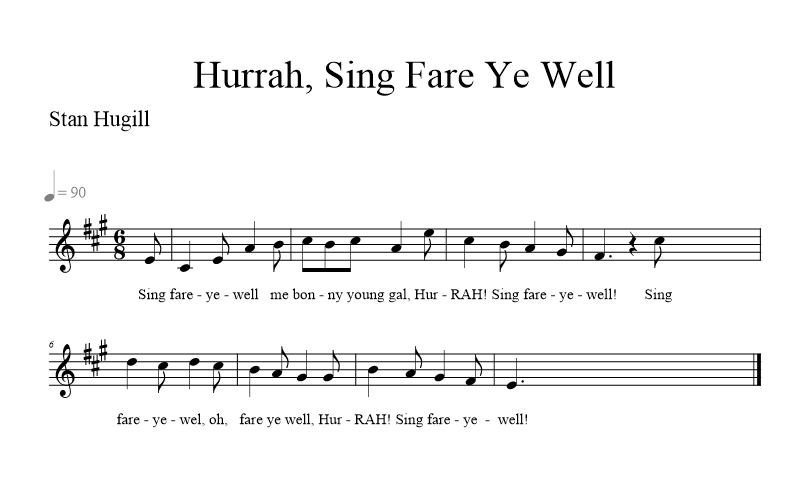
Here is the hauling song, resembling this latter somewhat “Hurrah Sing Fare Ye Well!” Whall calls it “O Fare Ye Well, My Bonnie Young Girl”. Stan Hugill gives us a version; with perhaps; a few more regular verses than usual; which were obtained from an old Liverpool seaman. Normally there was one pull in the refrain on the second syllable of “Hurrah”.
The song will be reconstructed by myself as the halyard shanty.
The source of this sea shanty
The music: “Shanties from the Seven Seas” by Stan Hugill (1st ed p 119).
The lyrics: “Shanties from the Seven Seas” by Stan Hugill (1st ed p 119).
The Record of the Hurrah, Sing Fare Ye Well
You also can find this record on my YouTube channel here or directly listen below. Additionally, if you want to share your opinion about the record or share your opinion you can do it in my Facebook forum here, or leave a comment at the bottom of this blog article.
The musical notation
The full lyrics
Hurrah Sing Fare Ye Well
Sing fare ye well me bonny young gal, – HurRAH! Sing fare ye well! Sing fare ye well, oh, fare ye well, – HurRAH! Sing fare ye well!
* 2 *
We’re bound; away to Callyo, Oh, fare ye well, me Liverpool gal,
* 3 *
I may cime back th ye some day, With a spanking’ big fat pay-day.
* 4 *
But when we get to Callyo, I’ll git me a nice bit o’ Dago,
* 5 *
As I walked out one mornin’ fair, I met a puta standin’ there.
* 6 *
She winked at me I do declare, Black as night was her raven hair.
* 7 *
She was a Spanish beauty bold. Her name was Carmen; so I’m told.
* 8 *
Oh, fare ye well; we’re bound away, We’re bound away this sailing day.
Interesting Facts about the Goodbye My Love Goodbye
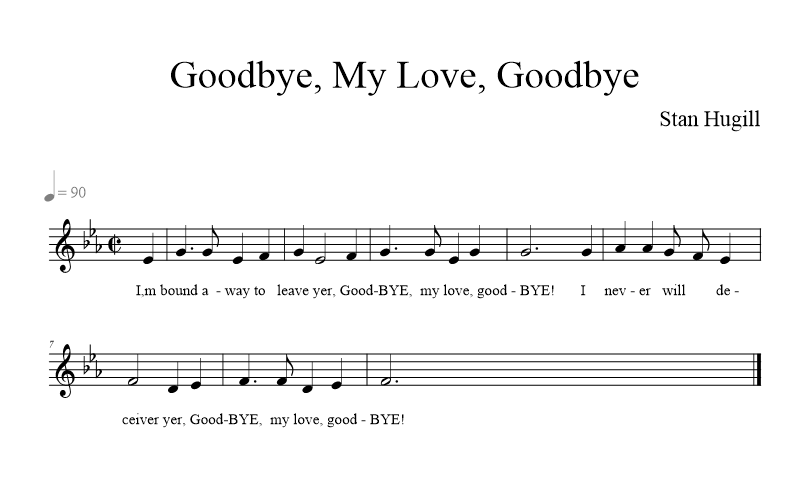
Here is the hauling shanty. Tozer and Colcord give a version of the former giving a set of very sentimental verses which Stan Hugill, fell sure to have been made up. C. F. Smith sees in it a resemblance to „Shallow Brown”.
The song will be reconstructed by myself as the halyard shanty.
The source of this sea shanty
The music: “Shanties from the Seven Seas” by Stan Hugill (1st ed p 118, 119).
The lyrics: “Shanties from the Seven Seas” by Stan Hugill (1st ed p 118, 119).
The Record of the Goodbye My Love Goodbye
You also can find this record on my YouTube channel here or directly listen below. Additionally, if you want to share your opinion about the record or share your opinion you can do it in my Facebook forum here, or leave a comment at the bottom of this blog article.
The musical notation
The full lyrics
Goodbye My Love Goodbye
I,m bound away to leave yer, – Good-BYE my love, good-BYE! I never will deceiver yer, – Good–BYE my love, good.BYE!
* 2 *
I’ll leave you my half pay, Sue, White-stocking Day soon will be due.
* 3 *
Have a drink on me, my dearie, For waiting’s mighty weary.
* 4 *
We’re bound away to ‘Frisco, Oh, cut her strings an’ let ‘er go!
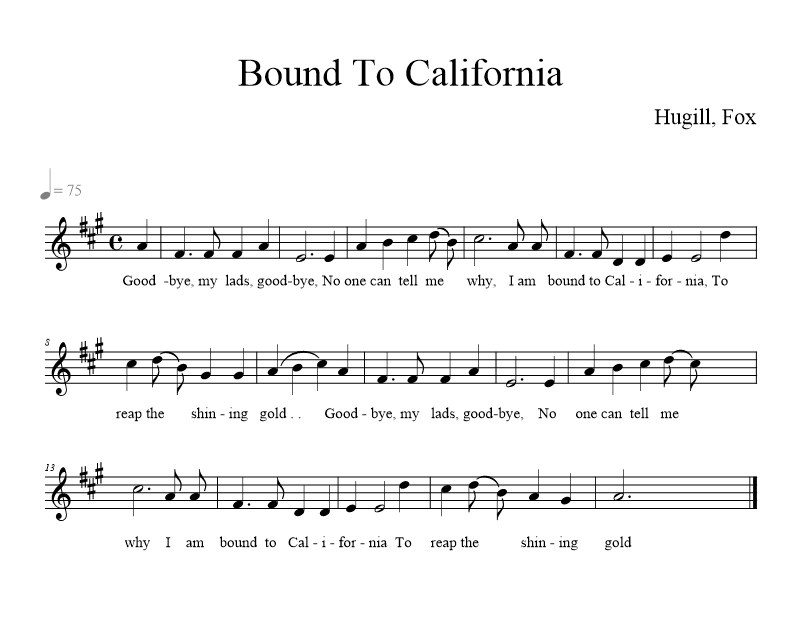
Bound To California is a capstan shanty of the Gold Rush Period which Miss C. F. Smith found and published in her “A Book of Shanties” (1927). She mentions, that Captain J. L. Vivian Millett singer who sang this song to her, remembers, that he heard it sung at Algoa Bay, in the days when anchorage off that port was still crowded with sailing ships. ” …A big vessel was just getting up her anchor. She had a good shanty crowd, and the chorus roared out by a score of voices came over the waters of the open roadstead with an unforgettable effect”.
Unfortunately, Captain Millett could only give Miss Smith the chorus of this shanty.
The song will be reconstructed by myself as the capstan shanty.
The source of this sea shanty
The music: Shanties from the Seven Seas by Stan Hugill (1st ed p 118).
The lyrics: Shanties from the Seven Seas by Stan Hugill (1st ed p 118).
The Record of the Bound To California
You also can find this record on my YouTube channel here or directly listen below. Additionally, if you want to share your opinion about the record or share your opinion you can do it in my Facebook forum here, or leave a comment at the bottom of this blog article.
The musical notation
The full lyrics
Bound To California
Good-bye, my lads, good-bye, No one can tell me why I am bound to California To reap the shining gold!
Good-bye, my lads, good-bye, No one can tell me why I am bound to California To reap the shining gold
Interesting Facts about Susannavisan (Stan Hugill Translation)
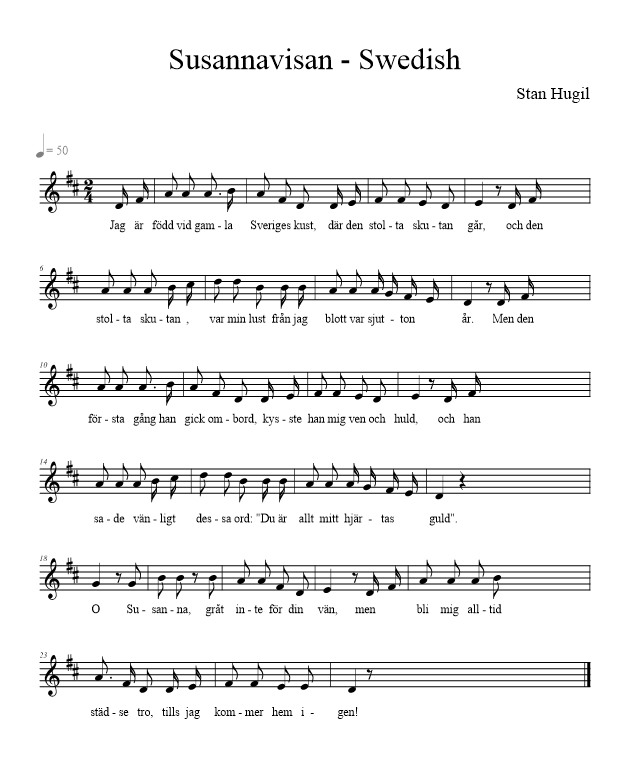
In the case of Susannavisan (Stan Hugill Translation) song, Stan Hugill again mentioned the source “Sang under Segel” Sigurd’s Sternwall’s Swedish shanty book (Reference to its being sung at the capstan is to be found in the Preface, page 12). From this book, Stan Hugill gives us two verses and melody to this beautiful song, the construction of the verses is really close to Stephen Foster’s version of “Oh Susanna”. Additionally, worth noting this version is a personal translation of Stan Hugill, so I think it deserves to sing it.
The source of this sea shanty
The music: “Shanties from the Seven Seas” by Stan Hugill (1st ed: p 117).
The lyrics: “Shanties from the Seven Seas” by Stan Hugill (1st ed: p 117).
The Record of the Susannavisan (Stan Hugill Translation)
You also can find this record on my YouTube channel here or directly listen below. Additionally, if you want to share your opinion about the record or share your opinion you can do it in my Facebook forum here, or leave a comment at the bottom of this blog article.
The full lyrics
Susannavisan (Stan Hugill Translation)
Oh, I was born on Sweden’s Coast, Where the fine ships sail along, And a fine ship was my heart’s desire, Since I was very young.
But the first time that he went aboard, He kissed me tenderly, And unto me he said these words, ‘You are all the word to me.’
– Oh, Susanna, now don’t ye cry for me, – Be faithful to your sailor boy – Till I come home from sea.
* 2 *
On a long voyage he went away, I sat alone and sighed. And when the wind was howling wild, ‘Tis oft at night I cried.
But when the tears ran down my cheecks, My sailor boy came home. He sang to me in deep content, From these arms I’ll never roam.
– Oh, Susanna, oh, don’t ye cry for me, – I’m homeward bound to you at last, – And now I’m safe with thee.
In the case of Susannavisan song, Stan Hugill again mentioned the source: “Sang under Segel”, Sigurd’s Sternwall’s Swedish shanty book (Reference to its being sung at the capstan is to be found in the Preface, page 12). From this book, Stan Hugill gives us two verses and a melody to this beautiful song, the construction of the verses is really close to Stephen Foster’s version of “Oh Susanna”. Unfortunately, I couldn’t find the “Sang under Segel”, but I found it in another book “Flottans Män Malmö visbok” (1942). In this book, I found another two verses of this great song, so my reconstruction will contain four verses. In „Flottans Män Malmö visbok”, I found another two verses of this great song, so my reconstruction will contain four verses.
The source of this sea shanty
The music: “Shanties from the Seven Seas” by Stan Hugill (1st ed: p 116).
The lyrics: “Shanties from the Seven Seas” by Stan Hugill (1st ed: p 116). and “Flottans Män Malmö visbok” (1942) – the last two verses.
The Record of the Susannavisan
I want to make a special thanks to Pontus Wallgren, who helped me with pronunciation to make it possible to sing this beautiful forebitter in the Swedish language. “Shanties from the Seven Seas” by Stan Hugill (1st ed: p 116).
You also can find this record on my YouTube channel here or directly listen below. Additionally, if you want to share your opinion about the record or share your opinion you can do it in my Facebook forum here, or leave a comment at the bottom of this blog article.
The musical notation
The full lyrics
Susannavisan
Jag är född vid gamla Sveriges kust, där den stolta skutan går, och den stolta skutan, var min lust från jag blott var sjutton år.
Men den första gång han gick ombord, kysste han mig ven och huld, och han sade vänligt dessa ord: “Du är allt mitt hjärtas guld”.
– O Susanna, gråt inte för din vän, – men bli mig alltid städse tro, – tills jag kommer hem igen!
* 2 *
På den långa resan drog han bort, jag satt ensam. O, min skatt! Och när vädret det var riktigt hårt, låg jag vaken mången natt.
Men när tåren bittert flöt på kind, kom min sjöman hem i hamn och så sjöng han med ett nöjsamt sinn´, då han tryckte mig i famn:
– O Susanna, gråt inte för din vän! – Jag gungat har uppå böljan blå, – och här har du mig igen.
* 3 *
Och så talte vi så månget ord, Vi förglömde storm och blåst, Men en dag han sa: “Min tös, jag tror, Vi behöver snart en präst.
Jag får ta en tur på två års tid, Men är lyckan med din vän, Kommer jag med rik’dom åter hit, Och vi går till prästen hän.
– O, Susanna, gråt dock ej för mig! – Jag till Kalifornien far – Och gräver guld för dig.”
* 4 *
I ett litet hus vid kusten bor Vi som lyckligt äkta par. Han kom hem igen, han höll sitt ord. Fyra raska barn vi har.
Han går icke mer på resor, nej! Men när stormen rasar vild, Han till barmen älskligt trycker mej Och så säger han så mild:
– “O, Susanna, mitt allt, min fröjd och lust, – Där finns ej man så glad som jag – På hela Sveriges kust!”
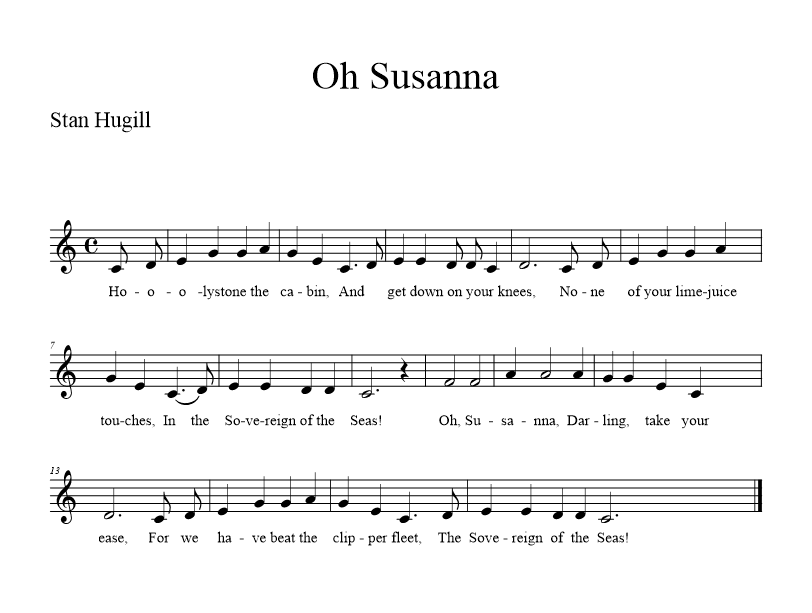
Oh, Susanna, another song from the time when the Gold Rush of 1849 happens was “Oh, Susanna”. Stan Hugill says, is that this song has never been in print, with the exception of Miss Colcord’s fragmentary version listed in her book as a fo’c’sle song.
So this is what Joanna C. Colcord gives us in her book (“Songs of American Sailormen” – 1938, in the “Roll & Go” – 1924, in both books we can find, the same amount of verses): “It was singular that with all the vast pride and delight of the sailor in his ship, so few songs were sung in celebration of the qualities of individual vessels. There was about California clipper “Sovereign of the Seas”, which went to the same tune as the ‘fourty-niners’ song”…
The source of this sea shanty
The music: “Songs of American Sailormen” – by Joanna Carver Colcord (1938).
The lyrics: “Shanties from the Seven Seas” by Stan Hugill (1st ed: p 116).
The Record of the Oh Susanna
You also can find this record on my YouTube channel here or directly listen below. Additionally, if you want to share your opinion about the record or share your opinion you can do it in my Facebook forum here, or leave a comment at the bottom of this blog article.
The musical notation
The full lyrics
Oh, Susanna
* 1 *
Holystone the cabin, And get down on your knees, None of your limejuice touches, In the Sovereign of the Seas!
* 2 *
Oh, Susanna, Darling, take your ease, For we have beat the clipper fleet, The Sovereign of the Seas!
Interesting Facts about The Sailor Fireman (I’ll Fire Dis Trip)
The Sailor Fireman (I’ll Fire Dis Trip) was already in print in 1950 in a book called “Nigger Melodies; being The Only Entire and Complete Work of Ethiopian Songs Extant” (Cornish Lamport & Co., New York, 1850, 2488., illustrated frontis, VG).
Stan Hugill states that this song may be the key to the origin of the verse of “Sacramento” and Foster’s “Camptown Races”. The original title of this song is “I’LL FIRE DIS TRIP”, and according to Stan Hugill’s research, originally has been written by a sailor who for the first, and probably the last time, tried the hard work of a fireman.
The song will be reconstructed by myself as the halyard shanty.
The source of this sea shanty
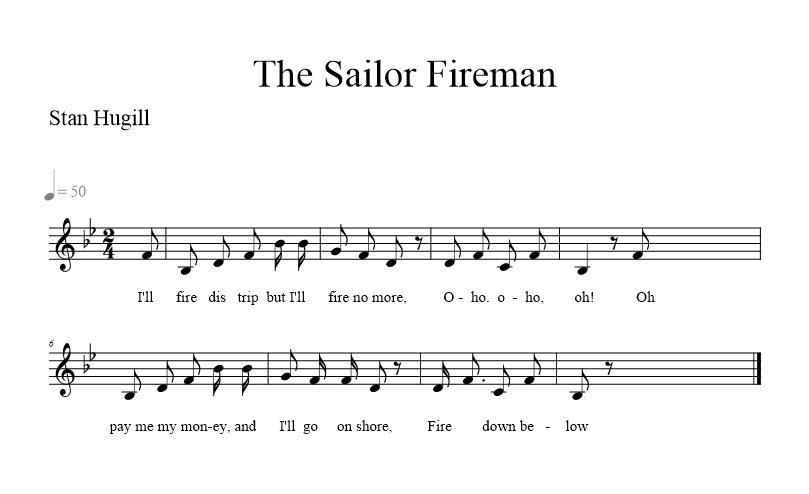
The music: “Shanties from the Seven Seas” by Stan Hugill (1st ed: p 115).
The lyrics: “Nigger Melodies; being The Only Entire and Complete Work of Ethiopian Songs Extant” (between 1842 and 1849) (page 168, 169).
The Record of The Sailor Fireman (I’ll Fire Dis Trip)
The version of this song in Stan Hugill’s book comes from Sigurd Sternvall’s “Sang under Segel” (1935). I decided to sing the original text of this song from “Nigger Melodies; being The Only Entire and Complete Work of Ethiopian Songs Extant”, printed over one hundred and seventy years ago (pages 168, 169), it has slightly different lyrics, compared to to this, what Stan Hugill’s gives to us.
I will try to reconstruct this song as a halyard shanty.
You also can find this record on my YouTube channel here or directly listen below. Additionally, if you want to share your opinion about the record or share your opinion you can do it in my Facebook forum here, or leave a comment at the bottom of this blog article.
The musical notation
The full lyrics
The Sailor Fireman (I’ll Fire Dis Trip)
I’ll fire dis trip but I’ll fire no more, – Oho. oho, oh! Oh, pay me my money, and I’ll go on shore, – Fire down below
* 2 *
Miss Fanny Bell, oh, fare you well, I’m going away p’r’aps to —–
* 3 *
A bully-boat, and a bully crew, And a bully-raggin’ captain too,
* 4 *
De posom jump and de panther roar, I woke dis morning at half-past four.
* 5 *
I creep out safely from my hive, And took a dram at half-past five.
* 6 *
Says I, ole boat, let’s have no tricks, Her biler bust,—at half-past six.
* 7 *
So now we trabel under sail, ‘Cause Jonah’s de man dat swallow’d de whale.
* 8 *
I’ll fire dis trip, but I’ll fire no more, Pay me my money and I’ll go on shore.
Interesting Facts about the Heisevise – Wergland version (Norwegian)
Heisevise was sung as a capstan anchor shanty, especially when raising the “mud-hook”.
Stan Hugill has given us a funny story about an uncensored, Norwegian version of this song. It is a conversation between old Norwegian sailors: ‘Do you remember how the Norwegian version of this shanty went?’ ‘I do, but… it is too horrible! What we sang is now better forgotten!’ ‘yes, that is so, … Let’s give Wergland’s bowdlerized version instead …’ Stan Hugill mentioned about seventeen verses of the original Wergland’s version, in fact, I found actually 25 of them. I found the full version of this great capstan shanty on Henrik Wergland’s “Folkeviser”(1849). Special thanks to Arne B Petersen, for helping with the learning of the ancient Norwegian dialect pronunciation.
The song will be reconstructed by myself as the capstan shanty.
The source of this sea shanty
The music: “Shanties from the Seven Seas” by Stan Hugill (1st ed: p 107).
The lyrics: “Folkeviser” by Henrik Wergland (1849).
Mentioned in: “Shanties from the Seven Seas” by Stan Hugill (1st ed: p 113, 114).
The Record of the Heisevise
You also can find this record on my YouTube channel here or directly listen below. Additionally, if you want to share your opinion about the record or share your opinion you can do it in my Facebook forum here, or leave a comment at the bottom of this blog article.
The full lyrics
Heisevise (Norvegian Wergland version)
Overt Land af Godt og ondt har Sit. – Ota Hayti, Ota Hayti! Jeg holder nu paa Norge mit. – In the Ota Hayti, ho!
– Blow, boys, blow for Californio, – There is plenty of gold, so I am told, – On the banks of Sacramento.
* 2 *
Om Sjelland flød som Grød i Smør – Jeg meer af mager Frihed gjor.
* 3 *
Var Jylland selv en Fleskeskank, den kjøber jeg for Norges Bank.
* 4 *
Ja heller Frihed uden Fleft! En feed og smørret Trældom best !
* 5 *
I Sverrig var jeg og til Gjæst. Hver finder sig nok hjemme bedst.
* 6 *
I Stockholms Borg boer Kongen godt. I Norge er hver Barm hans Slot.
* 7 *
I Ruøland Kneijer Byg og Rug ; men Slaven kryber paa fin Bug.
* 8 *
I Polen vorer Hampen svær. Gud hjælpe Den, som klager der !
* 9 *
Hollaenderen har guld endnu Menei en nordmands muntre hu.
* 10 *
Han sidder over Glasset stur . Sligt stemmer ci med vor Natur.
* 11 *
Og aldrig stjænker han sin Ven. Med ham jeg deler Skillingen.
* 12 *
St. Paul gjør Engelskmanden krij. Snehættend Top gaaer heit i Sky.
* 13 *
Den London Luft er mørk og tæt. Men hjemme aander jeg saa let .
* 14 *
Hurra for Britten ! Han er fri, og dygtig Sømand jo som Vi.
* 15 *
I Frankrig fode Druer groe. Vi drikke hjemme bem iro.
* 16 *
En Franskmand har fit hvide Bred . Mit sorte gie’r mig Marv og Kjod.
* 17 *
For Republiken flod hans Blod. Men Thronen staaer dog hvor den stod.
* 18 *
Han frister vel endnu engang. Da skal han faae en Æressang.
* 19 *
I Spanien Laurbær groe som Lyng. Men pas dig der for Dolkesting !
* 20 *
Der vorer gylden Appelsin. Den bringer jeg Allerkjæresten min.
* 21 *
Og hvor jeg foer dybt i Levant, min norske Hjemvce dog mig fandt.
* 22 *
J.Torreviz og Setuval Jeg mindedes min Fædredal.
* 23 *
Jeg mindedes min Faders Huus, og tog iland et Glædeßruus.
* 24 *
Og hvorsomhelst dets Frihedédag laae Skuden stolt med Norges Flag.
Interesting Facts about the Sacramento – Norvegian English worded version
Sacramento – Norvegian English worded version was sung as a capstan anchor shanty, especially when raising the “mud-hook”. Stan Hugill has given us a funny story about an uncensored, Norwegian version of this song. It is a conversation of old Norwegian sailors: ‘Do you remember how the Norwegian version of this shanty went?’ ‘I do, but… it is too horrible! What we sang is now better forgotten!’ ‘yes, that is so, … Let’s give Wergland’s bowdlerized version instead …’ Unfortunately, Stan Hugill Did not provide more verses, to this great song.
The song will be reconstructed by myself as the capstan shanty.
The source of this sea shanty
The music: “Shanties from the Seven Seas” by Stan Hugill (1st ed: p 107).
The lyrics: “Shanties from the Seven Seas” by Stan Hugill (1st ed: p 113).
The Record
You also can find this record on my YouTube channel here or directly listen below. Additionally, if you want to share your opinion about the record or share your opinion you can do it in my Facebook forum here, or leave a comment at the bottom of this blog article.
The full lyrics
Sacramento (Norvegian English worded version)
Now we are leaving here, shipmate, – Ota Hayti, Ota Hayti! Soon shall we see the Golden Gate, – In the Ota Hayti, ho!
– Blow, boys, blow for Californio, – There is plenty of gold, so I am told, – On the banks of Sacramento.
* 2 *
Oh heave and weigh the anchor light! The flying-fish is swimming tight.
Interesting Facts about the Der Hamborger Veermaster
Der Hamborger Veermaster, the Low German version very popular from known to every German sailing-ship man, was sung aboard the German four-masted barque Pamir as late as1951. This song was sung as a capstan anchor shanty, especially when raising the “mud-hook”.
The song will be reconstructed by myself as the capstan shanty.
The source of this sea shanty
The music: “Shanties from the Seven Seas” by Stan Hugill (1st ed: p 107).
The lyrics: “Shanties from the Seven Seas” by Stan Hugill (1st ed: p 112).
The Record of the Der Hamborger Veermaster
You also can find this record on my YouTube channel here or directly listen below. Additionally, if you want to share your opinion about the record or share your opinion you can do it in my Facebook forum here, or leave a comment at the bottom of this blog article.
The full lyrics
Der Hamborger Veermaster
Ick heff mol en Hamborger Veermaster sehn, – To my hoodah, to my hoodah! De Masten so scheef as den Schipper sien Been. – To my hoodah, hoodah, ho!
– Blow, boys, blow for Californio, – There is plenty of gold, so I am told, – On the banks of Sacramento.
* 2 *
Dat Deck weer von Isen, vull Schiet un vull Smeer, Dat weer de Schietgäng eer schönstes Pläseer.
* 3 *
Dat Logis weer vull Wanzen, de Kombüs weur vull Dreck, De Beschüten, de leupen von sülven all weg.
* 4 *
Dat Soltfleesch weer gröön, un de Speck weer vull Maden, Kööm gev dat blots an Wiehnachtsobend.
* 5 *
Un wulln wi mol seil’n, ik segg dat jo nur, Denn lööp he dree vörut und veer wedder retur.
* 6 *
As dat Schipp, so weer ok de Kaptain, De Lüd for dat Schipp weern ok blots schanghait.
To provide the best experiences, we use technologies like cookies to store and/or access device information. Consenting to these technologies will allow us to process data such as browsing behavior or unique IDs on this site. Not consenting or withdrawing consent, may adversely affect certain features and functions.
Functional
Always active
The technical storage or access is strictly necessary for the legitimate purpose of enabling the use of a specific service explicitly requested by the subscriber or user, or for the sole purpose of carrying out the transmission of a communication over an electronic communications network.
Preferences
The technical storage or access is necessary for the legitimate purpose of storing preferences that are not requested by the subscriber or user.
Statistics
The technical storage or access that is used exclusively for statistical purposes.The technical storage or access that is used exclusively for anonymous statistical purposes. Without a subpoena, voluntary compliance on the part of your Internet Service Provider, or additional records from a third party, information stored or retrieved for this purpose alone cannot usually be used to identify you.
Marketing
The technical storage or access is required to create user profiles to send advertising, or to track the user on a website or across several websites for similar marketing purposes.