Interesting Facts about the Gimme De Banjo – Harding
The “Gimme De Banjo – Harding” version was given to Stan Hugill by Harding Barbadian, who said it was a very popular Hauling song aboard ships in the West Indian and Honduras Logwood Trade. This song will be reconstructed as the short drag (t’gallants yards), shanty.
The source of this sea shanty
The music: “Shanties from the Seven Seas” by Stan Hugill (1st ed: p 341). The lyrics: “Shanties from the Seven Seas” by Stan Hugill (1st ed: p 341).
The Record of the Gimme De Banjo – Harding
You also can find this record on my YouTube channel here or directly listen below. Additionally, if you want to share your opinion about the record or share your opinion you can do it in my Facebook forum here, or leave a comment at the bottom of this blog article.
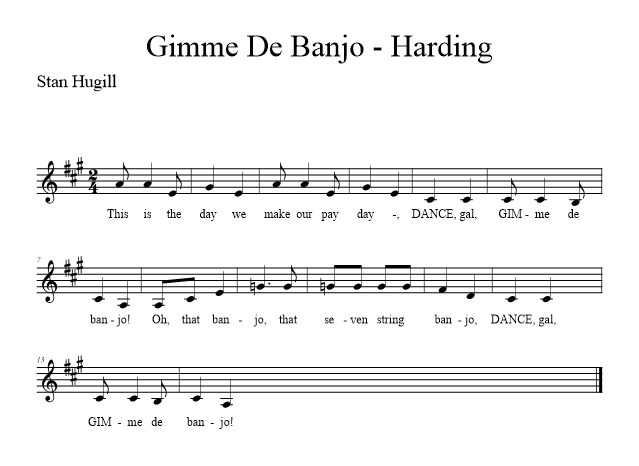
The musical notation
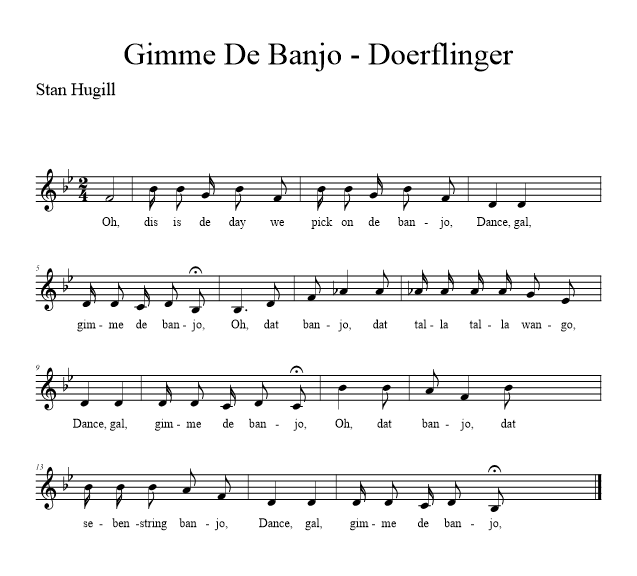
The full lyrics
Gimme De Banjo – Harding
This is the day we make our pay day, – Dance, gal, gimme de banjo! Oh, that banjo, that seven string banjo, – Dance, gal, gimme de banjo!
* 2 *
Haul away for Campeachy Bay, Oh, haul away an’ sretch out for yer pay-ay,
* 3 *
A dollar a day is a buckera’s pay, Oh, bend yer high shoes an’ lavender breeks, boys.
* 4 *
There’s my Sal, she’s the gal for me, boys, Oh, I know that she’ll be, a-waitin’ for me-e.
* 5 *
I’ll bang on the banjo — that ping-a, pong-a banjo! Oh, that banjo — that ping-a, pong-a banjo!
Interesting Facts about the Old Moke Pickin On The Banjo
“Old Moke Pickin On The Banjo” version was given to Stan Hugill by Harding Barbadian, who said it was sung at the capstan. Cecil Sharp gives one verse of this song, and he believes this is the variant of the Irish Folk Song “Shule Agra”. The word “too-rer-loo” in the chorus indicates an Irish connection. This song will be reconstructed as the capstan shanty.
The source of this sea shanty
The music: “Shanties from the Seven Seas” by Stan Hugill (1st ed: p 340). The lyrics: “Shanties from the Seven Seas” by Stan Hugill (1st ed: p 340).
The Record of the Old Moke Pickin On The Banjo
You also can find this record on my YouTube channel here or directly listen below. Additionally, if you want to share your opinion about the record or share your opinion you can do it in my Facebook forum here, or leave a comment at the bottom of this blog article.
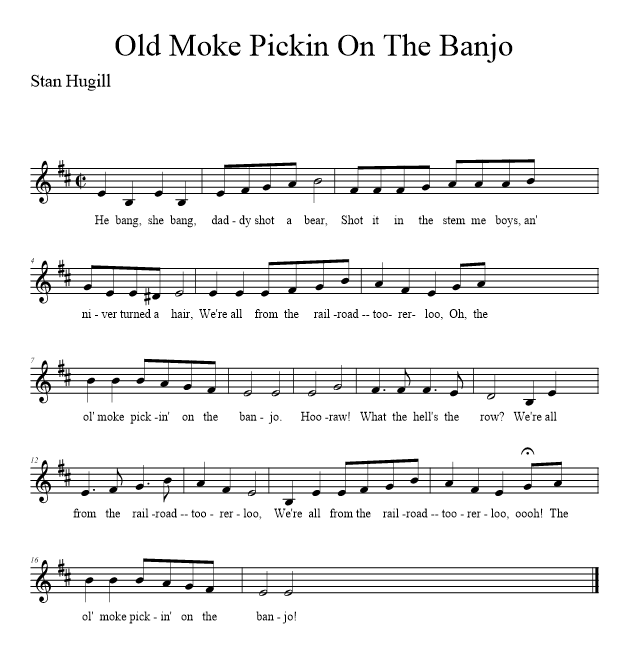
The musical notation
The full lyrics
Old Moke Pickin On The Banjo
He bang, she bang, daddy shot a bear, Shot it in the stem me boys, an’ niver turned a hair,
– We’re all from the railroad — too-rer-loo, – Oh, the ol’ moke pickin’ on the banjo.
– Hooraw! What the hell’s the row? – We’re all from the railroad — too-rer-loo, – We’re all from the railroad — too-rer-loo, – oooh! The ol’ moke pickin’ on the banjo!
* 2 *
Pat, get back, take in yer slack, heave away, me boys, Heave away, me bully boys, why don’t ye make some noise?
* 3 *
Roll her, boys, bowl her, boys, give ‘er flamin’ gip, Drag the anchor off the mud, an’ let the bastard rip!
* 4 *
Rock-a-block, chock-a-block, heave the caps’n round, Fish the flamin’ anchor up, for we are outward bound.
* 5 *
Out chocks, two blocks, heave away or bust, Bend yer backs, me bully boys, kick up some flamin’ dust.
* 6 *
Whisky-o, Johnny-O, the mudhook is a slight, ‘Tis a hell-ov-a-way to the gals that wait, an’ the ol’ Nantucket Light.
“The Shaver” capstan shanty. Terry claims that his uncle often sang it. He thinks that the “Poor Paddy Works On The Railway” tune comes from this song. This song will be reconstructed as the Capstan windlass shanty.
The source of this sea shanty
The source of this sea shanty: The music: “Shanties from the Seven Seas” by Stan Hugill (1st ed: p 339). The lyrics: “Shanties from the Seven Seas” by Stan Hugill (1st ed: p 339).
The Record of The Shaver
You also can find this record on my YouTube channel here or directly listen below. Additionally, if you want to share your opinion about the record or share your opinion you can do it in my Facebook forum here, or leave a comment at the bottom of this blog article.
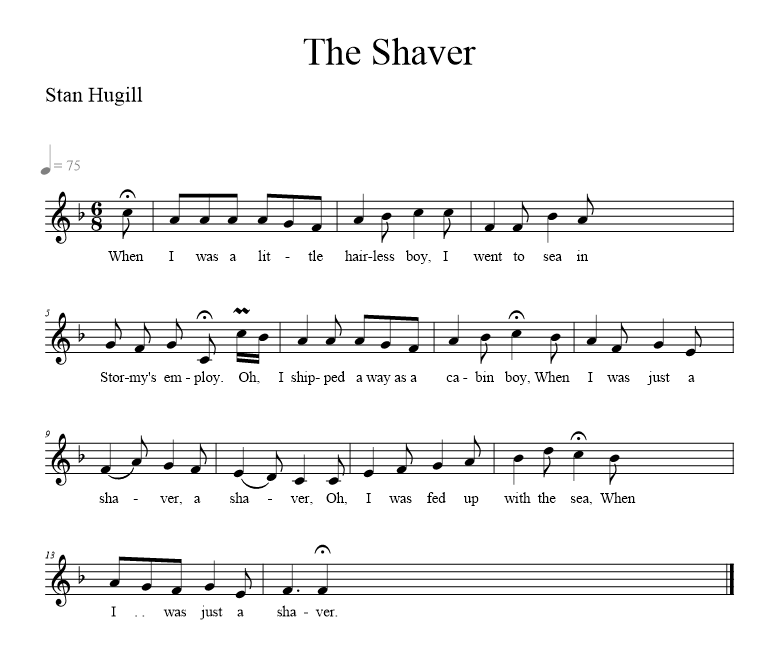
The musical notation
And the full lyrics
The Shaver
When I was a little hairless boy, I went to sea in Stormy’s employ. Oh, I shipped a way as a cabin boy,
– When I was just a shaver, a shaver, – Oh, I was fed up with the sea, – When I was just a shaver.
* 2 *
Oh, they whacked me up, an’ they whacked me down, The Mate he cracked me on the crown, They whacked me round an’ round an’ round,
* 3 *
When I went aloft through the lubber’s hole, The mate he cried, ‘Lord darn yer soul, Ye’ll do, me son, what yer bloomin’ well told!’
* 4 *
An’ when we lollop’d around Cape Horn, I wisht to hell I’d niver bin born, I felt like a sheep with its wool all shorn.
* 5 *
When we left behind the ice an’ rain, An’ once more to the tropics we came, The Mate came hazin’ me once again.
* 6 *
When we made port, well I skipped ship, I’d had enough for one bloomin’ trip, I’d stay ashore an’ never more ship.
Interesting Facts about the Poor Paddy Works On The Railway
“Poor Paddy Works On The Railway” usually used as the pump or capstan shanty “. Alden in Harpers Magazine (July 1882) declares that it is a “sailors” song tamed to do land service . . . on the minstrel stage. Stan Hugill also tells us that song was popular in the Western Ocean Packets about the time of the Irish Potato famine. This song will be reconstructed as the pump shanty.
The source of this sea shanty
The music: “Shanties from the Seven Seas” by Stan Hugill (1st ed: p 337). The lyrics: “Shanties from the Seven Seas” by Stan Hugill (1st ed: p 337, 338).
The Record of the Poor Paddy Works On The Railway
You also can find this record on my YouTube channel here or directly listen below. Additionally, if you want to share your opinion about the record or share your opinion you can do it in my Facebook forum here, or leave a comment at the bottom of this blog article.
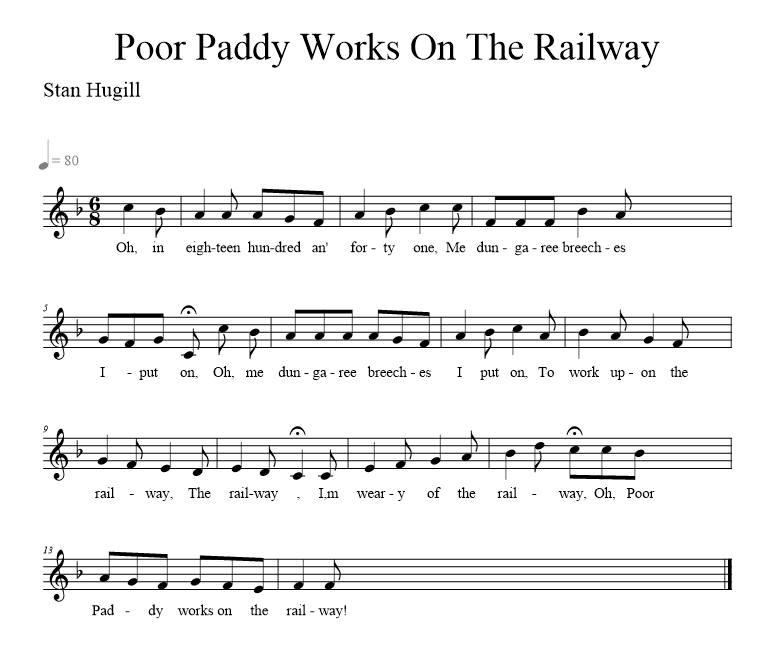
The musical notation
The full lyrics
Poor Paddy Works On The Railway
Oh, in eighteen hundred an’ forty one, Me dungaree breeches I put on, Oh, me dungaree breeches I put on, To work upon the railway,
– The railway, – I,m weary of the railway, – Oh, Poor Paddy works on the railway!
* 2 *
In eighteen hundred an’ fourty-two, I did not know what I should do, So I shipped away wid and Irish crew, To work upon the railway,
* 3 *
In eighteen hundred an’ fourty-three, I packet me gear an’ went to sea, I shipped away to Amerikee, To work …
* 4 *
In eighteen hundred an’ fourty-four, I landed on Columbia’s shore, I had a pick-axe an’ nothin’ more.
* 5 *
In eighteen hundred and forty-five, When Dan O’Connell he wuz alive, To break me leg I did contrive.
* 6 *
In eighteen hundred an’ fourty-six, Me drinks no longer I could mox, So I changed me trade to carrying bricks.
* 7 *
In eighteen hundred an’ forty-seven, Me Children numbered jist eleven, Of girls I’d four, of boys I’d seven.
* 8 *
In eighteen hundred an’ fourty-eight, I made a fortune, not to late, An’ shipped away to the River Plate.
* 9 *
In eighteen hundred an’ fourty-nine, I for a sigh of Home did pine, So I sailed down so uth to a warmer clime.
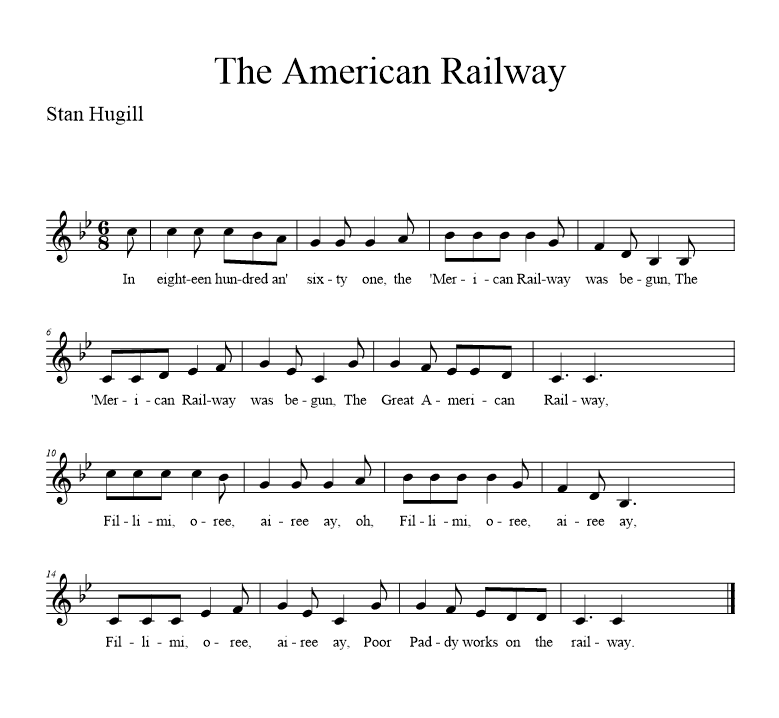
“The American Railway” is the shore version of the shanty ” Paddy Works On The Railway”.Most collectors think it started its life as a music-hall song, however, Richard Runciman Terry disagrees with this opinion. The land version was also sung by the early railroad workers of Young America around the forties and fifties of the nineteenth century. This song will be reconstructed as the shore song.
The source of this song
The music: “Shanties from the Seven Seas” by Stan Hugill (1st ed: p 337). The lyrics: “Shanties from the Seven Seas” by Stan Hugill (1st ed: p 337).
The Record
You also can find this record on my YouTube channel here or directly listen below. Additionally, if you want to share your opinion about the record or share your opinion you can do it in my Facebook forum here, or leave a comment at the bottom of this blog article.
The musical notation
The full lyrics
The American Railway
In eighteen hundred an’ sixty one, The ‘Merican Railway was begun, The ‘Mericun Railway was begun, The Great American Railway,
– Filimi, oree, airee ay, oh, – fillimi. oree, airee ay, – fillimi. oree, airee ay, – Poor Paddy works on the railway.
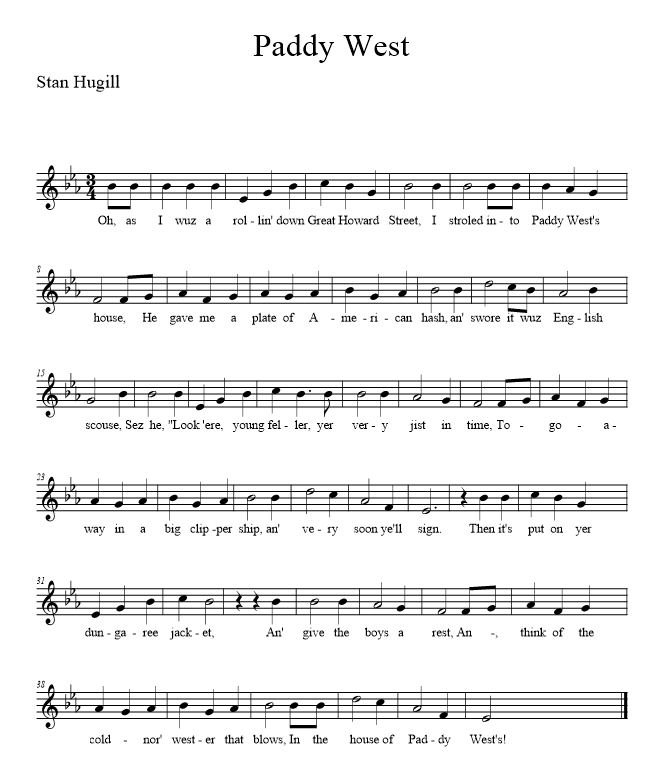
“Paddy West”, according to Stan Hugill many collectors state that song has always been Forebitter, but Hugill says his informants (not named unfortunately), state that the song was used as the Capstan shanty. The song is as old as the time of the Western Ocean Packets (probably 40s of the nineteenth century). The man from the title, Paddy West was a real historical person, he lived in Great Howard Street, Liverpool, where he was the owner of the sailor’s boarding house. The uniqueness of the way how he keeps his boarding house, he can turn the farmer into able-bodied seamen, in a couple of days. I think the lyrics of the song best explain the methods of the Paddy West to coaching the farmers, and after all this way of acting with farmers was way better than Shanghaiing.
The source of this sea shanty
The music: “Shanties from the Seven Seas” by Stan Hugill (1st ed: p 335).
The lyrics: “Shanties from the Seven Seas” by Stan Hugill (1st ed: p 335, 336).
The Record of the Paddy West
You also can find this record on my YouTube channel here or directly listen below. Additionally, if you want to share your opinion about the record or share your opinion you can do it in my Facebook forum here, or leave a comment at the bottom of this blog article.
The musical notation
The full lyrics
Paddy West
Oh, as I wuz a rollin’ down Great Howard Street, I stroled into Paddy West’s house, He gave me a plate of American hash, an’ swore it wuz English scouse, Sez he, “Look ‘ere, young feller, yer very jist in time, To go away in a big clipper ship, an’very soon ye’ll sign.
– Then it’s put on yer dungaree jacket, – An’ give the boys a rest, – An, think of the cold nor’wester that blows, – In the house of Paddy West’s!
* 2 *
Now he axed me if I had ever been to sea, I told him not till that morn; ‘Well, be Jasus,’ sez he, ‘a sailor ye’ll be, From the hour that jiz wuz born; Just go into a perlour, walk round the ol’ cow horn, An’ tell the mate that ye have been, oh, three times round the Horn!”
* 3 *
When I got into ol’ Paddy West’s house, The wind began to blow; He send me up to the lumber-room, The fore-royal for to stow; When I climbed up to the attic, no fore-royal could I find, So I jumped upon the window stilland furled the winder-blind.
* 4 *
It’s Paddy, me bhoy, he pipes all hands on deck, Their stations for to man. His wife, Sarah Ann, stood in the backyard, A bucket in her hand, His wife let go the bucket, the water flew on its way; ‘Clew up yer fore t’gallant, me sons, she’s takin’ in a say!’
* 5 *
To every two men that graduates, I’ll give wan outfit free, For rwo good men on watch at once Ye never need to see; Oilskins, me bhoys, ye won’t want, carpet slippers made o’ felt I will dish out to the pair o’ ye, an’ a ropeyarn for a belt.
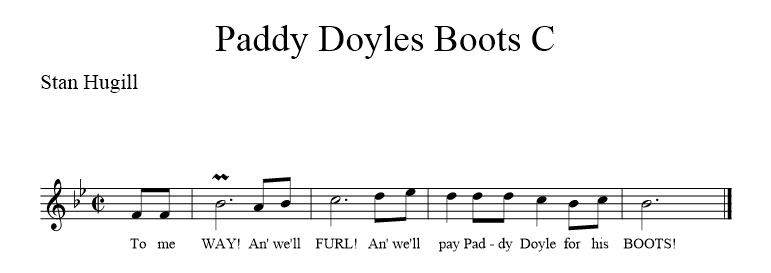
In Stan Hugill’s book “Paddy Doyles Boots C”, it is the song that opening family of the songs is with the word “Paddy”. This song is dedicated to one and only one job, namely: that of getting the mass of sodden, bellying canvas rolled up to the yard, also called “Tossing the bunt”. When singing this chant the haul usually came on the word “BOOTS!” Usually, there was no need for more than two or three verses at most. Probably this is only one type of shanty that is sung whole by all-hands (no shantymen or crew part only). Stan Hugill tells us that are three patterns in this song this is the third one: Pull on three words.
The source of this sea shanty
The music: “Shanties from the Seven Seas” by Stan Hugill (1st ed: p 333). The lyrics: “Shanties from the Seven Seas” by Stan Hugill (1st ed: p 333).
The Record of the Paddy Doyles Boots C
You also can find this record on my YouTube channel here or directly listen below. Additionally, if you want to share your opinion about the record or share your opinion you can do it in my Facebook forum here, or leave a comment at the bottom of this blog article.
The musical notation
The full lyrics
Paddy Doyles Boots C
To me WAY! An’ we’ll FURL! An’ we’ll pay Paddy Doyle for his BOOTS!
* 2 *
We’ll sing, WAY! An’ we’ll HEAVE! An’ we’ll pay Paddy Doyle for his BOOTS!
* 3 *
So we’ll HEAVE! With a SWING! An’ we’ll pay Paddy Doyle for his BOOTS!
In Stan Hugill’s book “Paddy Doyles Boots B”, it is the song that opening family of the songs is with the word “Paddy”. This song is dedicated to one and only one job, namely: that of getting the mass of sodden, bellying canvas rolled up to the yard, also called “Tossing the bunt”. When singing this chant the haul usually came on the word “BOOTS!” Usually, there was no need for more than two or three verses at most. Probably this is only one type of shanty that is sung whole by all-hands (no shantymen or crew part only). Stan Hugill tells us that are three patterns in this song this is the second one: The solos are varied with the same chorus throughout, the pull coming on “BOOTS!”.
The source of this sea shanty
The music: “Shanties from the Seven Seas” by Stan Hugill (1st ed: p 333). The lyrics: “Shanties from the Seven Seas” by Stan Hugill (1st ed: p 333).
The Record of the Paddy Doyles Boots B
You also can find this record on my YouTube channel here or directly listen below. Additionally, if you want to share your opinion about the record or share your opinion you can do it in my Facebook forum here, or leave a comment at the bottom of this blog article.
The musical notation
The full lyrics
Paddy Doyles Boots B
Yeo aye – an’ we’ll haul aye, To pay Paddy Doyle for his BOOTS!
* 2 *
Yeo aye – an’ we’ll sing aye, To pay Paddy Doyle for his BOOTS!
* 3 *
We’ll bunt up the sail with a fling aye! To pay Paddy Doyle for his BOOTS!
* 4 *
We’ll tauten the bunt an’ we’ll furl aye, To pay Paddy Doyle for his BOOTS!
* 5 *
We’ll skin the ol’ rabbit an’ haul eye, To pay Paddy Doyle for his BOOTS!
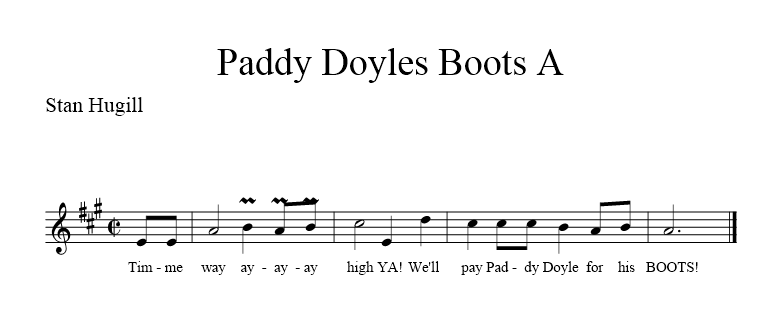
In Stan Hugill’s book “Paddy Doyles Boots A”, it is the song that opening family of the songs is with the word “Paddy”. This song is dedicated to one and only one job, namely: that of getting the mass of sodden, bellying canvas rolled up to the yard, also called “Tossing the bunt”. When singing this chant the haul usually came on the word “BOOTS!” Usually, there was no need for more than two or three verses at most. Probably this is only one type of shanty that is sung whole by all-hands (no shantymen or crew part only). Stan Hugill tells us that are three patterns in this song this is the first one: A wild “way-ay-ay” followed by “We’ll pay Paddy Doyle”, etc …, the haul coming on either the final grounted-out YA!, on BOOTS!, or on both.
The source of this sea shanty
The music: “Shanties from the Seven Seas” by Stan Hugill (1st ed: p 331). The lyrics: “Shanties from the Seven Seas” by Stan Hugill (1st ed: p 331 – 333).
The Record of the Paddy Doyles Boots A
You also can find this record on my YouTube channel here or directly listen below. Additionally, if you want to share your opinion about the record or share your opinion you can do it in my Facebook forum here, or leave a comment at the bottom of this blog article.
The musical notation
The full lyrics
Paddy Doyles Boots A
Timme way ay-ay-ay high YA! We’ll pay Paddy Doyle for his BOOTS!
* 2 *
Timme way ay-ay-ay high YA! We’ll all throw muck at the COOK!
* 3 *
Timme way ay-ay-ay high YA! We’ll all drink whisky an’ GIN!
* 4 *
Timme way ay-ay-ay high YA! We’ll all shave under the CHIN!
* 5 *
Timme way ay-ay-ay high YA! Who stole poor Paddy Doyle’s BOOTS!
* 6 *
Timme way ay-ay-ay high YA! We’ll bouse her up an’ be DONE!
* 7 *
Timme way ay-ay-ay high YA! We’ll bouse her up an’ be DONE!
* 8 *
Timme way ay-ay-ay high YA! The dirty ol, man’s on the POOP!
“Albertina” a Swedish pumping shanty, it has a melody very close to the opening line of a popular wartime song: “Twas down on the Rhine I met Rosalein”. Stan Hugill gives us two versions of this shanty, this one is the version from “Sang Under Segel” by Sigurd Sternvall (1935). Sternvall in his book says the song was equally popular among all Scandinavian seamen. Probably of Norwegian origin, because always been done to sing in an imitation of the Norwegian dialect. Sternvall also says the song was always used at the capstan. I will again reconstruct this song as the pump shanty.
The source of this sea shanty
The music: “Shanties from the Seven Seas” by Stan Hugill (1st ed: p 329). The lyrics: “Shanties from the Seven Seas” by Stan Hugill (1st ed: p 329).
The Record of the Albertina – Sternvall
You also can find this record on my YouTube channel here or directly listen below. Additionally, if you want to share your opinion about the record or share your opinion you can do it in my Facebook forum here, or leave a comment at the bottom of this blog article.
The musical notation
The full lyrics
Skonnert Albertina – Sternvall
Det skull byggas ett skepp uti, Norden, Albertina skall vara skeppets namn, – Pumpa läns! Albertina, låt så vara, Albertina, ingen fara, Albertina skall vara skeppets namn, – Pumpa läns!
– Albertina, låt så vara, Albertina, ingen fara, – Albertina skall vara skeppets namn,
– Pumpa läns!
* 2 *
Och det skeppet är allaredan lastat, Det är lastat med bayerskt öl och vin
Det är lastat, låt så vara, Det är lastat, ingen fara, Det är lastat med bayerskt öl och vin,
* 3 *
Men på straden står Ingrid och gråter, Ja, hon gråter efter lilla vännen sin, Ja, hon gråter, låt så vara, ja hon gråter, men vi fara Ja, hon gråter efter lilla vännen sin,
* 4 *
Varje sjömans grav är redan gräven, Den är gräven i böljorna de blå Den är gräven, låt så vara, den är gräven, men vi fara, Den är gräven i böljorna de blå
* 5 *
Och min gravskrift den är redan skriven, Den är skriven på finaste latin Den är skriven, låt så vara, den är skriven, men vi fara, Den är skriven på finaste latin
To provide the best experiences, we use technologies like cookies to store and/or access device information. Consenting to these technologies will allow us to process data such as browsing behavior or unique IDs on this site. Not consenting or withdrawing consent, may adversely affect certain features and functions.
Functional
Always active
The technical storage or access is strictly necessary for the legitimate purpose of enabling the use of a specific service explicitly requested by the subscriber or user, or for the sole purpose of carrying out the transmission of a communication over an electronic communications network.
Preferences
The technical storage or access is necessary for the legitimate purpose of storing preferences that are not requested by the subscriber or user.
Statistics
The technical storage or access that is used exclusively for statistical purposes.The technical storage or access that is used exclusively for anonymous statistical purposes. Without a subpoena, voluntary compliance on the part of your Internet Service Provider, or additional records from a third party, information stored or retrieved for this purpose alone cannot usually be used to identify you.
Marketing
The technical storage or access is required to create user profiles to send advertising, or to track the user on a website or across several websites for similar marketing purposes.