Interesting Facts about the Across The Western Ocean ( I )
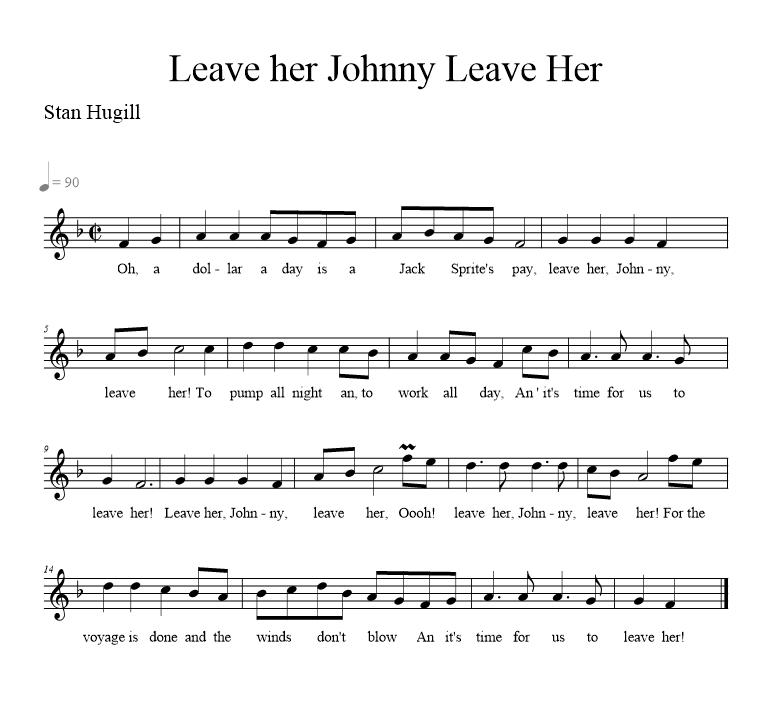
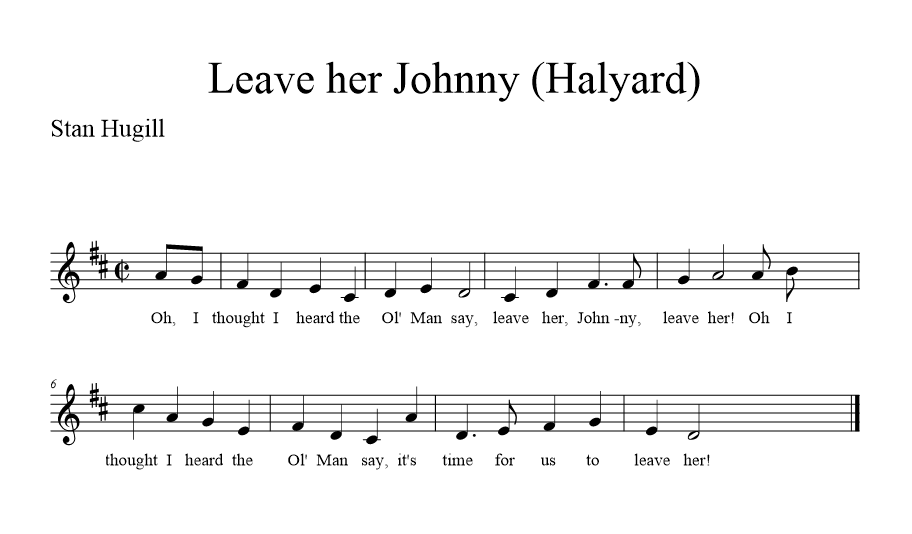
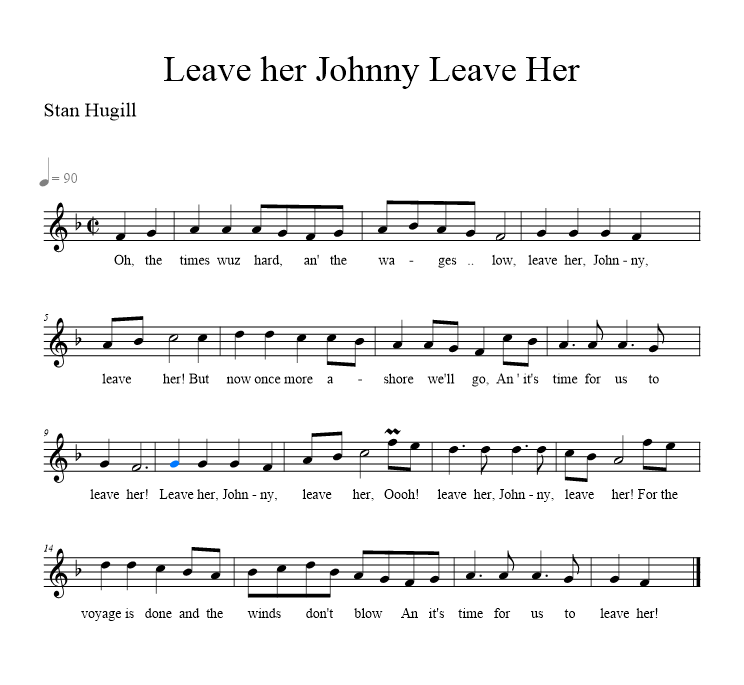
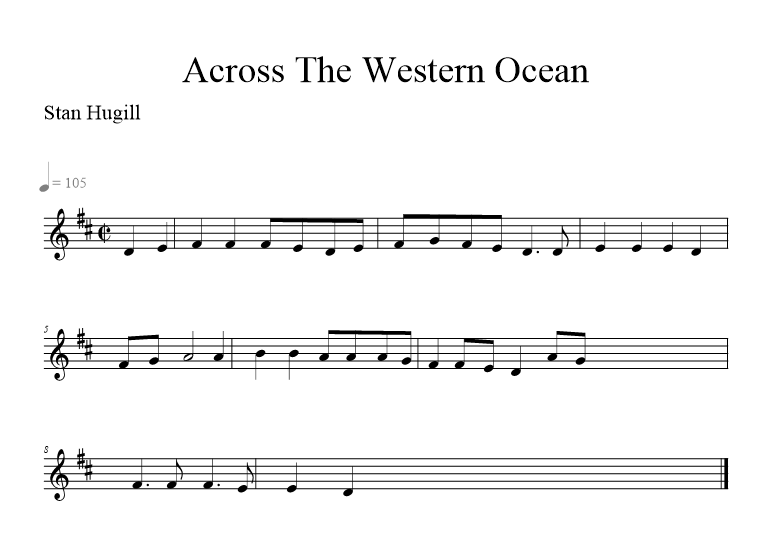
Here is probably one of the development stages for the very famous shanty “Leave her, Johnny, Leave here”, the “Across The Western Ocean ( I )”. Stan Hugill mentions this song just before the description of the “Leave her, Johnny, Leave here”. This is the hauling shanty and will be reconstructed as a halyard shanty.
The source of this sea shanty
The music: “Shanties from the Seven Seas” by Stan Hugill (1st ed: p 292). The lyrics: “Shanties from the Seven Seas” by Stan Hugill (1st ed: p 292, 293).
The Record of the Across The Western Ocean ( I )
You also can find this record on my YouTube channel here or directly listen below. Additionally, if you want to share your opinion about the record or share your opinion you can do it in my Facebook forum here, or leave a comment at the bottom of this blog article.
The musical notation
The full lyrics
Across The Western Ocean ( I )
Oh, though times are hard and the wages low, – AMELia whar yer BOUND to?, The Rocky Mountains is me home, – Oh, ACROSS the Western OCEAN!!
* 2 *
A land of promise there ye’ll see, I’m bound away across that sea.
* 3 *
To Liverpool that I’ll take my way, To Liverpool that Packet School.
* 4 *
There’s Liverpool Pat wid his tarpaulin hat, An’ Yannkee John, the Packet Rat.
* 5 *
Beware them Packet Ships I pray, They’ll steal yer gear an’ clothes away.
* 6 *
We are bound away from our friends and home, We’re bound away to seek for gold.
* 7 *
Mothers and sweetharts don’t ye cry, Sister an’ brothers say goodbye.
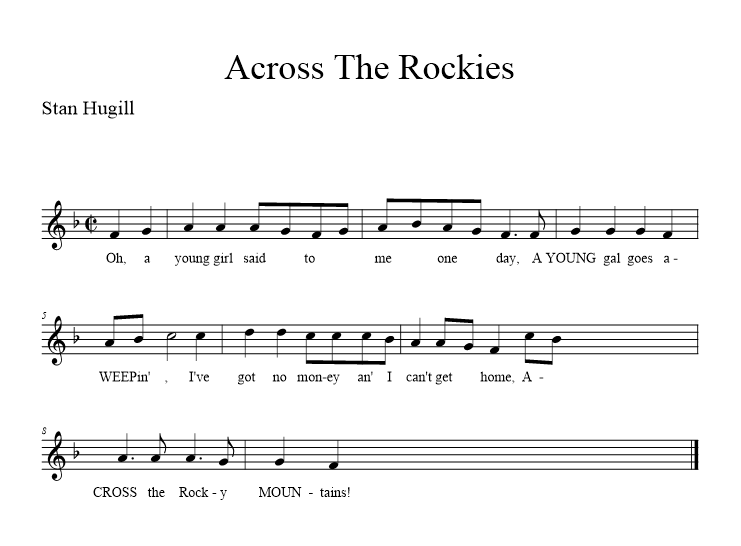
Here is probably one of the development stages for the very famous shanty “Leave her, Johnny, Leave here”, the “Across The Rockies”. The places where this shanty can be sung were various depending on time, so in the beginning was serve as the hauling shanty, mainly for halyards, and when the grand chorus was added later used mainly at the pumps and even capstan. Stan Hugill partially learned it from his mother’s father and partially from an Irish sailor, both used the final chorus. His suppositions carry over the theory that the song came to life about the time of the Irish potato famine, in the forties of the nineteenth century. This reconstruction will be sung as a pump shanty.
The source of this sea shanty
The music: “Shanties from the Seven Seas” by Stan Hugill (1st ed: p 292). The lyrics: “Shanties from the Seven Seas” by Stan Hugill (1st ed: p 292).
The Record of the Across The Rockies
You also can find this record on my YouTube channel here or directly listen below. Additionally, if you want to share your opinion about the record or share your opinion you can do it in my Facebook forum here, or leave a comment at the bottom of this blog article.
The musical notation
The full lyrics
Across The Rockies
Oh, a young girl said to me one day, – A YOUNG gal goes a-WEEPin’, I’ve got no money an’ I can’t get home, – ACROSS the Rocky MOUNtains!
* 2 *
Oh, what shall we poor shellbacks do? We’ve got no money and we can’t get home,
* 3 *
I thought I heard the Ol’ Man say, If ye git no money, oh, ye’ll niver git home.
* 4 *
Oh, my poor ol’ mother she wrote to me, She wrote to me to come home from sea.
* 5 *
Oh, I’ve got no money an’ I’ve got no clothes, I’ve joined a bunch of though hoboes.
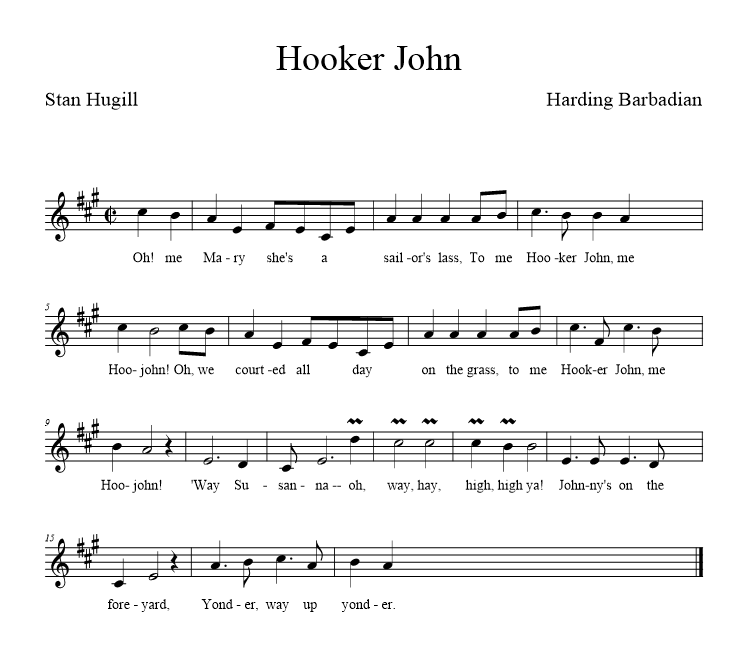
“Hoker John” is the capstan shanty, which comes from Harding Barbadian, probably the most recognizable source of the shanties that Stan Hugill when sailed with on merchant ships service. Harding Barbadian tells to Stan Hugill, that this song was still popular in the West Indies (1931). It probably originated as a cotton Stower’s song.
The source of this sea shanty
The music: “Shanties from the Seven Seas” by Stan Hugill (1st ed: p 291). The lyrics: “Shanties from the Seven Seas” by Stan Hugill (1st ed: p 291).
The Record of the Hooker John (Harding)
You also can find this record on my YouTube channel here or directly listen below. Additionally, if you want to share your opinion about the record or share your opinion you can do it in my Facebook forum here, or leave a comment at the bottom of this blog article.
The musical notation
The full lyrics
Hooker John (Harding)
Oh! me Mary she’s a sailor’s lass, – To me Hooker John, me Hoojohn! Oh, we courted all day on the grass, – to me Hooker John, me Hoojohn!
– ‘Way Susanna–oh, way, hay, high, high ya! – Johnny’s on the foreyard, – Yonder, way up yonder.
* 2 *
Oh, my Susie she’s a nigger’s gal, She’s nine foot high–that gal’s so taall.
* 3 *
Oh, my Flora she’s a hoosier’s frien’, She’s beamy round the ol’ beam-end.
* 4 *
Oh, Sally Brown she’s the gal for me, She courts a bit when her man’s at sea.
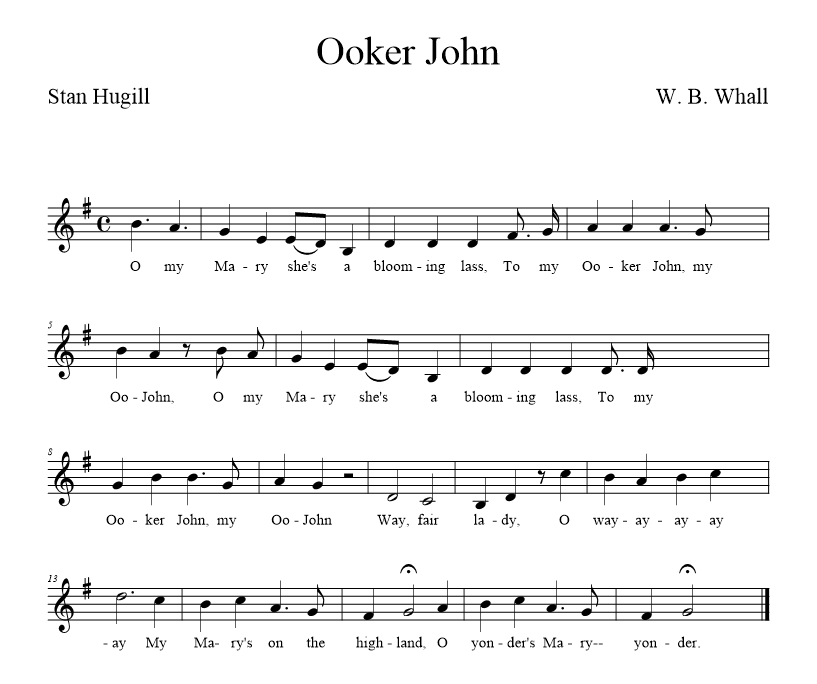
“Ooker John” is the shanty mentioned by Stan Hugill in his biggest book, when he describes the shanty with the title “Hooker John”. A couple of issues that this shanty has are that fact is, that was never directly told for what work was used this shanty for, however, was mentioned is similar to other capstan shanties, so by this and by the construction of verse and chorus with good probability we can say it is capstan shanty. Another issue is that Captain Whall in his book “Sea Songs Ships & Shanties” (4th enlarged edition 1913 page 101), which Stan Hugill refers to, doesn’t even give to us the title of this song, so actually, the title comes from Stan Hugill. Harding Barbadian tells to Stan Hugill, it was still popular in the West Indies (1931). It probably originated as a cotton Stower’s song.
The source of this sea shanty
The lyrics: “Sea Songs Ships & Shanties” by W. B. Whall (4th enlarged edition 1913 page 101). The lyrics: “Sea Songs Ships & Shanties” by W. B. Whall (4th enlarged edition 1913 page 101). Mentioned in: “Shanties from the Seven Seas” by Stan Hugill (1st ed p 290).
The Record of the Ooker John
You also can find this record on my YouTube channel here or directly listen below. Additionally, if you want to share your opinion about the record or share your opinion you can do it in my Facebook forum here, or leave a comment at the bottom of this blog article.
The musical notation
The full lyrics
Ooker John
O my Mary she’s a blooming lass, – To my Ooker John, my Oo-John, O my Mary she’s a blooming lass, – To my Ooker John, my Oo-John,
– Way, fair lady, O way-ay-ay-ay-ay, – My Mary’s on the highland, – O yonder’s Mary–yonder….
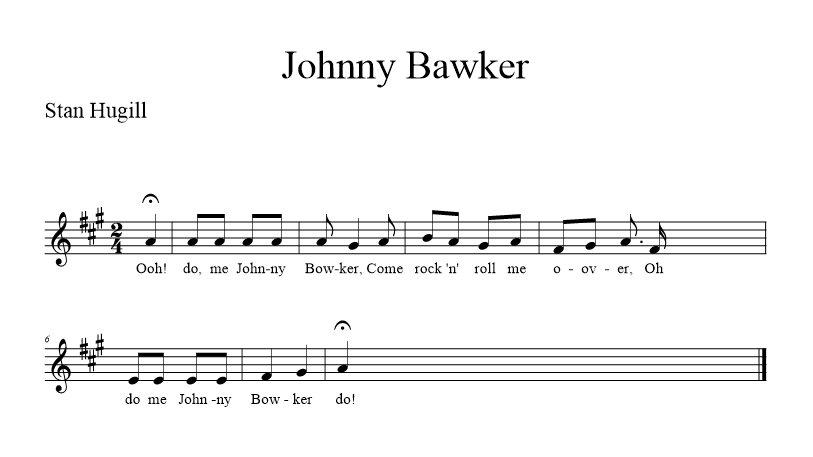
“Johnny Bawker” is another shanty from Stan Hugill’s “Johnny” shanties family. It was the shanty used for sheets. It was used for ‘sweating up’, i.e. to give a final drag on a halyard to gain the last inch, at tacks and sheets. Stan Hugill also mentions that this song was used for bunting sails, quite a unique theory because this job was considered the prerogative of “Paddy Doyle” shanty (we don’t know if Stan Hugill saw this song in action when sails were bunting or if this is only the theory). Another interesting fact is that the final “DO” was grunted out staccato, or rather the word was sung to its correct note and then a rising, gasped-out ‘UGH” would follow as the pull came.
And in end due to the specifics of the “sweetening up” job (final pulls), would not take more than three or four verses at the most. For my reconstruction, I select five verses which are more than enough for the described job.
The source of this sea shanty
The music: “Shanties from the Seven Seas” by Stan Hugill (1st ed: p 289). The lyrics: “Shanties from the Seven Seas” by Stan Hugill (1st ed: p 289, 290).
The Record of the Johnny Bawker
You also can find this record on my YouTube channel here or directly listen below. Additionally, if you want to share your opinion about the record or share your opinion you can do it in my Facebook forum here, or leave a comment at the bottom of this blog article.
The musical notation
The full lyrics
Johnny Bawker
Ooh! do, me Johnny Bowker, Come rock ‘n’ roll me over, – Oh do me Johnny Bowker do!
* 2 *
O do, me Johnny Bowker, Come roll me down to Dover,
* 3 *
O do, me Johnny Bowker, lets’ all go on a Jamboree.
* 4 *
O do, me Johnny Bowker, the watches are cala-la-shee.
* 5 *
O do, me Johnny Bowker, the chief mate he’s a croaker.
* 6 *
O do, me Johnny Bowker, the Old Man he’s a soaker.
* 7 *
O do, me Johnny Bowker, the bosun’s never sober.
* 8 *
O do, me Johnny Bowker, I bet ye are a rover.
* 9 *
O do, me Johnny Bowker, the he is a tailor.
* 10 *
O do, me Johnny Bowker, the chips he ain’t no sailor.
* 11 *
O do, me Johnny Bowker, come roll me in the clover.
* 12 *
O do, me Johnny Bowker, come rock an’ roll ‘er over.
* 13 *
O do, me Johnny Bowker, from Calais down to Dover.
* 14 *
O do, me Johnny Bowker, in London lives yer lover.
* 15 *
O do, me Johnny Bowker, the packet she is rollin’.
* 16 *
O do, me Johnny Bowker, come haul away the bowline.
* 17 *
O do, me Johnny Bowker, we’ll either break or bend it.
* 18 *
O do, me Johnny Bowker, we’re men enough to mend it.
* 19 *
O do, me Johnny Bowker, get round the corner, Sally.
* 20 *
O do, me Johnny Bowker, let me an’ you live tally.
* 21 *
O do, me Johnny Bowker, we’ll haul away an’ bend ‘er.
* 22 *
O do, me Johnny Bowker, me sweethart’s young an’ tender.
* 23 *
O do, me Johnny Bowker, one more pull then choke ‘er.
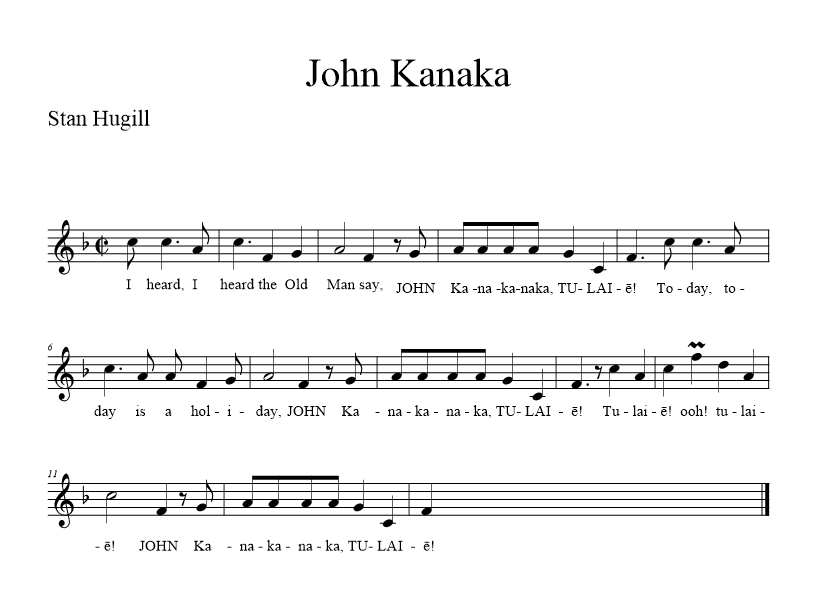
“John Kanaka” is a halyard shanty closely related to “Mobile Bay”. Stan Hugill informs us in his book, that this shanty is the first time it has been in print. This is one of the songs from a collection of wonderful shantymen, Harding of Barbados. “The last Shantyman,” says, that Harding sang it with many falsetto yelps and hitches almost impossible to imitate. Polynesian in origin chorus and the word “Tulai-ē” were Samoan. Also very unique for this halyard shanty are three solos and three refrains. Because I always prefer the origin audio record (which rarely exists), to using music notation, I will try to reconstruct this fantastic halyard shanty base from an album by Stan Hugill with Stormalong John’s band “Chants des Marins Anglais” (1992).
The source of this sea shanty
The music: “Shanties from the Seven Seas” by Stan Hugill (1st ed: p 288). The lyrics: “Shanties from the Seven Seas” by Stan Hugill (1st ed: p 288, 289).
The Record of the John Kanaka
You also can find this record on my YouTube channel here or directly listen below. Additionally, if you want to share your opinion about the record or share your opinion you can do it in my Facebook forum here, or leave a comment at the bottom of this blog article.
The musical notation
The full lyrics
John Kanaka
I heard, I heard the Old Man say, – JOHN Kanaka-naka, TULAI-ē! Today, today is a holiday, – JOHN Kanaka-naka, TULAI-ē! Tulai-ē! oooh! Tulai-ē! – JOHN Kanaka-naka, TULAI-ē!
* 2 *
We’ll work termorrer, but no work terday, We’ll work termorrer, but no work terday, Tulai-ē! oooh! Tulai-ē!
* 3 *
We’re bound away for ‘Frisco Bay, We’re bound away at the break o’ day, Tulai-ē! oooh! Tulai-ē!
* 4 *
We’re bound away around Cape Horn, We wisht ter Christ we’d niver bin born, Tulai-ē! oooh! Tulai-ē!
* 5 *
Oh, haul, O haul, oh haul away, Oh, haul away an’ make yer pay, Tulai-ē! oooh! Tulai-ē!
Interesting Facts about John come tell us as we haul away
“John come tell us as we haul away” is another shanty with “Johnny” in text, often sung at pumps. Stan Hugill tells us a bit more about what kind of pump he talks about it: “when the word ‘pump’ would be substituted for the word ‘haul’, although in the more modern flywheel type of pump where a bell-rope was used both words were equally appropriate.”
Also, Stan Hugill tells us that this is one of not too many shanties that had two singers for the solo lines.
The source of this sea shanty
The music: “Shanties from the Seven Seas” by Stan Hugill (1st ed: p 287). The lyrics: “Shanties from the Seven Seas” by Stan Hugill (1st ed: p 287, 288).
The Record of the John come tell us as we haul away
You also can find this record on my YouTube channel here or directly listen below. Additionally, if you want to share your opinion about the record or share your opinion you can do it in my Facebook forum here, or leave a comment at the bottom of this blog article.
The musical notation
The full lyrics
John come tell us as we haul away
From Liverpool Town we sailed away, – John, come tell us as we haul away! Outward bound at the break of day, – John, come tell us as we haul away! Aye, aye, haul, aye, – John, come tell us as we haul away!
* 2 *– First Shantyman:
Wuz ye never down in Mobile Bay? – John, come_tell us as we haul away! A-screwin’ cotton all the day, – John, come_tell us as we haul away! Aye, aye, haul, aye, – John, come_tell us as we haul away!
* 3 *– Second Shantyman:
Oh, yes, I’ve bin down Mobile Bay, – So he tells us as we haul away! A-screwin’ cotton all the day, – So he tells us as we haul away! Aye, aye, haul, aye, – So he tells us as we haul away!
* 4 * – First Shantyman:
What did yer see down in Mobile Bay? – John, come_tell us as we haul away! Were the gals all free an’ gay? – John, come_tell us as we haul away! Aye, aye, haul, aye, – John, come_tell us as we haul away!
* 5 * – Second Shantyman:
Oh this I saw in Mobile Bay, – So he tells us as we haul away! A spankin’ gal in a hammock lay, – So he tells us as we haul away! Aye, aye, haul, aye, – So he tells us as we haul away!
* 6 *– First Shantyman:
An’ this flash gal wuz Saucy May, – John, come_tell us as we haul away! She wuz tall an’ fine an’ had lots to say. – John, come_tell us as we haul away! Aye, aye, haul, aye, – John, come_tell us as we haul away!
* 7 *– Second Shantyman:
An’ what did yer do in Mobile Bay? – John, come_tell us as we haul away! Did yiz give that flash tart all yer pay? – John, come_tell us as we haul away! Aye, aye, haul, aye, – John, come_tell us as we haul away!
* 8 *– First Shantyman:
Oh, this I did in Mobile Bay, – So he tells us as we haul away! I courted this gal whose name was May, – So he tells us as we haul away! Aye, aye, haul, aye, – So he tells us as we haul away!
* 9 *– Second Shantyman:
I married her in Mobile Bay, – So he tells us as we haul away! An’ lived there happy many a day, – So he tells us as we haul away! Aye, aye, haul, aye, – So he tells us as we haul away!
“Johnny Come-A-Long”, a stamp-‘n’-go shanty popular in German ships. Stan Hugill took this shanty from “Knurrhahn” Seemannslieder und Shanties (Zweiter Band) by Richard Baltzer; Klaus Prigge; Knurrhahn-Lotsen-Gesangverein (1936). In comparison, Stan Hugill’s version is slightly different in text and almost identical in music to the “Knurrhahn” version, also title “Knurrhahn” is different (The title from “Knurrhahn” is “Johnny” you can find on page 90 and 91).
The source of this sea shanty
The music: “Shanties from the Seven Seas” by Stan Hugill (1st ed: p 286). The lyrics: “Shanties from the Seven Seas” by Stan Hugill (1st ed: p 273).
The Record of the Johnny Come-A-Long
My reconstruction will imitate “stamp-n-go” shanty.
You also can find this record on my YouTube channel here or directly listen below. Additionally, if you want to share your opinion about the record or share your opinion you can do it in my Facebook forum here, or leave a comment at the bottom of this blog article.
The musical notation
The full lyrics
Johnny Come-A-Long
Oh, Johnny, Johnny, John, Come along, come along, Oh, Johnny, Johnny, John, come along, Dont stand there like a silly ol’ fool, don’t stand there a lookin’ so cool, Dont be shy of the ladies, an’ the teeth in his mouth want bang-bang!
– Down by the sea, Where the watermelon grow, – Back to my home, I shall not go, – And shall I dream of love’s sweet song, – Who can be happier than a sailor tonight?
* 2 *
Oh, Johnny, Johnny, John, Was a sailorman, He’d bin around all day, Jolin’ with the ladies, playin’ hide’n’seek, Not a penny to pay for to have a little peek, Happy as the day went high-diddle-dee, An’ the girls all shouted bang-bang!
* 3 *
Oh, Johnny, Johnny, John, In the garden with his gun, Monkey’s been a-playin’ all the day, Johnny takes his gun and the gun was loaded, Johnny took his gun and the gun exploded, High-diddle-dee, high-diddle-bum, An’ he never let it go bang-bang!
* 4 *
Oh, Johnny, Johnny, John, Git along, git along, Leave little ladies on the shore, Keep off, John, leave the girls alone, Say goodbye an’ sail away for home, Don’t hang round any more, An’ his ol’ knees went bang-bang!
This is one of the most famous shanties of all “Hanging Johnny”. According to Stan Hugill’s Hanging Johnny, it can be legendary hangman Jack Ketch, but obviously, nobody can confirm this information, so we have to get it as a legend. Probably melancholy tune and macabre lyrics and rhythm length itself made this song one of the best halyard shanties ever. Here the description of how Stan Hugill described the use of this shanty: “The word ‘Hang’ was often used when ‘swinging’. In this maneuver (when a buntline or clewline or light halyard had to be given a few final strong pulls), one man took a part turn with the line around the portion of the belayin’-pin beneath the pin rail, while two or three other seamen with their hands as high as they could place them gripped the line and fell backward heavily, then ‘giving in’ the resultant slack to the chap at the pin.” Usually was used at t’gallant halyards.
The source of this sea shanty
The music: “Shanties from the Seven Seas” by Stan Hugill (1st ed: p 284). The lyrics: “Shanties from the Seven Seas” by Stan Hugill (1st ed: p 283, 284, 285).
The Record of the Blow the Hanging Johnny
“Shanties from the Seven Seas” by Stan Hugill (1st ed p 203, 204).
You also can find this record on my YouTube channel here or directly listen below. Additionally, if you want to share your opinion about the record or share your opinion you can do it in my Facebook forum here, or leave a comment at the bottom of this blog article.
The musical notation
The full lyrics
Hanging Johnny
Oh, they calls me Hangin’ Johnny, – AWAY, boys, AWAY! They sez I hangs for money, – So HANG, boy-oys, HANG!
* 2 *
They sez I hang for money, But hangin’ is so funny,
* 3 *
At first I hanged me daddy, An’ then I hanged me mammy.
* 4 *
Oh, yes, I hanged me mother, Me sister, an’ me brudder.
* 5 *
I hanged me sister Sally, I hanged the whole damn family.
* 6 *
An’ then I hanged me granny, I hanged her up quite canny.
* 7 *
I’d hang the mate and skipper, I’d hang ’em by their flippers.
* 8 *
I’d hang a ruddy copper, I’d give him the long dropper.
* 9 *
I’d hang a rotten liar, I’d hang a bloomin’ frair.
* 10 *
I’d hang to make things jolly, I’d hang Jill, Jane, an’ Polly.
* 11 *
A rope, a beam, a ladder, I’d hang yiz all tergether.
* 12 *
We’ll hang an’ haul tergether, We’ll hang for better weather.
Interesting Facts about the Supen Ut En Dram På Man
The “Supen Ut, En Dram Pa Man”, a fantastic Swedish Capstan shanty from “Sang Under Segel” by Sigurd Sternvall (1935) (1st ed p 322, 323). is the shanty which also we can include in the Hugill family of shanties with the words “Whisky Johnny” in the theme. It comes from recollections of sailmaker Oskar Johansosson of Masthugget in Gothenburg. According to the footnotes from the original book it was very popular among all the Scandinavian vessels lying in Delagoa Bay, Portuguese East Africa, in the year 1904.
The source of this sea shanty
The music: “Shanties from the Seven Seas” by Stan Hugill (1st ed p 282). The lyrics: “Shanties from the Seven Seas” by Stan Hugill (1st ed p 282, 283).
The Record of the Supen Ut En Dram På Man
You also can find this record on my YouTube channel here or directly listen below. Additionally, if you want to share your opinion about the record or share your opinion you can do it in my Facebook forum here, or leave a comment at the bottom of this blog article.
The musical notation
The full lyrics
Supen Ut, En Dram På Man
Å, supen ut, en dr–am på man! Väl klarar skutan sig från land. om blott I hugger i med kläm. – En dram för oss Johnnies!
– Kom hör, kom hör, kom hör oss nu! – Ur djupa strupar kallas du. – En tår som går från lår till lår, – en dram för oss Johnnies!
* 2 *
Du stewart, fram med flaska grann! Fyll i en peg till varje man! De ä långt till Rio som ni vet.
* 3 *
Slå pall i spelet, vinda hem! Nu går det med en väldans kläm, slik olja nyttar som I ser.
* 4 *
Den stewart kommer snart igen, så fort vårt ankar vindats hem. Ligg an på spaken, alle man!
* 5 *
Fast heaven, gubbar, klart vid fall! Nu alla segel sättas skall, stolt skutan faller av för vind.
To provide the best experiences, we use technologies like cookies to store and/or access device information. Consenting to these technologies will allow us to process data such as browsing behavior or unique IDs on this site. Not consenting or withdrawing consent, may adversely affect certain features and functions.
Functional
Always active
The technical storage or access is strictly necessary for the legitimate purpose of enabling the use of a specific service explicitly requested by the subscriber or user, or for the sole purpose of carrying out the transmission of a communication over an electronic communications network.
Preferences
The technical storage or access is necessary for the legitimate purpose of storing preferences that are not requested by the subscriber or user.
Statistics
The technical storage or access that is used exclusively for statistical purposes.The technical storage or access that is used exclusively for anonymous statistical purposes. Without a subpoena, voluntary compliance on the part of your Internet Service Provider, or additional records from a third party, information stored or retrieved for this purpose alone cannot usually be used to identify you.
Marketing
The technical storage or access is required to create user profiles to send advertising, or to track the user on a website or across several websites for similar marketing purposes.