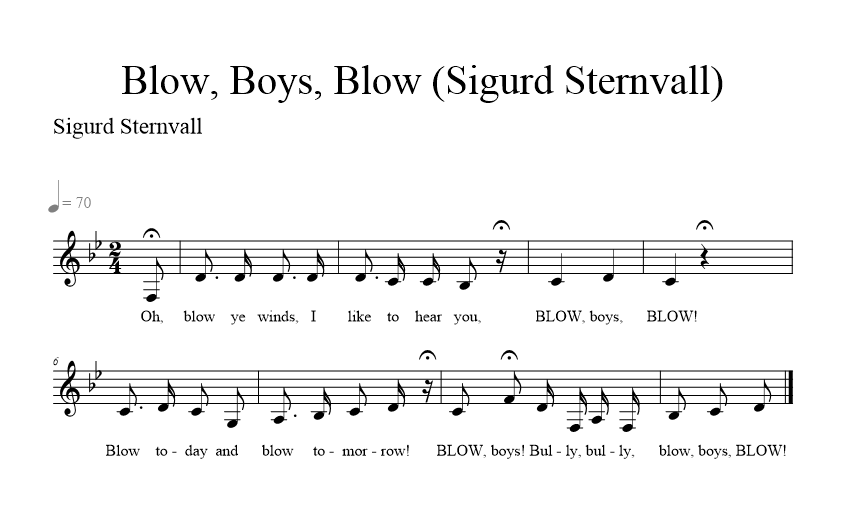
Blow Boys Blow (odd verses)

Interesting Facts about Blow Boys Blow (odd verses)

I collected from page 229 of Stan Hugill’s book printed odd verses (Blow Boys Blow (odd verses)), they have been used, been sung by shantymen on various decks of sailing ships, so I do not see any reason to forget those verses and leave them unused. This is the reason why I cannot omit them, and I will be over the moon to sing them as a halyard shanty way as previous full versions of this shanty from the book.
This was a shanty in which the singer often repeated the solo lines, to string out on a long haul.

The song will be reconstructed by myself as the halyard shanty.

The source of this sea shanty

The music: “Shanties from the Seven Seas” by Stan Hugill (1st ed p 226).

The lyrics:  “Shanties from the Seven Seas” by Stan Hugill (1st ed p 228, 229).

The Record of the Blow Boys Blow (odd verses)

You also can find this record on my YouTube channel here or directly listen below. Additionally, if you want to share your opinion about the record or share your opinion you can do it in my Facebook forum here, or leave a comment at the bottom of this blog article.

The full lyrics

Blow Boys Blow (odd verses)

Blow,me boys, an’ blow tergether,
– BLOW, boys, BLOW!
Blow,me boys for better waether.
– BLOW, me bully boys, BLOW!

* 2 *

Blow, boys, blow, the cook’s drawin’ water,
A bob for the cook an’ a cheer for his daughter.

* 3 *

She files aloft the stripes an’ stars,
She has cotton canvas an’ pitchpine spars.

* 4 *

A yankee ship came down the river,
There’s the style to make ye shiver.
* 5 *

Blow, me boys, we’ve come to cheer yer.

* 6 *

Another pull, ho, rock an’ shake ‘er.
For go she must an’ go we’ll make ‘er.

* 7 *

I though I heard the Old Man say
Another pull an’ then belay.

Related to this sea shanty

Blow Boys Blow (A)

Up Up My Boys Up A Hill

Blow Boys Blow (C)

Darcy Lever – The Young Sea Officer’s (1819)

Darcy Lever – The Young Sea Officer’s (1819)

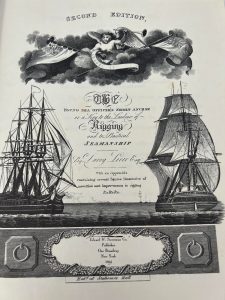
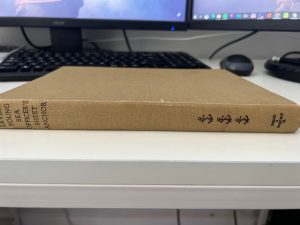
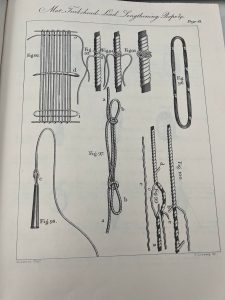
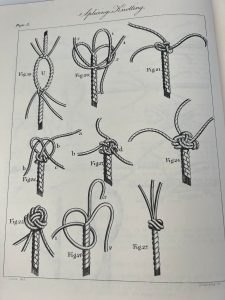
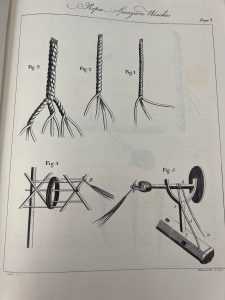
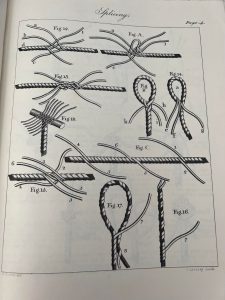
It is my great pleasure to present to you this book, it is a gem for all maritime enthusiasts. The full title of the book is “The Young Sea Officer’s Sheet Anchor: Or a Key to the Leading of Rigging and Practical Seamanship”. The length of the title is not unusual for the books from this time of history. As we go from the past into ‘nova days’ time we can observe a shortening of titles, verses in songs, and so on. It seems to be very natural in our current times, to receive just short information to minimize the time cost of gaining knowledge. But this book is not from our time. It is from the past and gives us a snip of the specific knowledge; displayed in every possible small detail. To read this book is like discovering a user guide. Complicated steam machines in the 21st century contain drawings, explanations, and all necessary knowledge.

The language used in Darcy Lever – The Young Sea Officer’s Sheet Anchor

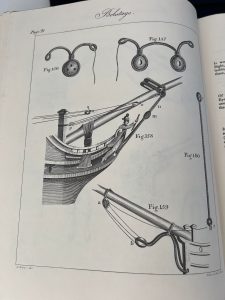
I asked myself: ‘Did you understand everything from this book?’, and the answer was “Hell, no”. The reason is the book contains tones of the specific nautical language. A lot of terms, from the book are forgotten and not used more than 100 years past. But it doesn’t matter. A great number of pictures and drawings inside the book, give us an explanations.

Why this book is so crucial for the shanty singer or shanty enthusiasts?

Well, every time I try to reconstruct some forgotten shanty I have an issue with one thing, imagine himself as a part of the gang heaving or hauling the rope during ship work. And it is not a general issue, I can easily Imagine pulling or pushing activities. There is a huge difference between when imagination is filled with imagining where this halyard ends you can Imagine a sailor shouting the yard “All Clear” from the yard, and you know what he did to be prepared for this shout when you know where belaying pins are; and why some old pictures show raise yard by pulling on board of the ship. This book gives you this information.

Conclusion

Well, every time I try to recreate some forgotten shanties; I have a problem with one thing: imagine myself being part of the crew; heaving or hauling the rope while working on the ship. And that’s not a general problem, it’s easy to imagine pulling or pushing. But it’s a huge difference; when a simple hazy image from our imagination; turns into a picture where you can imagine where that halyard ends; you can imagine a sailor screaming “All Clear” from the yard; and you know what he did to prepare to that scream when you know; where the belaying pins are and why in some old photos you can see halyard pulling from the side of the ship and not from the base of the mast. This book contains all of this information.

This book describes knots, rigging, and elements of all complicated machinery that operates sails on tall ships. It tells you how reef mainsail happens, how to install topmast on main masts, and tons of other information. If you buy it your shanty singing will be much less virtual, at least in your head, and definitely, you will be closer to discovering the true spirit of the sea shanties.

Do you want to be more involved?

You can find excellent records of sea shanties here. If you want to discuss this book or share your opinion you can do it in my Facebook forum here, or below post in the comment section.

Related to The Young Sea Officer’s

Glyn Davies – Cerddi Huw Puw (1922)

Bjorn Landstrom – The Ship (1961)

Cicely Fox Smith – Sea Songs and Ballads 1917 – 1922 (1930)

Glyn Davies – Cerddi Huw Puw (1922)

Glyn Davies – Cerddi Huw Puw (1922)

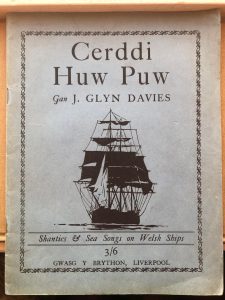
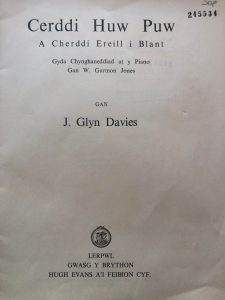
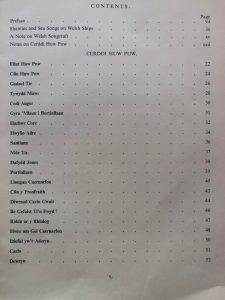
Glyn Davies – Cerddi Huw Puw (1922), is one of the books known by myself when I could see the shanties and sea songs in the Welsh language. The Welsh language (really unique), is used in one of the countries of the land of the United Kingdom. It has a very different accent and vocabulary than the English language.

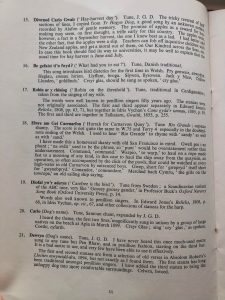
The book is an experiment for an author’s children. Experiment to increase the popularity of the Welsh language by singing in Welsh schools. Speaking of the authenticity of the songs you can find in the collection, the tunes have been taken at random: Old Welsh and Old English melodies. Also, shanties and sea songs were picked up on Welsh ships. Some thirty years before the book was printed (around 1890). Some of the tunes were made up by an author, some just for an author’s amusement. Overall the book is very unique. I didn’t see any references to other collectors’ books to this one, which can be good or bad.

Do you want to be more involved?

You can find excellent records of sea shanties here. If you want to discuss this book or share your opinion you can do it in my Facebook forum here, or below post in the comment section.

Related to the Cerddi Huw Puw

Joanna Colcord – Songs Of American Sailormen (1938)

R. W. Saar & Gilbert Forsyth – Twelve Sailors Songs or Chanteys v1 (1927)

R. W. Saar & Gilbert Forsyth – Twelve Sailors Songs or Chanteys v2 (1927)

Joanna Colcord – Songs Of American Sailormen (1938)

Joanna Colcord – Songs Of American Sailormen (1938)

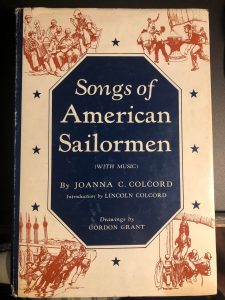
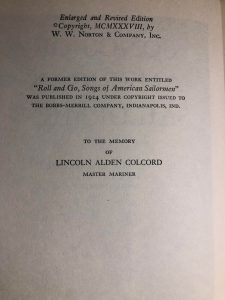
Songs Of American Sailormen (1938) by Joanna Carver Colcord is a cornerstone of the American heritage of the sea shanties. The author herself was born at sea. The father of an author Lincoln Colcord was a captain of a merchant fleet ship for over two decades. The edition from 1938 is an enlarged and revised book from 1924.
The author of the book “Songs of American Sailormen”; describes a huge amount of shanties not only from the musical point of view; but also from the side of the work for which the described shanties were used. Joanna C Colcord’s book is, next to William Doerflinger’s “Shantymen and Shantyboys” and the works of Frederick Pease Harlow; the most important authentic source of shanties and information on shanties.
An interesting fact for Polish fans of shanties is that Joanna C Colchord’s books; were one of the main source texts of the works of one of the two most popular shanty bands; “Cztery Refy”. According to the story of Simon Spalding; in the 1980s, at the request of Jerzy Rogacki; Simon Spalding, using a photocopier (Xero); copied the work of Joanna C Colcord at the Mystic Seaport Museum; one for Jerzy Rogacki and the other for himself. Jerzy Rogacki received a parcel from “America”, containing a valuable photocopy of this wonderful book.

Do you want to be more involved?

You can find excellent records of sea shanties here. If you want to discuss this book or share your opinion you can do it in my Facebook forum here, or below post in the comment section.

Related to the Songs Of American Sailormen

R. W. Saar & Gilbert Forsyth – Twelve Sailors Songs or Chanteys v1 (1927)

R. W. Saar & Gilbert Forsyth – Twelve Sailors Songs or Chanteys v2 (1927)

John Ashton – Real sailor songs (1891)

R. W. Saar & Gilbert Forsyth – Twelve Sailors Songs or Chanteys v2 (1927)

R. W. Saar & Gilbert Forsyth – Twelve Sailors Songs or Chanteys v2 (1927)

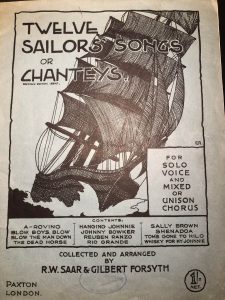
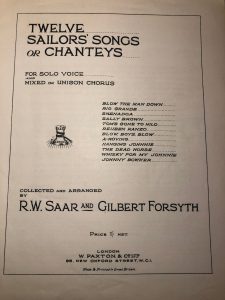
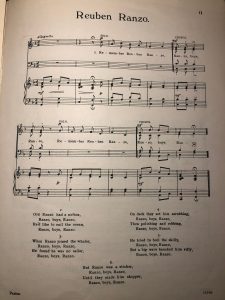
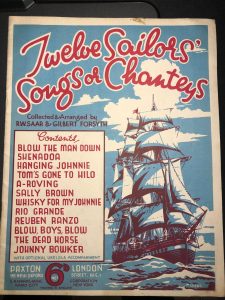
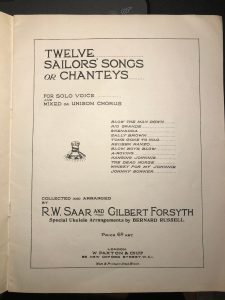
R. W. Saar & Gilbert Forsyth – Twelve Sailors Songs or Chanteys v2 is a collection of twelve shanties; very famous. The book gives us a full range and a selection of rhythms from various types of sea shanties. However, according to the author, who says in the preface, it is worth noting that the songs have been textually and melodically adapted to the stage, so for people looking for original lyrics, this is not a good place.

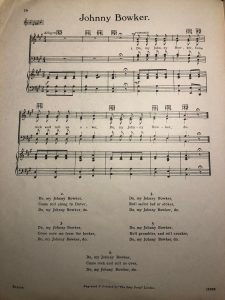
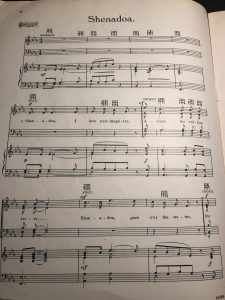
As important; it should be mentioned that; in addition to the notation; all songs have chords for the ukulele (in a nice simple form of a neck sketch; with marked places where you should press the strings.

Another note for Polish fans: the book contains the song “Blow, Boys, Blow!” it has a melody almost identical to the beautiful song “Brzegi Congo River”; by Janusz Sikorski (an author of the Polish text); one of the members of the band Stare Dzwony. If you follow the f “My Library” – posts on my Fan Page; you probably have a deja-vu; so the description is the same as in the previous item with the same title, except for the cover, the items differ in that in this edition you will find samples of two songs at the end of the book, which is not in the previous position, so now at least you know that you don’t have to get in both positions.

Do you want to be more involved?

You can find excellent records of sea shanties here. If you want to discuss this book or share your opinion you can do it in my Facebook forum here, or below post in the comment section.

Related to the Twelve Sailors Songs or Chanteys v2

Joanna Colcord – Songs Of American Sailormen (1938)

Glyn Davies – Cerddi Huw Puw (1922)

R. W. Saar & Gilbert Forsyth – Twelve Sailors Songs or Chanteys v1 (1927)

R. W. Saar & Gilbert Forsyth – Twelve Sailors Songs or Chanteys v1 (1927)

R. W. Saar & Gilbert Forsyth – Twelve Sailors Songs or Chanteys v1 (1927)

R. W. Saar & Gilbert Forsyth – Twelve Sailors Songs or Chanteys v1 (1927) is a collection of twelve shanties. A good selection of very famous sea shanties. The book gives us a full range and a selection of rhythms from various types of sea shanties. However, according to the author, who says in the preface, it is worth noting that the songs have been textually and melodically adapted to the stage, so for people looking for original lyrics, this is not a good place.

As important, it should be mentioned that, in addition to the notation, all songs have chords for the ukulele (in a nice simple form of a neck sketch with marked places where you should press the strings. Another note for Polish fans: the book contains the song “Blow, Boys, Blow!” it has a melody almost identical to the beautiful song “Brzegi Congo River” by Janusz Sikorski (an author of the Polish text), one of the members of the band Stare Dzwony.

Do you want to be more involved?

You can find excellent records of sea shanties here. If you want to discuss this book or share your opinion you can do it in my Facebook forum here, or below post in the comment section.

Related to the Twelve Sailors Songs or Chanteys v1

John Ashton – Real sailor songs (1891)

W. G. Whittaker – Blow the wind southerly (1921)

Jim Mageean – Heave Away (2020)

John Ashton – Real Sailor Songs (1891)

John Ashton – Real Sailor Songs (1891)

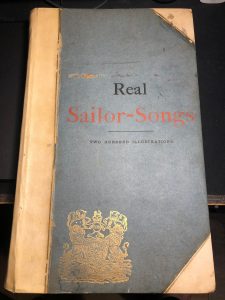
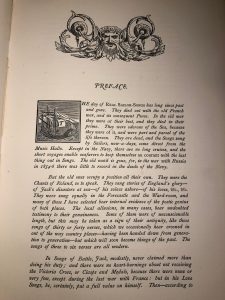
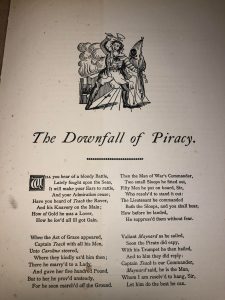
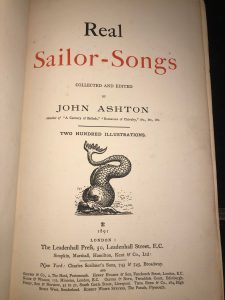
The book is a collection of nautical songs and poems, collected by John Ashton. With two hundred woodcut illustrations throughout. Including Sea Fight, Press-gang, Disaster, Ashore, and Love songs. It also contains poems entitled The Battle of Trafalgar, Bold Napier, The Lady’s Love for a Sailor, and many more. This book is a masterpiece for many reasons, the first being a collection of songs, which cannot be found anywhere but in this book.

The earliest source of some of the songs.

Another reason is that in this book we find the first or one of the earliest versions of the song “Flash Frigates” which is the original of the beautiful song “La Pique” and later “Dreadnought”. This song is significant for Polish fans of sea songs. It is because it is the parent of a wonderful song, sung by the group Cztery Refy “Lśniąca Fregata”.

The last reason is the amazingly beautiful, its huge size (it is the largest book in my collection!), Woodcut illustrations, and the fact that the same top-quality paper and printing method were used as used for printing broadsides. The whole thing is so spectacular that the cheapest online copy of this book costs £ 220, I highly recommend it. Of course, as always, for those interested in particular songs, contact me and I can provide photos of the song you are looking for.

Do you want to be more involved?

You can find excellent records of sea shanties here. If you want to discuss this book or share your opinion you can do it in my Facebook forum here, or below post in the comment section.

Related to the Real Sailor Songs

W. G. Whittaker – Blow the wind southerly (1921)

Joanna Colcord – Roll And Go – Songs of American Sailormen (1924)

Frederick J Davis; Ferris Tozer – Sailors’ songs or “chanties” (3rd Edition) – (1906)

W. G. Whittaker – Blow the wind southerly (1921)

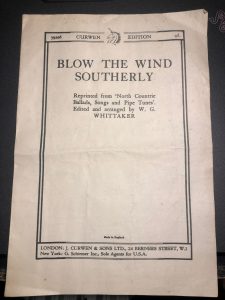
Blow The Wind Southerly – Reprinted by W. G. Whittaker (1921).

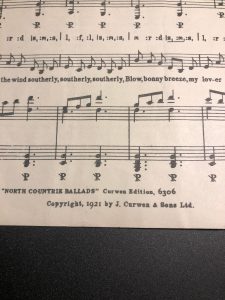
Here is a single track release “Blow The Wind Southerly” a reprint of this beautiful song from the book “North Countrie Ballads, Songs and Pipe Tunes”, edited and arranged by W. G. Whittaker. I reached this position through Stan Hugill, who mentioned the origins of “The Fishes”, in his book, on page 197 of the first edition (1961). Stan Hugill says that this is the original from which the sea shanties of the same title were made.

As we know, this song is undoubtedly a song by Scottish fishermen. The origin is of course much older. Jim Mageean told me that, It’s a Tyneside song from where He lived, the first time this song appeared in print was in The Bishoprick Garland (Cuthbert Sharp 1834), and the Northumbrian Minstrelsy ( Bruce & Stokoe 1887), then in Songs and Ballads of Northern England (John Stokoe 1892).

Do you want to be more involved?

You can find excellent records of sea shanties here. If you want to discuss this book or share your opinion you can do it in my Facebook forum here, or below post in the comment section.

Related to the Blow The Wind Southerly

Frederick J Davis; Ferris Tozer – Sailors’ songs or “chanties” (3rd Edition) – (1906)

Joanna Colcord – Roll And Go – Songs of American Sailormen (1924)

John Sampson – The Seven Seas Shanty Book (1927)

Joanna Colcord – Roll And Go – Songs of American Sailormen (1924)

Joanna Colcord – Roll And Go – Songs of American Sailormen

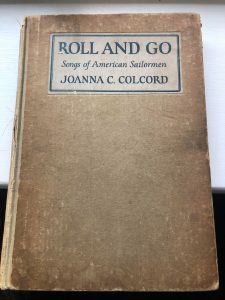
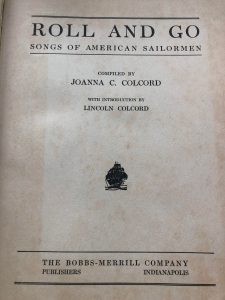
The book by Joanna Colcord – Roll And Go – Songs of American Sailormen is a cornerstone of the American heritage of the sea shanties. The author herself was born at sea. Her father Lincoln Colcord was a captain of a merchant fleet ship for over two decades. Joanna Colcord describes a huge amount of shanties not only from the musical point of view but also from the side of the work for which the shanties were used.

Colcord’s book is, next to William Doerflinger’s “Shantymen and Shantyboys” and the works of Frederick Pease Harlow, the most important authentic source of shanties and information on shanties.
An interesting fact for Polish fans of shanties is that Joanna Colcord’s book was one of the main source texts of the works, of one of the two most popular shanty bands in Poland: “Cztery Refy”. According to the story of Simon Spalding, in the 1980s, at the request of Jerzy Rogacki, Simon Spalding, using a photocopier (Xero), copied the work of Joanna C Colcord at the Mystic Seaport Museum, one for Jerzy Rogacki and the other for himself. Jerzy Rogacki received a parcel from “America”, containing a valuable photocopy of this wonderful book.

Do you want to be more involved?

You can find excellent records of sea shanties here. If you want to discuss this book or share your opinion you can do it in my Facebook forum here, or below post in the comment section.

Related to the Roll And Go – Songs of American Sailormen

The Atlantic Monthly – July (1858)

Robert C. Leslie – A Waterbiography (1894)

Jerzy Wadowski – Piesni Spod żagli (1989)

Frederick J Davis; Ferris Tozer – Sailors’ songs or “chanties” (3rd edition 1906)

Frederick J Davis; Ferris Tozer – Sailors’ songs or “chanties” (3rd edition 1906)

There is hardly any collection of sea shanties that would not mention Sailors’ songs or “chanties” (3rd edition 1906) as a real source of shanties. Through Joanne C. Colcord, Stan Hugill, and many others, everyone respects this source, and the source is truly wonderful. If any of you are planning to gain this phenomenal position, please be careful, because of the earlier editions, the fewer shanties. So the first edition contains twenty-some sea shanties, and the third edition fifty. One of the main advantages of this collection is a sufficiently large number of stanzas for each song.
Note about the edition, why even bother? Well, the first edition of the Sailors’ Songs or “chanties” (3rd Edition) contains 24 sea shanties, the second 40, and the 3rd one 50, so there is a huge difference in the amount of the content.

Do you want to be more involved?

You can find excellent records of sea shanties here. If you want to discuss this book or share your opinion you can do it in my Facebook forum here, or below post in the comment section.

Related to the Sailors’ songs or “chanties”

John Sampson – The Seven Seas Shanty Book (1927)

Richard Runciman Terry – The Shanty Book Part 2 (1926)

The Atlantic Monthly – July (1858)