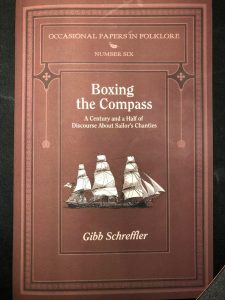
Gibb Schreffler – Boxing The Compass (2018)

Gibb Schreffler – Boxing The Compass

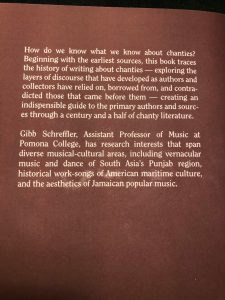
I have already read a few books on shanties, and the life and work of Tars from the period when the sails dominated seas and oceans. Each of the items I read brings something to my knowledge; but I must admit that this time; I was really positively surprised by the Gibb Schreffler’s – Boxing The Compass.

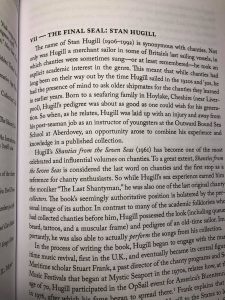
Although the author, Gibb Schreffler; surprised me more than once; I will only mention that he was the first (channel name on YT: Hultonclint); to do the almost impossible: he recorded on YouTube all the shanties and forebitters from Stan Hugill’s work – “Shanties From the Seven Seas” ( well, maybe almost all of them; but of course, it’s just a matter of approach; whether each version of the shanty from this book can be treated separately). His articles helps me a lot, and really extended my knowledge, which he publishes on the world’s largest forum of folk music; “Mudcat Caffe” (on the Mudcat Caffe forum, uses the nick Gibb Sahib). In addition, he is a musicologist lecturer, closely associated with the Mystic Seaport Museum.

his book, as I have already mentioned, surprises with its professionalism

This book, as I have already mentioned, surprises with its professionalism, is a great scientific compendium, showing the activity over the centuries concerning, finding, acquiring, shanties collection, and describes each source perfectly, showing its influence, but also the approach to the subject of individual collectors, I try to show the value of each of these works, in an academic manner. There are little guesswork and a lot of reliable and proven information on the subject.

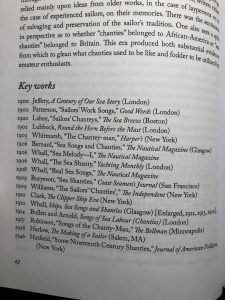
This book is enriched; by a huge list of source texts; which are a great place for the list of the greatest works dealing with shanties. One more note, this book does not contain shanties, but contains the knowledge about people and works describing shanties, does not even describe the shanties themselves “per sé”. For all shanties enthusiasts who wish to have a general view of the history of shanties learning, this is a must-have position.

Do you want to be more involved?

You can find excellent records of sea shanties here. If you want to discuss this book or share your opinion you can do it in my Facebook forum here, or below post in the comment section.

Related to Gibb Schreffler – “Boxing the Compass”

The Atlantic Monthly – July (1858)

Robert C. Leslie – A Waterbiography (1894)

Stan Hugill – Shanties and Sailors’ Songs (1969)

Blow The Wind Wester. – Second Version

Interesting Facts about the Blow The Wind Wester. – Second Version

According to Stan Hugill, both versions of the “Blow The Wind Wester.” song, recorded and documented by Cecil Sharp in the “Journal of the Folk-Song Society” (No 18 from January 1914) was a shanty sang at capstan and at the pumps. This version was Sung by Mrs. L. Hoper, Hambridge, Somerset, April 4th, 1904.

The song will be reconstructed by myself as the capstan shanty.

The source of this sea shanty

The music: “Journal of the Folk-Song Society” (No 18 from January 1914).

The lyrics:  “Shanties from the Seven Seas” by Stan Hugill (1st ed p 197).

The Record of the Blow The Wind Wester. – Second Version

You also can find this record on my YouTube channel here or directly listen below. Additionally, if you want to share your opinion about the record or share your opinion you can do it in my Facebook forum here, or leave a comment at the bottom of this blog article.

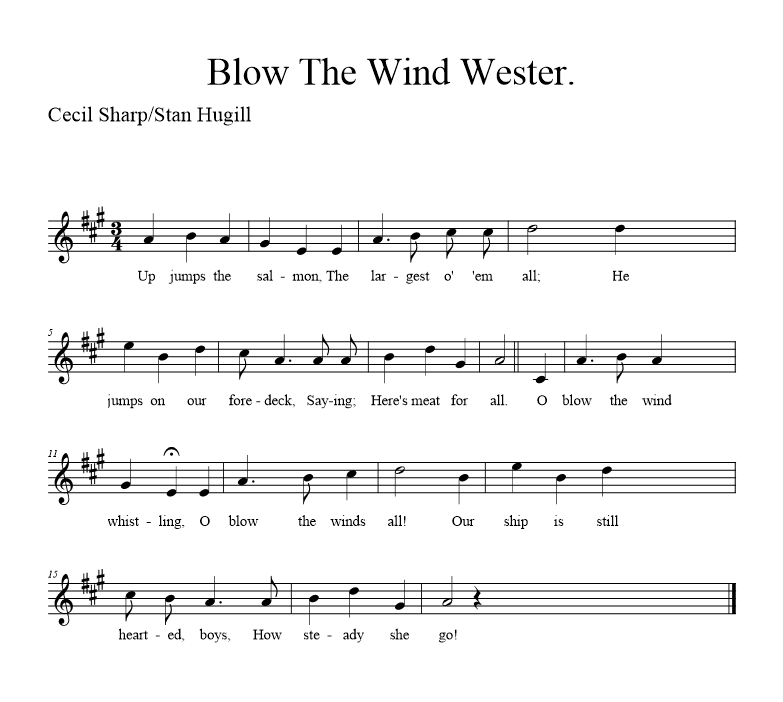
The musical notation
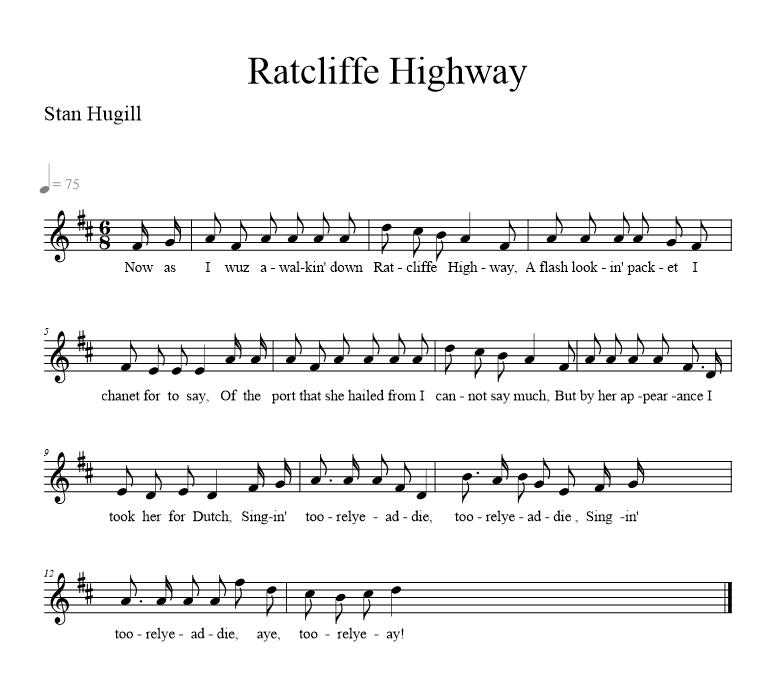
Blow The Wind Wester. - Second Version - music notation

The full lyrics

Blow The Wind Wester. (Second Version)

Up jumps the salmon,
The largest o’ ’em all;
He jumps on our fore-deck,
Say-ing; Here’s meat for all.

– O blow the wind whistling, O blow the winds all!
– Our ship is still hearted, boys, How steady she go!

* 2 *

Up jumps the shark,
The largest of all;
He jumps on our fore-deck:
You should die all!

* 3 *

Then up jumps the sprat,
The smallest of all ;
He jumps on our fore-deck,
Saying: We shall be drowned all!

Related to this sea shanty

Rio Grande – Norvegian sailor version

Opsang For Brasiliefareren, Briggen Preciosa (Norwegian)

Sacramento (A)

Blow The Wind Wester. – First Version

Interesting Facts about Blow The Wind Wester. (First Version)

According to Stan Hugill, both version of the “Blow The Wind Wester.” song, recorded and documented by Cecil Sharp in the “Journal of the Folk-Song Society” (No 18 from January 1914) was a shanty sang at capstan and at the pumps. This version was Sung by Mr. Wm. Woolley (aged 84), Bincombe, Somerset, January 6th, 1908.

The song will be reconstructed by myself as the capstan shanty.

The source of this sea shanty

The music: “Journal of the Folk-Song Society” (No 18 from January 1914).

The lyrics:  “Shanties from the Seven Seas” by Stan Hugill (1st ed p 197).

The Record of the Blow The Wind Wester. – First Version

You also can find this record on my YouTube channel here or directly listen below. Additionally, if you want to share your opinion about the record or share your opinion you can do it in my Facebook forum here, or leave a comment at the bottom of this blog article.

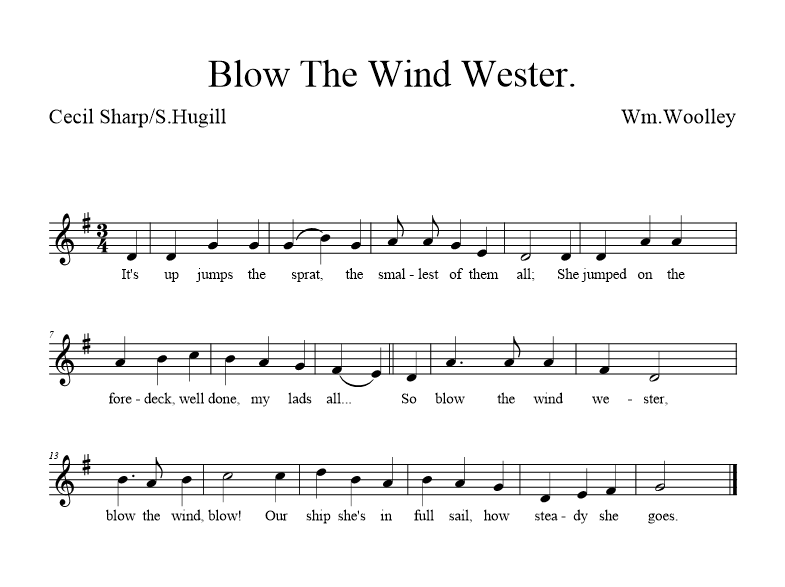
The musical notation

Blow The Wind Wester. - First Version - music notation

The full lyrics

Blow The Wind Wester. (First Version)

It’s up jumps the sprat, the smallest of them all;
She jumped on the foredeck, well done, my lads all…

– So blow the wind wester, blow the wind, blow!
– Our ship she’s in full sail, how steady she goes.

* 2 *

Then up jumps the eel, with his slippery tail;
He jumped on the fore deck and glistened the sail.

* 3 *

Then up jumps the nirl-log, with his pretty spots;
He jumped on the fore deck and looked on the top.

* 4 *

Then up jumps the nirl-log, with his rolling teeth;
He said: “Mr. Captain, shall I cook your beef? “

* 5 *

Then up jumps the roter, the king of the sea;
He jumped on the fore deck and turned the key.

Related to this sea shanty

Rio Grande (F)

Bound for the Rio Grande (R. R. Terry’s Version)

Rio Grande (A. Connan Doyle version)

Blow The Wind Southerly – Shore Song

Interesting Facts about Blow The Wind Southerly

The melody and text of the Blow The Wind Southerly, which you will hear in my reconstruction, were taken from the earliest source I can achieve W. G. Whittaker’s “Blow The WInds Southetly” (1921 by J.Curwen & Sons Ltd.), but the origin, of course, is much older and some part of this song was first in print in the Sharp, Cuthbert, ed. (1834) “The bishoprick garland, or A collection of legends, songs, ballads, &c. belonging to the county of Durham”. This song generally is called “The Fishes”, it is the origin of the shanty under the same title. What we know about it this song is undoubtedly a Scottish fishermen’s song.

The song will be reconstructed by myself as the shore song.

The source of this sea shanty

The music: “Blow The WInds Southetly” by W. G. Whittaker (1921 by J.Curwen & Sons Ltd.).

The lyrics:  “Blow The WInds Southetly” by W. G. Whittaker (1921 by J.Curwen & Sons Ltd.).

Mentioned in: “Shanties from the Seven Seas” by Stan Hugill (1st ed p 197).

The Record of the Blow The Wind Southerly

You also can find this record on my YouTube channel here or directly listen below. Additionally, if you want to share your opinion about the record or share your opinion you can do it in my Facebook forum here, or leave a comment at the bottom of this blog article.

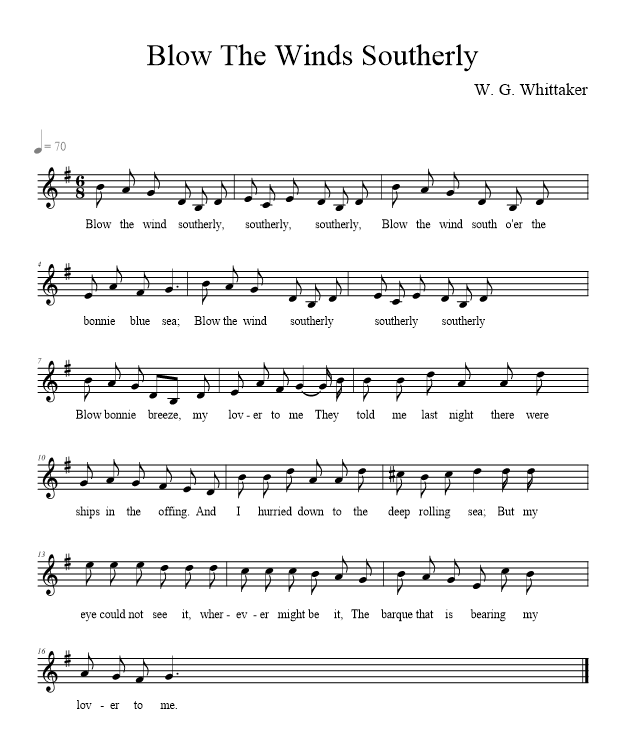
The musical notation

Blow The Wind Southerly -music notation

The full lyrics

Blow The Wind Southerly

Blow-the wind southerly, southerly, southerly,
Blow
the wind south o’er the bonnie blue sea;
Blow-the wind southerly southerly southerly
Blow bonnie breeze, my lover to me

They told me last night there were ships in the offing.
And I hurried down to the deep rolling sea;
But my eye could not see it, wherever might be it
The barque that is bearing my lover to me.

* 2 *

Blo.w the wind southerly, southerly, southerly
Blow the wind south, that my lover may come;
Blo
.w the wind southerly southerly southerly,
Blow bonnie breeze, and bring him safe home.

I stood by the lighthouse the last time we parted,
Till darkness came down o’er the deep rolling sea!
And no longer I saw the bright bark of my lover–
Blow bonnie ‘breeze, and ‘bring him to me.

* 3 *

Blo.w the wind southerly, southerly, southerly
Blow the wind south, that my lover may come;
Blo
.w the wind southerly southerly southerly,
Blow bonnie ‘breeze, and ‘bring him to me.

Is it not ‘sweet to ‘hear the breeze singing,
As lightly it comes o’er the deep rolling sea?
But sweeter and dearer by far when ’tis bringing
The bark of my true love in safety to me.

Related to this song

The Wild Miz-Zou-Rye (Alan Lomax) -River Song

Hieland Laddie (B) – stevedores chant

The Powder Monkey – Shore Sea-Song

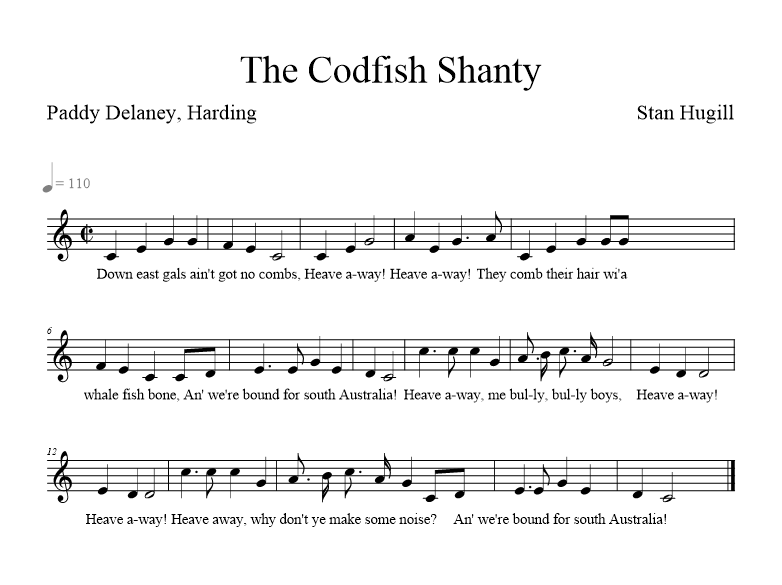
The Codfish Shanty

Interesting Facts about The Codfish Shanty

One another version of the very popular capstan shanty “South Australia” is a version called “The Codfish Shanty”, and it’s due to on account of the prominence of the codfish in this shanty. The following version is got by Stan Hugill from his shipmate shantymen Harding (American version), and Paddy Delaney old-timer who told Stan Hugill about British alternatives.

The song will be reconstructed by myself as the capstan shanty.

The source of this sea shanty

The music: “Shanties from the Seven Seas” by Stan Hugill (1st ed p 196).

The lyrics:  “Shanties from the Seven Seas” by Stan Hugill (1st ed p 196).

The Record of The Codfish Shanty

You also can find this record on my YouTube channel here or directly listen below. Additionally, if you want to share your opinion about the record or share your opinion you can do it in my Facebook forum here, or leave a comment at the bottom of this blog article.

The musical notation

The Codfish Shanty - music notation

The full lyrics

The Codfish Shanty

Down east gals ain’t got no combs,
– Heave away! Heave away!
They comb their hair wi’a whale fish bone,
– An’ we’re bound for south Australia!

– Heave-away, me bully, bully boys,
– Heave-away! Heave away!
– Heave away, why don’t ye make some noise?
– An’ we’re bound for South Australia!

* 2 *

Yankee gals don’t sleep on beds,
They go to sleep on codfish’s heads,

* 3 *

Cape Cod gals have got big feet,
Codfish’s rows is nice an’ sweet.

* 4 *

Quaker gals don’t wear no frills,
They’re tight an’ skinny as a halibut’s gills.

* 5 *

Glou’ster gals make damn fine cooks,
They’re good at catching sprats on hooks.

* 6 *

Nantucket gals are very fine,
They know how to bait a codfish line.

Related to this sea shanty

Round The Bay Of Mexico

Rio Grande (D)

Rio Grande (E)

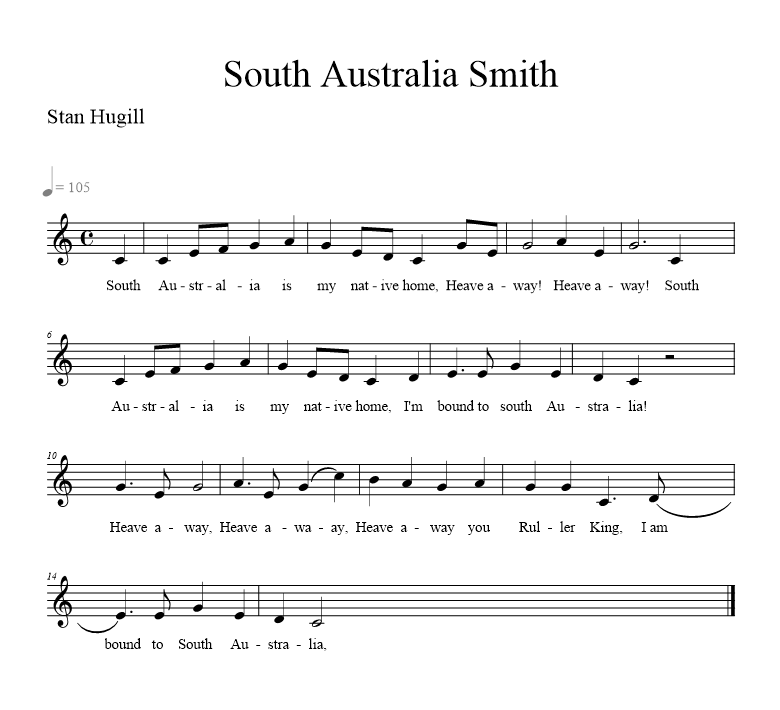
South Australia – L. A. Smith Version

Interesting Facts about the South Australia – L. A. Smith Version

South Australia – L. A. Smith Version”, is usually sung at capstan (anchor) and pumps. This version comes from L. A. Smith’s “Music Of The Waters” (1888), Stan Hugill claims South Australia – L. A. Smith Version is too sentimental and “Shore-ified” to ring genuine, also he says L. A. Smith makes too much use of the word “main”, word sailors never used for “sea”.

The song will be reconstructed by myself as the capstan shanty.

The source of this sea shanty

The music: “The Music of The Waters” by Laura Alexandrine Smith (1888) (1st ed p 49, 50).

The lyrics:  “The Music of The Waters” by Laura Alexandrine Smith (1888) (1st ed p 49, 50).

Mentioned in: “Shanties from the Seven Seas” by Stan Hugill (1st ed p 195).

The Record of South Australia – L. A. SmithVersion

You also can find this record on my YouTube channel here or directly listen below. Additionally, if you want to share your opinion about the record or share your opinion you can do it in my Facebook forum here, or leave a comment at the bottom of this blog article.

The musical notation

South Australia - L. A. Smith  Version - music notation

The full lyrics

South Australia (L. A. Smith Version)

– Heave away, Heave away,
– Heave away, you Ruler King,
– I am bound to South Australia,

* 1 *

South Australia is my native home,
Heave away! Heave away!
South Australia is my native home,
I’m bound to south Australia!

– Heave away, Heave away,
– Heave away, you Ruler King,
– I am bound to South Australia,

* 2 *

There ain’t but the one thing grieves my mind,
To leave my dear wife and child behind.

* 3 *

I see my wife standing on the quay,
The tears do start as she waves to me.

* 4 *

When I am on a foreign shore,
I’ll think of the wife that I adore.

* 5 *

Those crosses you see at the bottom of the lines,
Are only to put me in mind.

* 6 *

As I was standing on the pier,
A fair young maid to me appeared.

* 7 *

As I am standing on a foreign shore,
I’ll drink to girl that I adore.

* 8 *

For I’ll tell you the truth, and I’ll tell you no lie,
If I don’t love that girl I hope I may die.

* 9 *

Liza Lee, she promised me,
When I retured she would marry me.

* 10 *

And now I am on a foreign strand,
With a glass of whisky in my hand,

* 11 *

And I’ll drink a glass to the foreign shore,
And one to the girl that I adore.

* 12 *

When I am homeward bound again,
My name I’ll publish on the main.

* 13 *

With a good captain and a jolly crew,
A good captain and chief mate, too,

* 14 *

Now fare thee well, fare thee well,
For sweet news to my girl I’ll tell.

Related to this sea shanty

The Lowlands Low (A)

The Lowlands Low (B)

Santiana D (Norwegian)

South Australia (Doerflinger Version)

Interesting Facts about the South Australia (Doerflinger Version)

South Australia (Doerflinger Version) was a shanty; it was usually been sung; by the sailors on board the merchant ships; at the capstan (anchor) and pumps. South Australia was probably, created by the emigrant days; when thousands traveled by sailing ship to Semaphore Roads, Port Adelaide, South Australia. Here version from William Main Doerflinger’s book “Shantymen And Shantyboys” (1951). In the Doerflinger’s book; we also can meet another forgotten shantyman for a list of great shantymen from who William Doerflinger has this song: William Laurie of Sailors’ Snug Harbor.
Unfortunately, Doerflinger recorded only one stanza of this beautiful version.

The song will be reconstructed by myself as the capstan shanty.

The source of this sea shanty

The music: “Shanties from the Seven Seas” by Stan Hugill (1st ed p 195).

The lyrics:  “Shanties from the Seven Seas” by Stan Hugill (1st ed p 195).

The Record of South Australia (Doerflinger Version)

You also can find this record on my YouTube channel here or directly listen below. Additionally, if you want to share your opinion about the record or share your opinion you can do it in my Facebook forum here, or leave a comment at the bottom of this blog article.

The musical notation

South Australia (Doerflinger Version) - music notation

The full lyrics

South Australia. (Doerflinger Version)

Oh, in South Australia where I was born,
– Heave away! Haul away!
In South Australia round Cape Horn,
– I’m – bound; for south Australia!

– Heave away, you Ruler King
– Heave away! Haul away!
– Heave away, don’t you hear me sing?
– We’re bound; for South Australia!

Related to this sea shanty

South Australia (Harlow version)

The Gals O’ Chile

Larry Marr

South Australia (Harlow version)

Interesting Facts about South Australia (Harlow version)

“South Australia (Harlow version)”, is usually sung at capstan (anchor) and pumps. This shanty had a rather poor regulation pattern and all shantymen had to improvise to make it see the job through. This version mentioned by Stan Hugill comes from Frederick Pease Harlow’s “The Making of a Sailor” (1928). According to Harlows shipmate, this version was sung as anchor shanty on the very famous clipper ship Thermopylae. A couple of words about Harlow’s shantyman, I know usually shantymen were anonymous artists, they turned sailors’ life for better, and also made jobs easier by using shanties, this time we don’t know a surname but at least we know the name of the Harlow’s, so we can call him a Shantyman Dave.
Stan Hugill gives us only the original lyrics from “The Making of a Sailor”, but he forgot about the melody, so I took it myself from Harlow’s book.

The song will be reconstructed by myself as the capstan shanty.

The source of this sea shanty

The music: “The Making of a Sailor” by Frederick Pease Harlow (1928).

The lyrics:  “Shanties from the Seven Seas” by Stan Hugill (1st ed p 194, 195).

The Record of South Australia (Harlow version)

You also can find this record on my YouTube channel here or directly listen below. Additionally, if you want to share your opinion about the record or share your opinion you can do it in my Facebook forum here, or leave a comment at the bottom of this blog article.

The musical notation

South Australia (Harlow version) - music notation

The full lyrics

South Australia (Harlow version)

South Australia is my native land,
– Heave away! Heave away!
Mountains rich in quartz and sand,
– I am bound for south Australia!

– He-ave away! Heave away!
– He
ave away, you Ruler King
– I am bound for South Australia!

* 2 *

Gold and wool, brings ships to our shore,
And our coal will load many more.

* 3 *

Here’s a packet anchored off the pier,
There’s a bar ashore with foaming beer.

* 4 *

Heave! Oh heave! and we’ll all go ashore,
Where we will drink with girls galore.

* 5 *

Glasses filled, we’ll touch with a clink,
Heave! bullies, heave! the girls want a drink.

* 6 *

I see Julia, standing on the quay,
With a dame for you and me.

* 7 *

At the head of Sandridge Raiload pier,
Straight to Mother Shilling’s we’ll steer.

* 8 *

Julia slings the sheoak at the bar
And welcomes sailors from afar.

* 9 *

In the dance hall there you’ll pick your girl
With golden hair and teeth of pearl.

* 10 *

She will drink you while at the bar,
And call you, “Dear, my own Jack Tar.”

* 11 *

She’ll waltz you round in a dizzy dance,
While you’re half drunk and in a trance.

* 12 *

Then we’ll drink to Mother Shilling’s name,
And drink again to the lovely dame.

* 13 *

In the arms of girls we’ll dance and sing,
For sheoak will be Ruler King.

* 14 *

Drunk! For sheoak’s gone to our head,
The girls can put us all to bed.

Related to this sea shanty

Magelhan (Orginal)

Mother Carey’s

Rolling King

Rolling King

Interesting Facts about the Rolling King

“Rolling King” sometimes called “South Australia”, is usually sung at capstan (anchor) and pumps. This shanty was probably born on the emigrant days when thousands traveled by sailing ship to Semaphore Roads, Port Adelaide, South Australia. We can find this song in the most significant shanty collections books such as L. A. Smith, Miss Colcord, or William Doerflinger.

The song will be reconstructed by myself as the capstan shanty.

The source of this sea shanty

The music: “Shanties from the Seven Seas” by Stan Hugill (1st ed p 193).

The lyrics:  “Shanties from the Seven Seas” by Stan Hugill (1st ed p 193).

The Record of the Rolling King

You also can find this record on my YouTube channel here or directly listen below. Additionally, if you want to share your opinion about the record or share your opinion you can do it in my Facebook forum here, or leave a comment at the bottom of this blog article.

The musical notation

Rolling King - music notation

The full lyrics

Rolling King

South Australia is me home,
– Heave away! Heave away!
South Australia is me home,
– An’ we’re bound for south Australia!

– He-ave away! Heave away!
– He-ave away you Rolling King
– An’ we’re bound for south Australia!

* 2 *

My wife is stadin’ on the quay,
The tears do start as she waves to me,

* 3 *

An’ when I’m on a foreign shore,
I’ll think o’ me darlin’ that I adore.

* 4 *

There ain’t but one thing grieves me mind,
To leave my wife an’ child bechind.

* 5 *

There ain’t but one thing grieves me
An’ that’s me wife an’ dear ba-bee.

* 6 *

An’ as I stand on a foreign shore,
I’ll drink to the wife that I adore.

* 7 *

Now I’m on a foreign strand,
With a glass o’ pisco in me hand.

* 8 *

I’ll drink a glass to my own shore,
I’ll drink to the gal that I adore.

* 9 *

I’ll tell ye now, it ain’t no lie,
I’ll love that gal until I die.

* 10 *

This cross ye see at the bottom of the line,
Is only to keep ye in my mind.

* 11 *

Now we’re homeward bound again,
I’ll soon be seeing Sarah Jane.

* 12 *

Oh, fare-ye-well, now fare-ye-well,
Oh, fare-ye-well, I wish ye well.

Related to this sea shanty

Rolling Home A

Rolling Home B

Magelhan

Mother Carey’s

Interesting Facts about the Mother Carey’s

Mother Carey’s, is just a small piece that survived from this beautiful capstan shanty, Stan Hugill tells us one of his friends, Scot called Macmillan, a man holding a master’s square-rig ticket, sang to Stan Hugill piece of the shanty. The shanty is related to tune to the British “Rolling Home”. Unfortunately only survived the one verse and chorus, exactly as much as the mentioned MacMillan remembered.

The song will be reconstructed by myself as the capstan shanty.

The source of this sea shanty

The music: “Shanties from the Seven Seas” by Stan Hugill (1st ed p 192).

The lyrics:  “Shanties from the Seven Seas” by Stan Hugill (1st ed p 192).

The Record of the Mother Carey’s

You also can find this record on my YouTube channel here or directly listen below. Additionally, if you want to share your opinion about the record or share your opinion you can do it in my Facebook forum here, or leave a comment at the bottom of this blog article.

The musical notation

Mother Carey's - music notation

The full lyrics

Mother Carey’s

The brave west wind it filled our top-s’ls,
an’ bore us outward bound,
Outward bound across the Western,
outward bound for ‘Frisco Town,

– Sheet it home — that, big main tops’l,
– Sheet it home — boys, good an’ true,
– For we’re bound — to Mot-her Carey’s,
– where she feeds — her chicks at sea.

Related to this sea shanty

Shenandoah – Bullen

Goodnight Ladies

Rolling Home By The Silver Moon