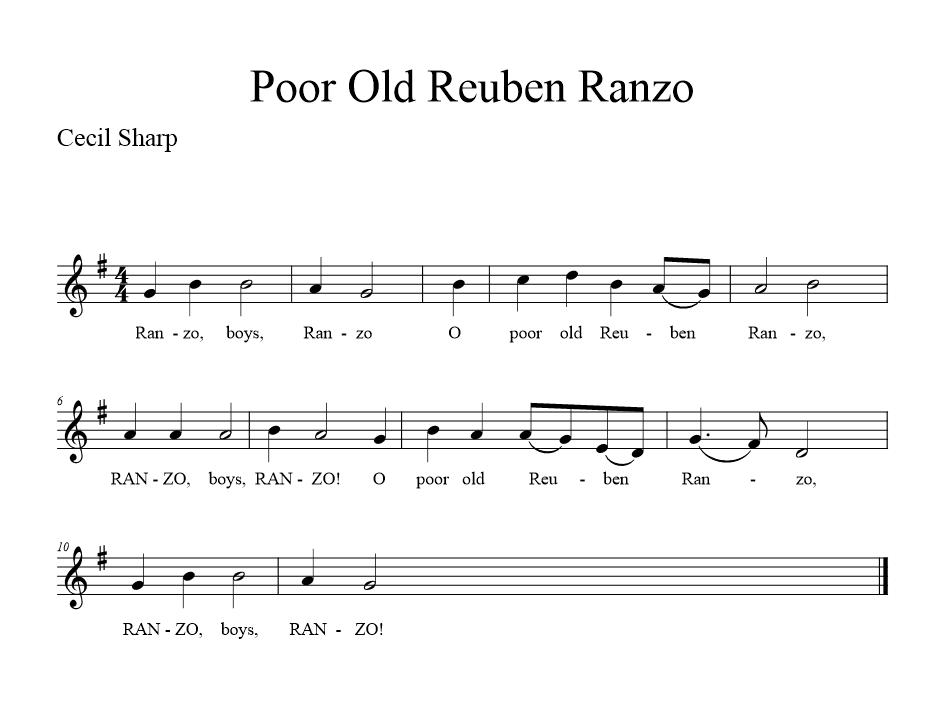
Now, Poor Old Reuben Ranzo is a shanty built around the dirtiest “sailor” who ever shipped – Reuben Ranzo. This Halyard shanty was one of the most rousing of all of the halyard shanties. This shanty due to the some of the themes was very popular amongst whalers. This version comes from Cecil J. Sharp – “English Folk-Chanteys” (1914), is in Sharps’s book in the chapter “Pulling Chanteys” on page 37. Here oryginal comment from Sharp’s book:
No. 32. POOR OLD REUBEN RANZO. Sung by Mr. John Short, at Watchet. This chantey is a very generally known one, and versions of it are to be found in all the chief Collections. Who Reuben Ranzo was no one seems to know ; Mr. Whall suggests that ” Ranzo ” may be a corruption of ” Lorenzo.”
* It is possible that English chanteymen learned the name from Scandinavian sailors, for I am told that Danish sailors often sing about Daniel Rantzau (1529-69), who commanded the Danish forces in the seven-years (or three- crown) war with Sweden (1563-70).
The song will be reconstructed by myself as the halyard shanty.
The source of the Poor Old Reuben Ranzo
The music: “English Folk Chanteys” by Cecil Sharp (1914).
The lyrics: “English Folk Chanteys” by Cecil Sharp (1914).
Mentioned in: “Shanties from the Seven Seas” by Stan Hugill (1st ed p 242).
The Record of the Poor Old Reuben Ranzo
You also can find this record on my YouTube channel here or directly listen below. Additionally, if you want to share your opinion about the record or share your opinion you can do it in my Facebook forum here, or leave a comment at the bottom of this blog article.
The musical notation
The full lyrics
Poor Old Reuben Ranzo. (Cecil Sharp)
O poor old Reuben Ranzo, – RANZO, boys, RANZO! O poor old Reuben Ranzo, – RANZO, boys, RANZO!
* 2 *
O ! Ranzo was no sailor. O ! Ranzo was no sailor.
* 3 *
He shipped on board a whaler. He shipped on board a whaler.
* 4 *
He shipped with Captain Taylor. He shipped with Captain Taylor.
* 5 *
The man that shot the sailor. The man that shot the sailor.
* 6 *
He could not do his duty. He could not do his duty.
* 7 *
He couldn’t boil the coffee. He couldn’t boil the coffee.
* 8 *
The Captain being a good man. The Captain being a good man.
* 9 *
He taught him navigation. He taught him navigation.
* 10 *
We took him to the gratings. We took him to the gratings.
* 11 *
And gave him nine and thirty. And gave him nine and thirty.
* 12 *
O! That was the end of Ranzo. O! That was the end of Ranzo.
Interesting Facts about the Reuben Ranzo II – Doerflinger
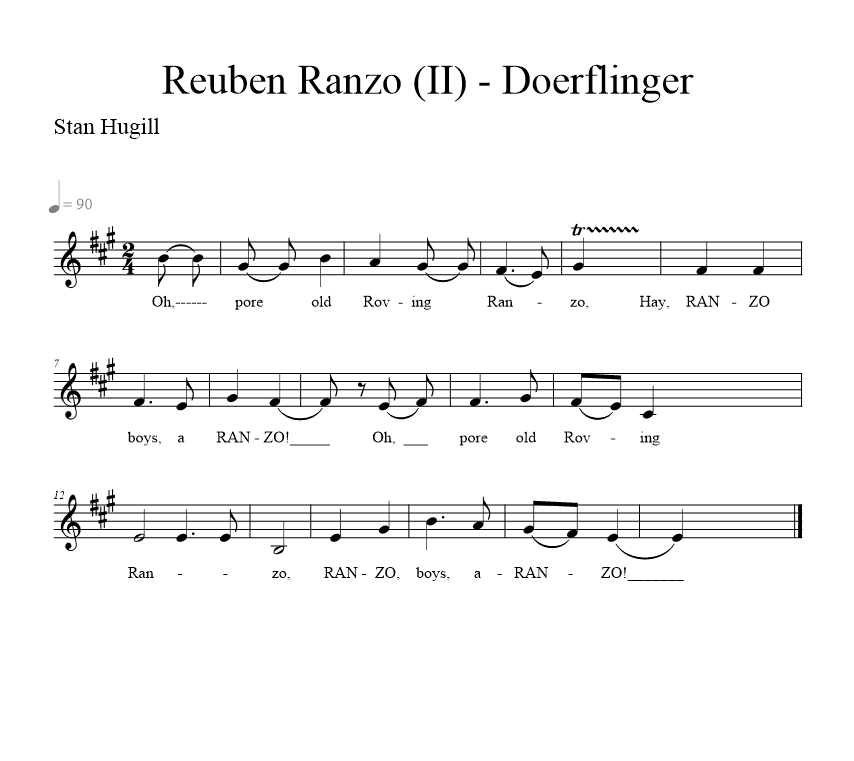
Now, Reuben Ranzo II – Doerflinger is a shanty built around the dirtiest “sailor” who ever shipped – Reuben Ranzo. This Halyard shanty was one of the most rousing of all of the halyard shanties. This shanty due to the some of the themes was very popular amongst whalers. Here is the Doerflinger version, his Shantyman sends him to South Georgia, which Stan Hugill think is an anachronism since Antarctic whaling didn’t commence until between the two World Wars after the South Sea cachalot became nearly extinct and new-fangled whalers began to search for a blue whale. The song that Stan Hugill mentioned is the “Reuben Ranzo (II)” on page 24 of the Doerflingers – “Shantymen And Shantyboys” (1951).
The song will be reconstructed by myself as the halyard shanty.
The source of this sea shanty
The music: “Shantymen And Shantyboys” by William Main Doerflinger (1951).
The lyrics: “Shantymen And Shantyboys” by William Main Doerflinger (1951).
Mentioned in: “Shanties from the Seven Seas” by Stan Hugill (1st ed p 242).
The Record of the Reuben Ranzo II – Doerflinger
You also can find this record on my YouTube channel here or directly listen below. Additionally, if you want to share your opinion about the record or share your opinion you can do it in my Facebook forum here, or leave a comment at the bottom of this blog article.
The musical notation
The full lyrics
Reuben Ranzo (II) – Doerflinger
Oh, pore old Roving Ranzo, – Hay, RANZO, boys, a RANZO! Oh, pore old Roving Ranzo, – RANZO, boys, a RANZO!
* 2 *
Now, Ranzo he was no sailor. Now, Ranzo he was no sailor.
* 3 *
So pore old Roving Ranzo, So pore old Roving Ranzo,
* 4 *
Now they shipped him on board of a whaler! Now they shipped him on board of a whaler!
* 5 *
Now the captain he liked Ranzo. Now the captain he liked Ranzo.
* 6 *
So the captain taugh him how to read and write. So the captain taugh him how to read and write.
* 7 *
He taught him navigation. He taught him navigation.
* 8 *
When he got his first mate’s papers, When he got his first mate’s papers,
* 9 *
He became a terror to whalers! He became a terror to whalers!
* 10 *
He was known all over the world as He was known all over the world as
* 11 *
As the worst old bastard on the seas! As the worst old bastard on the seas!
* 12 *
He would take his ship to Georgiay, He would take his ship to Georgiay,
* 13 *
And there he’d drag for sperm whale. And there he’d drag for sperm whale.
* 14 *
He lost the only ship he had. His first and last and only ship
* 15 *
Was the “Morgan”, and she’s known everywhere. Was the “Morgan”, and she’s known everywhere.
* 16 *
Now, he’s gone to hell and we’re all glad! Now, he’s gone to hell and we’re all glad!
* 17 *
Now, I’ve told you he was no sailor. Now, I’ve told you he was no sailor.
* 18 *
He was a New York tailor. He was a New York tailor.
* 19 *
Whether a tailor or a sailor, Whether a tailor or a sailor,
Interesting Facts about the Reuben Ranzo – Hugills version
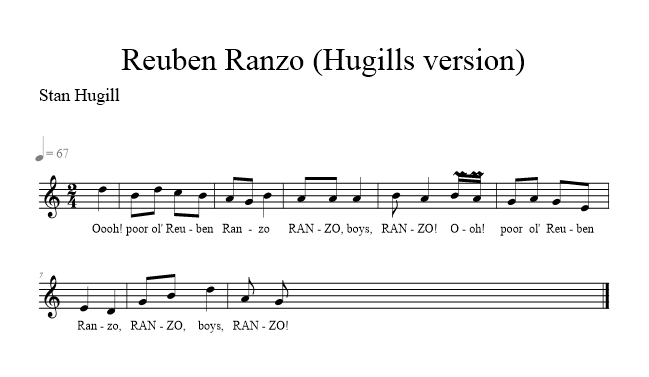
Now, Reuben Ranzo – Hugills version is a shanty built around the dirtiest “sailor” who ever shipped – Reuben Ranzo. This Halyard shanty was one of the most rousing of all of the halyard shanties. This shanty due to the some of the themes was very popular amongst whalers.
An intriguing fact about this song was theories about who it was the Reuben Ranzo, some shanty collectors have different theories about it. So namely were four theories: 1 – He was a native of the Azores, of Portuguese descent, and shipped in a whaler. 2 – He was a famous Danish hero of the sixteen century, a certain Daniel Rantzau. 3 – C. F. Smith claimed it was a Russian or Polish Jew with a name like Ronzoff – his “Christian” name of Reuben would certainly suit the bill. 4 – He was American Latin, a “greenhorn”, hence his first name “Reuben” – “Reub” or “Rube” is still used in the States to mean yokel or farmer. This is the Stan Hugill version it is the combination of the verses given from A. Spencer, ex-American barque “Monongahela” and the Bosun of the “Garthpool”.
The song will be reconstructed by myself as the halyard shanty.
The source of this sea shanty
The music: “Shanties from the Seven Seas” by Stan Hugill (1st ed p 240).
The lyrics: “Shanties from the Seven Seas” by Stan Hugill (1st ed p 240, 241, 242).
The Record of the Reuben Ranzo – Hugills version
You also can find this record on my YouTube channel here or directly listen below. Additionally, if you want to share your opinion about the record or share your opinion you can do it in my Facebook forum here, or leave a comment at the bottom of this blog article.
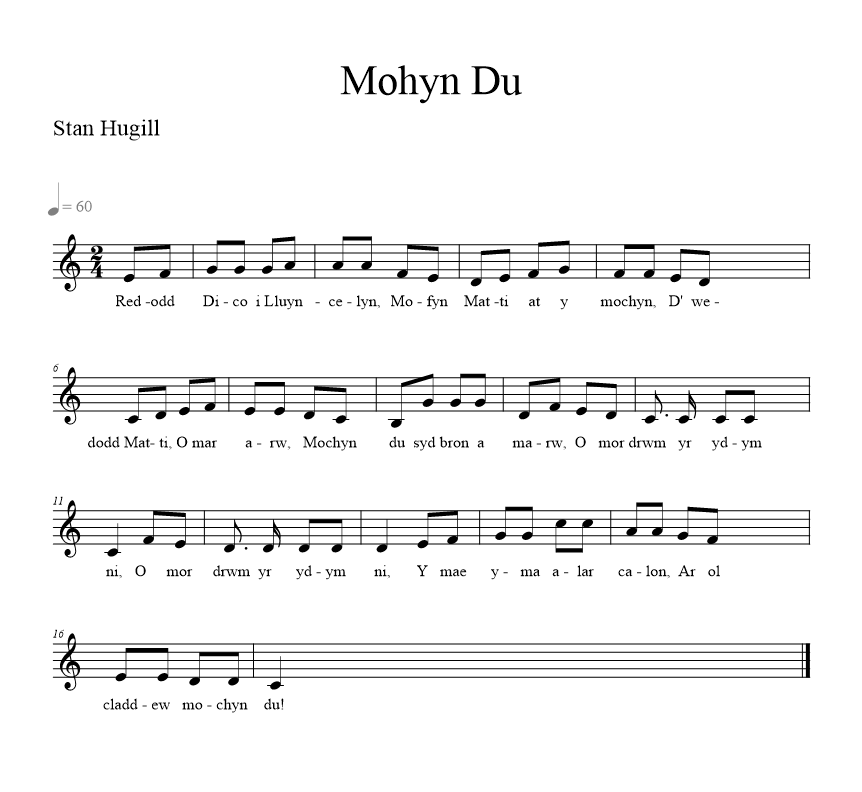
Mochyn Du was probably the most popular capstan shanties among Welsh crews, on the ships hailing in the main from Liverpool. This song is a folk song under another name “The Black Pig”. Stan Hugill obtained these lyrics from H. B. Jones. Stan Hugill also states that were many versions of this song but not all of them were sung at sea.
The song will be reconstructed by myself as the capstan shanty.
The source of this sea shanty
The music: “Shanties from the Seven Seas” by Stan Hugill (1st ed p 238).
The lyrics: “Shanties from the Seven Seas” by Stan Hugill (1st ed p 238).
The Record of the Mochyn Du
You also can find this record on my YouTube channel here or directly listen below. Additionally, if you want to share your opinion about the record or share your opinion you can do it in my Facebook forum here, or leave a comment at the bottom of this blog article.
The musical notation
The full lyrics
Mochyn Du
Redodd Dico i Lluyncelyn, Mofyn Mati at y mochyn, D’wedodd Matti, O mar arw, M0chyn-du syd bron a marw,
– O mor drwm yr ydym ni, – O mor drwm yr ydym ni, – Y mae yma alar calon, – Ar ol claddew m0chyn; du!
* 2 *
Melws iawn yw cael rhew seliscen, O gig mochyn gyda thatan, Ond y awr rhaid gwnaid heb hwnw, M0chyn-du syd wedi marw.
– O mor drwm yr ydym ni, – O mor drwm yr ydym ni, – Y mae yma alar calon, – Ar ol claddew m0chyn; du!
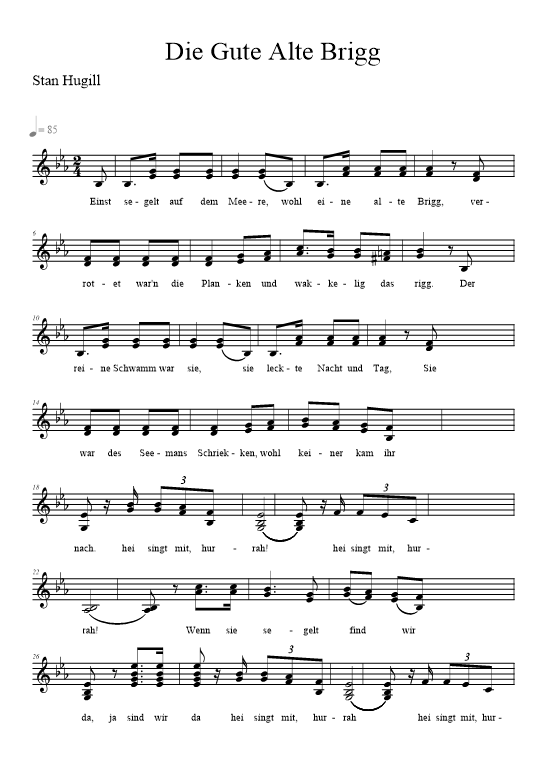
The Den Gamla Bryggen or Svineper was the most popular pumping shanty of all Scandinavian. The original was the Norvegian, but also we can find the German and Swedish versions. Die Gute Alte Brigg is the German version of this shanty Stan Hugill took from Knurrhahn, taken down by Ludvig Dinklage. The footnote reads: ‘Old Scandinavian sailor song, of about 1800; known to many old-time seamen in other languages.’ It is given as a capstan song (gang spill).
An interesting fact about this song is that Stan Hugill gives us only four stanzas in his book, fortunately, I have in my collection Knurrhahn: Seemannslieder und Shanties both tomes, and in the second tome (Zweiter Band), on pages 46, 47, and 48 I did find an original song with eleven (!) stanzas, which is the fair length for capstan (gang-spill), shanty. So here we go I have the chance to reconstruct this shanty in full length.
The song will be reconstructed by myself as the pump shanty.
The source of this sea shanty
The music: “Knurrhahn – Seemannslieder und Shanties” Richard Baltzer; Klaus Prigge; Knurrhahn-Lotsen-Gesangverein (1936) (Zweiter Band, page 46, 47, and 48).
The lyrics: “Shanties from the Seven Seas” by Stan Hugill (1st ed p 235).
The Record of the Die Gute Alte Brigg
You also can find this record on my YouTube channel here or directly listen below. Additionally, if you want to share your opinion about the record or share your opinion you can do it in my Facebook forum here, or leave a comment at the bottom of this blog article.
The musical notation
The full lyrics
Die Gute Alte Brigg
Einst segelt auf dem Meere, wohl eine alte Brigg, verrotet war’n die Planken und wakkelig das Rigg. Der reine Schwamm war sie, sie leckte Nacht und Tag, Sie war des Seemanns Schrekken, wohl keiner kam ihr nach.
– Hei singt mit, hurrah! Hei singt mit, hurrah! – Wenn sie segelt sind wir da, ja sind wir da, – Hei singt mit, hurrah! Hei singt mit, hurrah! – Wenn sie segelt sind wir da, ja sind wir da.
* 2 *
Kein Kompaß, keine Karte war jemals hier an Bord. Wir steuern nach den Möven, die fliegen auch nach Nord, Wir steuern nach den Wellen und nach des Skippers Hut, In Peilung mit dem Großbaum, der Kurs der ist dann gut!
– Hei singt mit, hurrah! Hei singt mit, hurrah! – Denn wir gehen jetzt in See, ja jetzt in See, – Hei singt mit, hurrah! hei singt mit, hurrah! – Denn wir gehen jetzt in See, ja jetzt in See.
* 3 *
Der Smutje war ein Aaskerl, sein kochen nicht weit her, Macht Hammelfleisch vom Haifisch, dazu Stockholmer Teer. Und dann sein Irish Stew stank zehn Meilen gegen Wind, Aus Möwendreck und Ratten einen Pudding er uns bringt.
– Hei singt mit, hurrah! Hei singt mit, hurrah! – Solch Tschau-Tschau ist immer da, ja ist immer da, – Hei singt mit, hurrah! Hei singt mit, hurrah! – Solch Tschau-Tschau ist immer da, ja ist immer da,
* 4 *
Ihr Skipper war ein Witzbold, er steckte voller Spaß, Entweder tanzt er hornpipe od’r singt mit tiefem Bass “Ja ja, sie ist schon alt, ich lieb’ sie ja so sehr, Die Brigg, die ist mein Mädchen, das schönste auf dem Meer!”
– Hei singt mit, hurrah! Hei singt mit, hurrah! – Uns’rer Brigg ein hoch, Vivat!, ja ein hoch, Vivat! – Hei singt mit, hurrah! Hei singt mit, hurrah! – Uns’rer Brigg ein hoch, Vivat!, ja ein hoch, Vivat!
* 5 *
Wir hatten keine Lampen, doch war’s auch so im Lot, Wir nahm’n des Bootsmanns Rüker, der glänzte grün und rot. Und eh’ die Nacht hereinbricht, steht er schon in der Rüst, Ein tiefer Schluck vom Black and White, schon leuchtet seine Nüff.
– Hei singt mit, hurrah! Hei singt mit, hurrah! – Es gibt Whisky jetzt auf See! ja jetzt auf See! – Hei singt mit, hurrah! Hei singt mit, hurrah! – Es gibt Whisky jetzt auf See! ja jetzt auf See!
* 6 *
Und hat der Reeder Wieg’nfest, dann gibt es manchen Jux, Der Smutt kocht uns ‘ne Suppe aus einer alten Bux, Er würzt sie mit ‘n Oelrock, ‘nen Seestiebel dabei, Mit Seegras, Kakerlatjes, das gibt ‘nen feinen Brei.
– Hei singt mit, hurrah! Hei singt mit, hurrah! – Den der Seeman kotzt nach Lee! ja kotzt nach Lee – Hei singt mit, hurrah! Hei singt mit, hurrah! – Den der Seeman kotzt nach Lee! ja kotzt nach Lee
* 7 *
Der Skipper hat ein Herzlieb, das ist so rund und fett, Mit einer Toppnants-Talje wir schnüren ihr korsett. Der Bootsmann singt ‘n Shanty, wir fallen kräftig ein. Ihr Mieder ist aus Segeltuch, ist Bramtuch Nummer neun.
– Hei singt mit, hurrah! Hei singt mit, hurrah! – All uns Tauwark, dat bruukt, Se’! ja dat bruukt, Se’! – Hei singt mit, hurrah! Hei singt mit, hurrah! – All uns Tauwark, dat bruukt, Se’! ja dat bruukt, Se’!
* 8 *
Wir hatten kaum noch Flaggen am Maste aufzuziehn, Da heißten wir das Lorchen, das war rot, gelb und grün. Der Papagei wird wild, er schreit in einem fort “Ich werd den Mast zerschmetten, wenn ich häng’ noch mal dort!”
– Hei singt mit, hurrah! Hei singt mit, hurrah! – ‘s hängen Federn an der Rah, ja an der Rah! – Hei singt mit, hurrah! Hei singt mit, hurrah! – ‘s hängen Federn an der Rah, ja an der Rah!
* 9 *
Der Skipper hat ‘ne Tante, die hat ‘nen schulschen Blick, Sie könnt’ ‘nen Haifisch töten, die Wach’ jagt sie zurück. ‘nen Sturm, den konnt’ sie bannen, das war ihr bestes Tun. Sah er ihr Backbord-Auge, da schwieg selbst Gott Neptun.
– Hei singt mit, hurrah! Hei singt mit, hurrah! – Jetzt setzt’s Prügel hier und da, ja hier und da. – Hei singt mit, hurrah! Hei singt mit, hurrah! – Jetzt setzt’s Prügel hier und da, ja hier und da.
* 10 *
Wir waren kurz an Segeln, da setzten wir ‘n Sack, Den heißten wir in Großtopp, dort schlug er niemals back. Als Ballon bläht er sich im Winde prall und voll, Und alle Möven krächzen: “Sind denn die Kerle toll?”
– Hei singt mit, hurrah! Hei singt mit, hurrah! – Wir gehör’n nicht mehr auf See! nicht mehr auf see! – Hei singt mit, hurrah! Hei singt mit, hurrah! – Wir gehör’n nicht mehr auf See! nicht mehr auf see!
* 11 *
Nun, Jungens, kommt das Ende von uns’rer guten Brigg. Am Holm von Kopenhagen träumt sie von ihrem Glück Mit vielen alten Kähnen lieght sie da Bord an Bord, Für Katzen und für Spazten der schönste Heimatort.
– Hei singt mit, hurrah! Hei singt mit, hurrah! – Viele Strolche gibt’s jetzt da, ja gibt’s jetzt da! – Hei singt mit, hurrah! Hei singt mit, hurrah! – Viele Strolche gibt’s jetzt da, ja gibt’s jetzt da!
(I thank Fred Winkel for correcting my mistakes in copying the text from the original book in Gothic font.)
The Den Gamla Briggen or Svineper was the most popular pumping shanty of all Scandinavian. The original was the Norvegian, but also we can find the German and Swedish versions. This is a Swedish version of this beautiful pump shanty, it comes from “Sang under Segel” (1935), Sigurd Sternwall’s Swedish shanty book. The Swedish version gives us the same story but has a different type of chorus. It is in “broken-down”, i. e. “spoiled” Norvegian according to the notes in Sternval’s book.
Fortunately for me, I have Sigurd’s Sternwall’s book in my collection and I compared Stan Hugill verses with Sternval’s ones, and I discovered that Hugills 4th verse doesn’t appear in Sternwall’s book, which must come from the J. Ingemarsson of Valberg (Shantyman which gives this version to Stan Hugill). Also, the tempo in the original song in music notation is 3/4 in Stan Hugill’s book 2/4. And last comparing value Stan Hugill gives us 8 verses (including a unique one from the J. Ingemarsson of Valberg), and Sternvall gives us 15. The biggest dilemma for me was which version I should reconstruct, the obvious choice was Sigurd Sternvall’s version because his book is much rarer than Hugill’s “Shanties From the Seven Seas”. But because Hugill’s version contains this one completely unique 4th verse I will reconstruct Hugill’s print version.
The song will be reconstructed by myself as the pump shanty.
The source of this sea shanty
The music: “Shanties from the Seven Seas” by Stan Hugill (1st ed p 235).
The lyrics: “Shanties from the Seven Seas” by Stan Hugill (1st ed p 235).
The Record of the Den Gamla Briggen
You also can find this record on my YouTube channel here or directly listen below. Additionally, if you want to share your opinion about the record or share your opinion you can do it in my Facebook forum here, or leave a comment at the bottom of this blog article.
The musical notation
The full lyrics
Den Gamla Briggen
Udi Parmarentha der låg en gammel brigg, Udi Stykker var hans sail, og udsliten var hans rigg, – For ti-di-li, am-tam-ta, For ti-di-li, am-tam-ta! – Vi hurra for den reisen naar vi kom till Langeland.
* 2 *
Foruden hvide lester var han sort som en ravn, Det var en gammel vase, han var kjöbt fra Kjöbenhavn.
* 3 *
En hver ma nu vidden skuden var ej rar, Forthy bogspröjtet var aabrekt det beste som der var.
* 4 *
Vi had ingen klyverbom, vi rigged ud en kolt, Og folket orket ingenting, var udpint og sult.
* 5 *
Gallionen hun laa allt i veien for oss. Hver gang vi skulle have voran klyvare loss.
* 6 *
Og spröjtet den peger i den himmelske sky, Og atten aarhundrede siden den skudden var ny.
* 7 *
Kompass udi sitt nakterhaus, det har hun aldrig haft, Vi stryde efter kullen på en gammel flossehat.
* 8 *
Nakterhuset var vel ett gammelt vejaskul, Og ratten er gjort av ett gamelt rokkehjul.
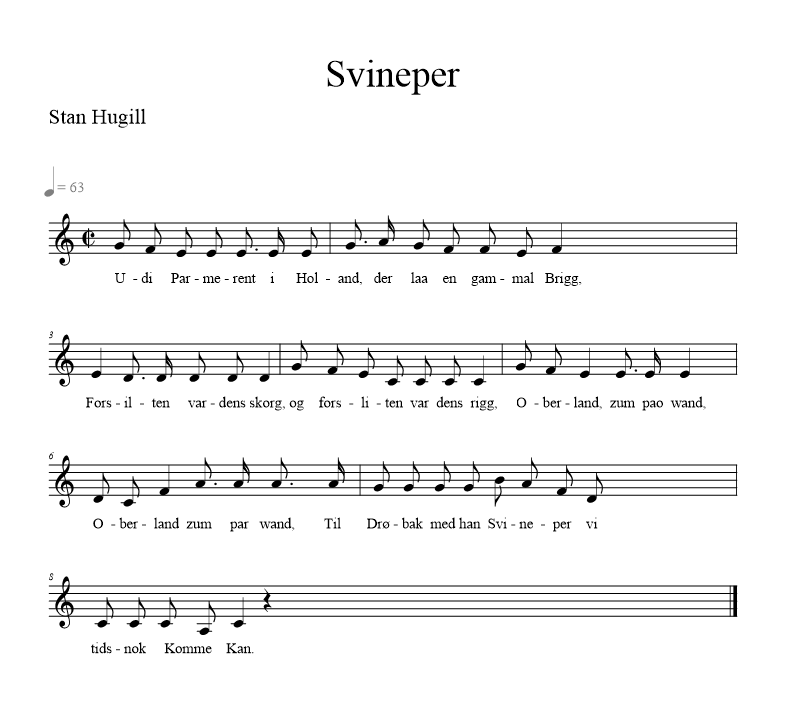
The Dirty Old Pig or Svineper was the most popular pumping shanty of all Scandinavian. The original was the Norvegian, but also we can find the German and Swedish versions. A couple of facts about this song, first Stan Hugill first time heard this song from shantyman Paddy Griffiths. Paddy Griffiths get this song from Norwegian barque. The second version that you can see here is Stan Hugill from “Opsang Fra Seilskibstiden”. But the tune Stan Hugill learned from a Norwegian sailor is called”Big Skan”. A third and most intriguing fact is that choruses are in five different languages. In the Norwegian version, a play on words is very noticeable. There is mention of a “real” pig. But usually, more often the reference is to the skipper – a dirty old hog, i. e. Svineper.
The song will be reconstructed by myself as the pump shanty.
The source of this sea shanty
The music: “Shanties from the Seven Seas” by Stan Hugill (1st ed p 232, 233).
The lyrics: “Shanties from the Seven Seas” by Stan Hugill (1st ed p 232, 233).
The Record of the Svineper
You also can find this record on my YouTube channel here or directly listen below. Additionally, if you want to share your opinion about the record or share your opinion you can do it in my Facebook forum here, or leave a comment at the bottom of this blog article.
The musical notation
The full lyrics
Svineper
Udi Parmerent i Holand, der laa en gammal Brigg, Forsilten vardens skorg, og forsliten var dens rigg, – Oberland, zum pao wand, Oberland zum par wand, – Til Drøbak med han Svineper vi tidsnok Komme Kan.
* 2 *
Det fandtes ikke kompas eller mathaus ved dens ratt, Vi styrte efter pullen i Per Svine’s gamle hatt; – Ober land zum par wand, ober land zum par wand, – Til Drøbak med han Svineper vi tindsnok komme kan.
* 3 *
Kahytten den var umalt, men ruffen der var god, Og Køierne var malte med vaeggelusblod; – Overland som tibrands, overlands som paa vand, – Til Drøbak med den Griseper vi aldrig komme kan.
* 4 *
Skutesiden den ratten og daekket hak i hul, Og ratten bare et gammelt kjaerrehjul; – Overland som paa vand, overland som paa vand, – Til Drøbak med den Grisper vi aldrig komme kan.
* 5 *
Vi matte pumpe laens imellem hvert et glas, Og naar vi gik fra haven, skar vi katten ind til bras; – Gi mig ranson paa vand, gi mig ranson paa vand – Og fire mand i giggen satte Svineper iland.
* 6 *
Vi hadde ikke bramsel, vi heiste op et skjort, Og jamen holdt det godt saalaenge veiret det var tort; – Gi mig ranson paa vand, gi mig ranson paa vand, – Og fire mand giggen satte Svineper iland.
* 7 *
Og baasmanden spytta, han sver og bandte paa, At grastaug til taljerip fik’n aldrig til at staa; – Hive langsomt fra land, hive langsomt fra land, – Der Bergenske møer snart møte nok vi kan.
* 8 *
Og naar vi først var kommet et stykke ut fra land, Drak Svineper mer braendevin end alle mand drakvand; – Hive langsomt fra land, hive langsomt fra land, – De Bergenske møer snart møte nok vi kan.
* 9 *
Det var Søndagsmorra, vi blev purret ut til baut, Men naar vi saa i luka, laa kjølsvinet og flaut; – Kors i Herrans namn, hur det går langsomt från land, – Vi hurra for den resan, när vi kom til Köpenhamn.
* 10 *
Og engang i vekka vi melkevelling fik, Da fik vi suge purka som om paa daekket gik; – Kors i Herrans namn, hur det går langsomt från land, – Vi hurra för den resan, när vi kom til Köpenhamn.
Interesting Facts about Blow Boys Blow (Norwegian)
Blow Boys Blow (Norwegian) is another shanty with the word “Blow” is fine old tops’l halyard shanty “Blow, Boys, Blow”. This was a shanty in which the singer often repeated the solo lines, to string out on a long haul.
This is the Norwegian language version. Explanation below text says: After G. W. Larsen, National Old Sailors Home – Fredriksvern.
The song will be reconstructed by myself as the halyard shanty.
The source of this sea shanty
The music: “Shanties from the Seven Seas” by Stan Hugill (1st ed p 230).
The lyrics: “Shanties from the Seven Seas” by Stan Hugill (1st ed p 230, 231).
The Record of the Blow Boys Blow (Norwegian)
You also can find this record on my YouTube channel here or directly listen below. Additionally, if you want to share your opinion about the record or share your opinion you can do it in my Facebook forum here, or leave a comment at the bottom of this blog article.
The full lyrics
Blow, Boys, Blow (Norwegian)
Paa vaade veie vil vi vandre, – BLOW, boys, BLOW! Vi tager avsked med hverandre, – BLOW, me bully boys, BLOW!
* 2 *
Jeg ser min flamme staar paa pynten, Hun graeter visst, ti slut er mynten.
* 3 *
Til mersefaldet styrmand kalder, Og heis nu klyver, til hun falder.
* 4 *
Hun driver rundt–en maned til roret, Og hiv nu ankret op i sporet!
* 5 *
Hal op i styrbords agterbraser! Vor styrmand flyr nu rundt og maser,
* 6 *
Fra kysten nu saa fint hun langer, Der ser vi Okso fyrtaarn pranger.
* 7 *
Snart har vi Lindesnaes isigte– Nu styrmand maa de peile rigtig!
* 8 *
Det frisker op med bris nordostlig– Hun slinger praegtig–det er kos’lig.
* 9 *
Kaptein roper: Hei du stuert! Slipp nu laerken ut av buret!
* 10 *
Skjaenk i en og la os smake, Et skjont farvel for dem tilbake.
* 11 *
Heis nu seilet hoit paa stangen! Nu er det oppe–slutt med sangen.
Interesting Facts about the Oh Blow Ye Winds I Like To Hear You
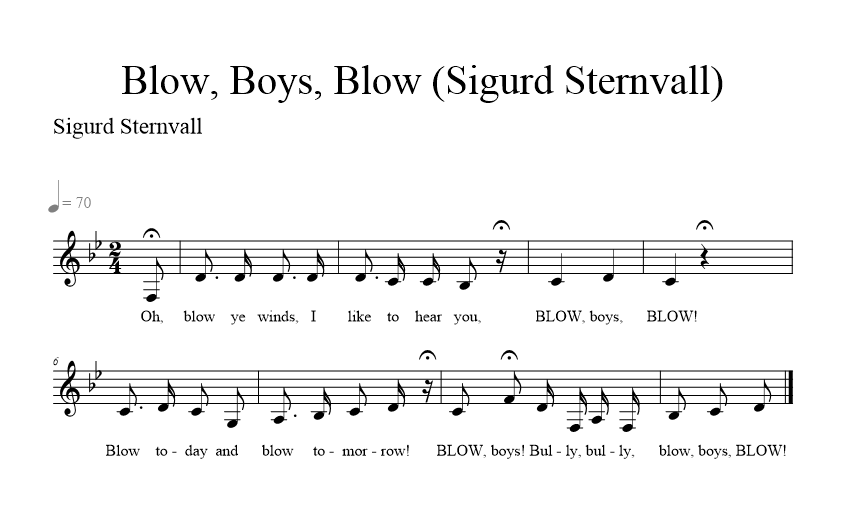
Stan Hugill on page 230 of the “Shanties From The Seven Seas”, mentioned he discovered this version by searching foreign sources. The book Stan Hugil talk about, is the “Sang Under Segel” of the Sigurd Sternvall. The song we can find on page 370 of the source (fortunately this book is a part of my collection of the shanty books). The oryginal comment from Sternvall’s book say: …”The text by sailmaker Gustaf Wiman, Boston, 1909. “Bully “s have the same as mischievous. In English college slang, it also has this meaning. “Belaying pin’s soup” is in Swedish translation nothing more than a good cooking beat.”…
The song will be reconstructed by myself as the halyard shanty.
The source of this sea shanty
The music: “Sang Under Segel” by Sigurd Sternvall (1935).
The lyrics: “Sang Under Segel” by Sigurd Sternvall (1935). This reconstruction will contain full text and music notation from Sigurd Sternvall’s book, and also the title is changed from the original.
Mentioned in: “Shanties from the Seven Seas” by Stan Hugill (1st ed p 230).
The Record of the Oh Blow Ye Winds I Like To Hear You
You also can find this record on my YouTube channel here or directly listen below. Additionally, if you want to share your opinion about the record or share your opinion you can do it in my Facebook forum here, or leave a comment at the bottom of this blog article.
The musical notation
The full lyrics
Oh Blow Ye Winds I Like To Hear You
Oh, blow ye winds, I like to hear you, – BL0W boys BL0W! Blow today and blow tomorrow! – BL0W boys! Bully, bully, BLOW, boys, blow!
* 2 *
A Yankee ship came down the river. Her mast and spars they shine like silver.
* 3 *
How do you know she is a Yankee clipper? By the stars and stripes she flies behind her.
* 4 *
And who do you think is the master of her? One-eyed Kelly, the Bowery runner.
* 5 *
And what do you think they will have for dinner? Belaying pin’s soup and monkeys liver.
Interesting Facts about Blow Boys Blow (odd verses)
I collected from page 229 of Stan Hugill’s book printed odd verses (Blow Boys Blow (odd verses)), they have been used, been sung by shantymen on various decks of sailing ships, so I do not see any reason to forget those verses and leave them unused. This is the reason why I cannot omit them, and I will be over the moon to sing them as a halyard shanty way as previous full versions of this shanty from the book. This was a shanty in which the singer often repeated the solo lines, to string out on a long haul.
The song will be reconstructed by myself as the halyard shanty.
The source of this sea shanty
The music: “Shanties from the Seven Seas” by Stan Hugill (1st ed p 226).
The lyrics: “Shanties from the Seven Seas” by Stan Hugill (1st ed p 228, 229).
The Record of the Blow Boys Blow (odd verses)
You also can find this record on my YouTube channel here or directly listen below. Additionally, if you want to share your opinion about the record or share your opinion you can do it in my Facebook forum here, or leave a comment at the bottom of this blog article.
The full lyrics
Blow Boys Blow (odd verses)
Blow,me boys, an’ blow tergether, – BLOW, boys, BLOW! Blow,me boys for better waether. – BLOW, me bully boys, BLOW!
* 2 *
Blow, boys, blow, the cook’s drawin’ water, A bob for the cook an’ a cheer for his daughter.
* 3 *
She files aloft the stripes an’ stars, She has cotton canvas an’ pitchpine spars.
* 4 *
A yankee ship came down the river, There’s the style to make ye shiver.
* 5 *
Blow, me boys, we’ve come to cheer yer. Blow, me boys, we’ve come to cheer yer.
* 6 *
Another pull, ho, rock an’ shake ‘er. For go she must an’ go we’ll make ‘er.
* 7 *
I though I heard the Old Man say Another pull an’ then belay.
To provide the best experiences, we use technologies like cookies to store and/or access device information. Consenting to these technologies will allow us to process data such as browsing behavior or unique IDs on this site. Not consenting or withdrawing consent, may adversely affect certain features and functions.
Functional
Always active
The technical storage or access is strictly necessary for the legitimate purpose of enabling the use of a specific service explicitly requested by the subscriber or user, or for the sole purpose of carrying out the transmission of a communication over an electronic communications network.
Preferences
The technical storage or access is necessary for the legitimate purpose of storing preferences that are not requested by the subscriber or user.
Statistics
The technical storage or access that is used exclusively for statistical purposes.The technical storage or access that is used exclusively for anonymous statistical purposes. Without a subpoena, voluntary compliance on the part of your Internet Service Provider, or additional records from a third party, information stored or retrieved for this purpose alone cannot usually be used to identify you.
Marketing
The technical storage or access is required to create user profiles to send advertising, or to track the user on a website or across several websites for similar marketing purposes.