Clifford Beckett – Shanties And Forebitters (1914)

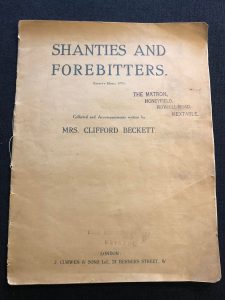
Shanties And Forebitters

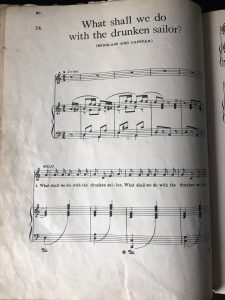
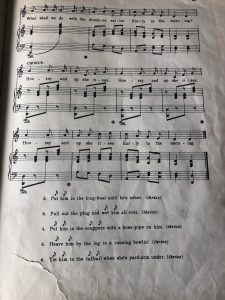
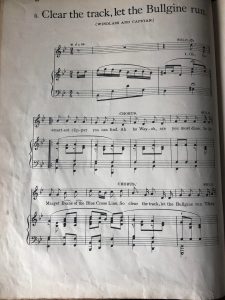
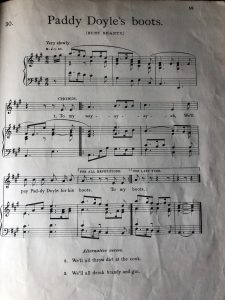
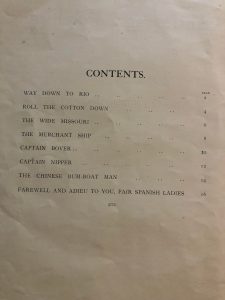
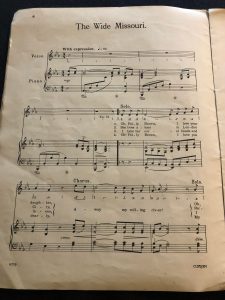
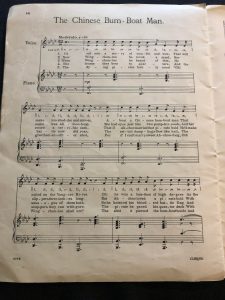
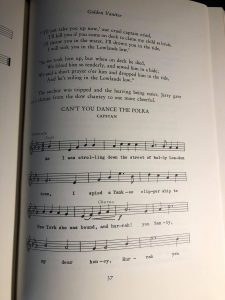
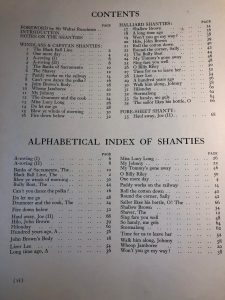
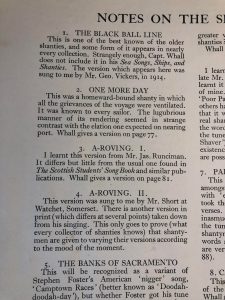
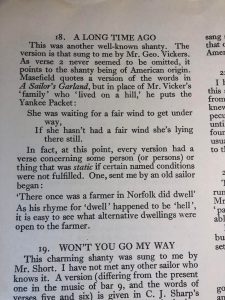
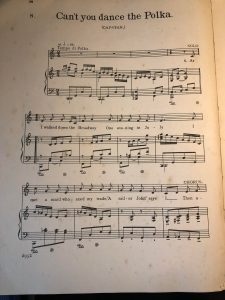
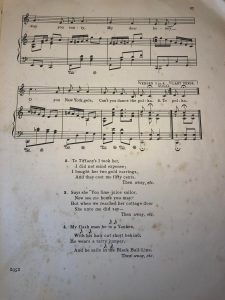
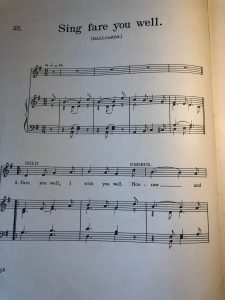
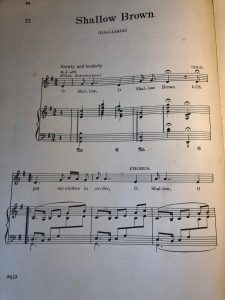
Clifford Beckett – Shanties And Forebitters (1914) is a collection of eight songs. The short introduction contains some interesting information, it is interesting, for example, that some of the sentences from this description sound identical (almost word for word) to the part of the introduction to one of R. R. Terry’s collections, written several years later. Noticeable is that this book is the first place where we can find the word “forebitter”. For Polish fans of shanties and “forebitters”, there are the original lyrics for the song “Chinese Sailor” sung by one of the two most popular shanty bands in Poland, the Stare Dzwony (Old Bells) and also The Pioruners Band.

Do you want to be more involved?

You can find excellent records of sea shanties here. If you want to discuss this book or share your opinion you can do it in my Facebook forum here, or below post in the comment section.

Related to Clifford Beckett – Shanties And Forebitters

Robert C Adams – On Board The Rocket (1879)

S. Taylor Harris – Six Sea Shanties (1925)

Harpers Monthly Magazine (1882)

S. Taylor Harris – Six Sea Shanties (1925)

S. Taylor Harris – Six Sea Shanties

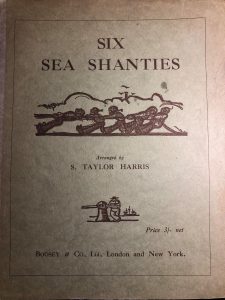
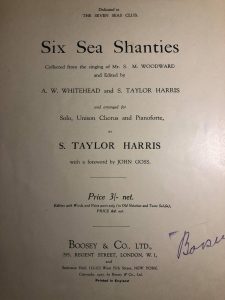
The full name of this book is: “Six Sea Shanties music / collected from the singing of SM Woodward and edited by AW Whitehead and S. Taylor Harris; and arranged for solo, unison chorus and pianoforte by S. Taylor Harris; with a foreword by John Goss “. It’s amazing how much we can learn from even the title, of this very rare and hard-to-get position. So we have the name of the shantymen, Mr. S. M. Woodward, the author, and the type of instrument for which the score was arranged.
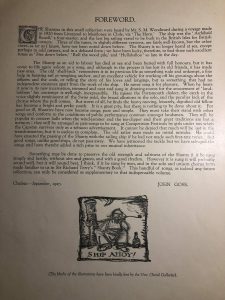
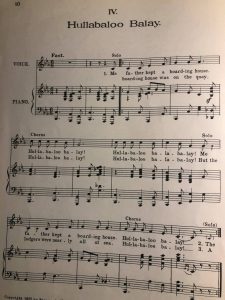
Returning to the item, it contains six sea shanties, along with sheet music.

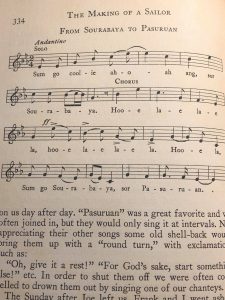
The introduction of Taylor Harris – Six Sea Shanties front page is also full of information that may be useful. It is worth mentioning that this item is (or should be) especially valuable for Polish shanty lovers, because here for the first time appeared in print, a well-known and popular shanty “hullabaloo-balay”, Polish title ” halabaluby lej “. The copy I bought, was the last copy available in the entire virtual world.

Do you want to be more involved?

You can find excellent records of sea shanties here. If you want to discuss this book or share your opinion you can do it in my Facebook forum here, or below post in the comment section.

Related to the Six Sea Shanties

Gibb Schreffler – Boxing The Compass (2018)

The Chamber Journal (1869)

Richard Terry – Shanties With Descants (1921)

Robert C Adams – On Board The Rocket (1879)

Robert C Adams – On Board The Rocket

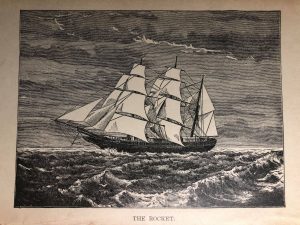
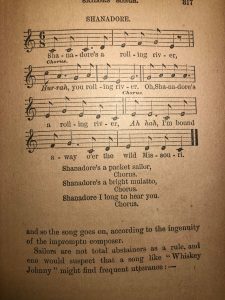
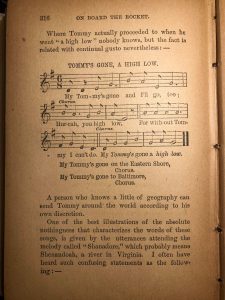
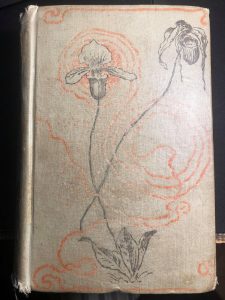
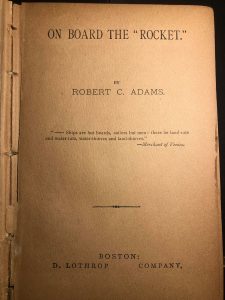
Robert C. Adams – On Board, The Rocket is precious for shanty lovers, aside from the great description of real life on a sailing ship, from an officer’s perspective. It contains one of the oldest collections of shanties. Robert C. Adams – On Board is the “must have” for anyone who wants to seriously gain real knowledge about life on board, and shanties. One of the curiosities is the text of the sea shanties “Tommy’s Gone To Hilo” This book is proof that the word “Hilo” is out of the question, and the original title is “Tommy’s Gone, A High Low”.

Do you want to be more involved?

You can find excellent records of sea shanties here. If you want to discuss this book or share your opinion you can do it in my Facebook forum here, or below post in the comment section.

Related to Robert C. Adams – On Board The Rocket

Frederick Pease Harlow – Chanteying Aboard American Ships (1962)

Halina Stefanowska – Rozspiewane Morze (1975)

Jim Mageean – Sail Away (2021)

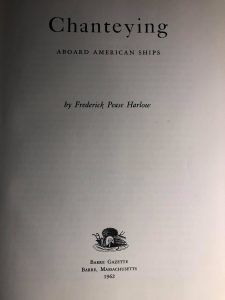
Frederick Pease Harlow – Chanteying Aboard American Ships (1962)

Big thanks, to my mentor, teacher, and friend from the United States, Simon Spalding.

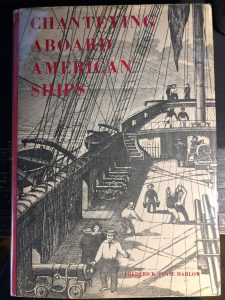
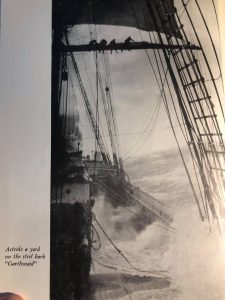
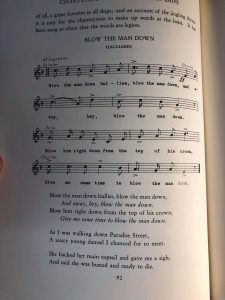
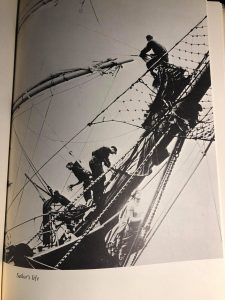
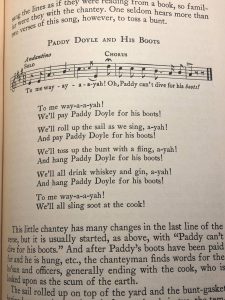
For recommending and introducing me to Frederick Pease Harlow – Chanteying Aboard American Ships. This book is a real treasure for lovers of sea shanties and the times of ironmen on wooden ships. I also wish to recommend reading another Harlow book: “The Making Of A Sailor”. Both complement each other very well. The first “The Making Of A Sailor” describes works where shanties were used. The second “Chanting on American Ships”, is more like a collection of them.

Finally, it is worth adding that many of the greatest shanties singers point to both Harlow’s books. They are one of the main sources of their repertoire and knowledge about sea shanties. Simon Spalding talks about his book “My Secret Weapon”. A few sea shanties from this book Simon Spalding sang on the album “Round The Capstan”, recorded with the Polish shanty band Cztery Refy. Cztery Refy and Stare Dzwony are the leading bands singing traditional shanties in Poland.

Do you want to be more involved?

You can find excellent records of sea shanties here. If you want to discuss this book or share your opinion you can do it in my Facebook forum here, or below post in the comment section.

Related to Chanteying Aboard American Ships

Frederick Pease Harlow – The making of a sailor (1928)

Bjorn Landstrom – The Ship (1961)

Cicely Fox Smith – Sea Songs and Ballads 1917 – 1922 (1930)

Frederick Pease Harlow – The making of a sailor (1928)

Frederick Pease Harlow – The making of a sailor

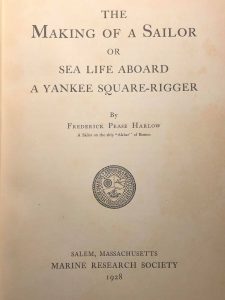
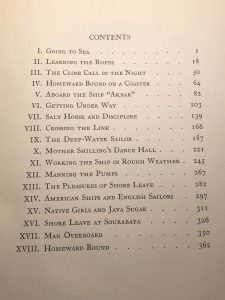
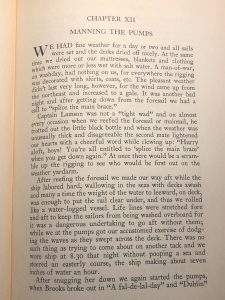
First, I would like to thank my mentor, teacher, and (I dare to say it publicly for the first time) my friend, from the United States, Simon Spalding for recommending and introducing me to Frederick Harlow who wrote this great work. This book is a real treasure for shanty enthusiasts and the times of ironmen on wooden ships. You can put this book in the same row with such works as “The Merchant Vessel” by Nordhoff. or Richard Dana’s “Two Years Before Mast”.

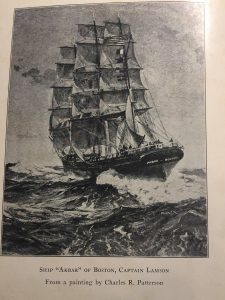
This is simply a sailor’s diary, detailing the life of a sailor, with shanties intertwined in the plot. Real descriptions of the deep sea sailor profession, his life on the sea and onshore. This book is best read together with Frederick Harlow’s second book “Chanteying Aboard American Ships”. Both complement each other perfectly. The first describes works where shanties were used, and the second is a huge collection of them. Finally, it is worth adding that many of the greatest shanty singers point to both Harlow’s books as one of the main sources of their repertoire and knowledge about shanties.

Do you want to be more involved?

You can find excellent records of sea shanties here. If you want to discuss this book or share your opinion you can do it in my Facebook forum here, or below post in the comment section.

Related to The making of a sailor

Harpers Monthly Magazine (1882)

Jerzy Wadowski – Piesni Spod żagli (1989)

Jim Mageean – Heave Away (2020)

Harpers Monthly Magazine (1882)

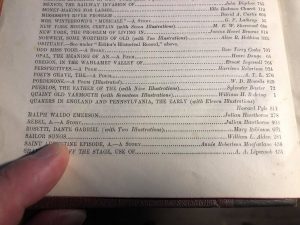
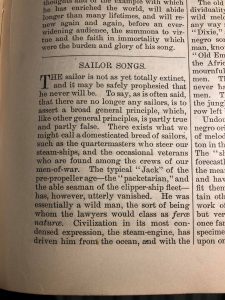
Sailor Songs – William L. Alden

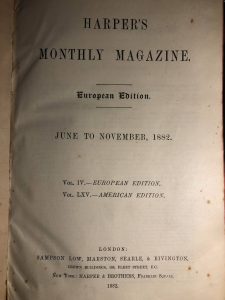
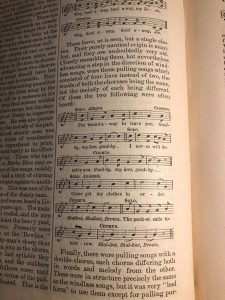
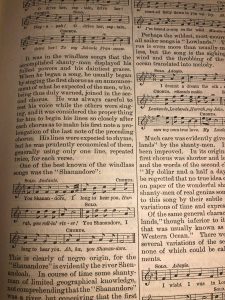
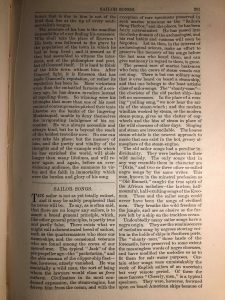
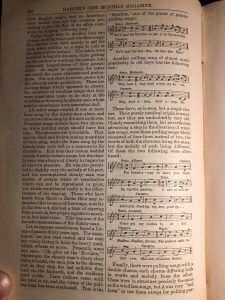
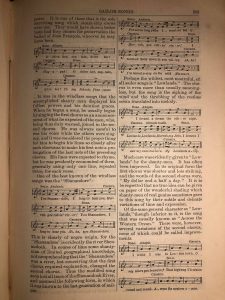
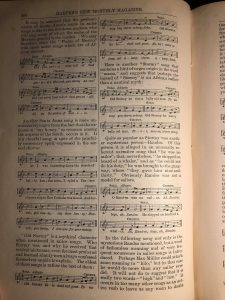
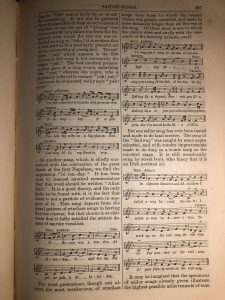
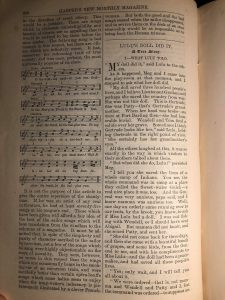
In the Harper’s Monthly Magazine from June to November 1882, we can find a spectacular collection of sea shanties. Interestingly enough is the fact that an author talking about the sailors says that the typical “Jack” of the pre-propeller age – the “packeterian”; and the able saman of the clipper-ship fleet – has, however, utterly varnished”, in an article from 1882! Whatever we can think, we need to understand how misunderstood and underestimated the importance of the sources, is and how priceless it is to read shanty collections like this one.

This is essential to preserve the authentic character of those songs. This is one of the earliest collections containing musical notations of the shanties covering around twenty shanties. “Bowline”, “Haul away Joe”, “Good-by My love goodbye”, and much more, we can find in this article. Very close to the original, printed, about 80 years before Stan Hugill’s “Shanties From The Seven Seas”. For all maritime and merchant fleet culture lovers, and most importantly for shanty enthusiasts, this article screams to be read. If anyone wants to read this article and does not have access, please contact me through Messenger, and I will be happy to share images of the whole article.

Do you want to be more involved?

You can find excellent records of sea shanties here. If you want to discuss this book or share your opinion you can do it in my Facebook forum here, or below post in the comment section.

Related to Harpers Monthly Magazine (1882) – Sailor Songs

Richard Terry – Shanties With Descants (1921)
Jerzy Wadowski – Piesni Spod żagli (1989)

Robert C. Leslie – A Waterbiography (1894)

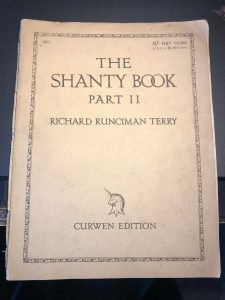
Richard Runciman Terry – Shanties With Descants (1921)
Richard Runciman Terry – Shanties With Descants – Grand Hall Shanty revival

“Shanties with Descants” – Shanties collected and arranged by SIR RICHARD TERRY. Descants written by MAURICE JACOBSON – set 1(date of publication unknown to me).
Here is the publication, one of the many published during the so-called “Grand Hall shanty revival”, when tenors in beautiful tuxedos and choirs of classical music singers played scenes from “ship decks” on the stages of theaters, where the shantymen sang and the choir sailors in perfect harmony, answered in the chorus. The period of this revival falls in the second and third decades of the 20th century.

In the publication, we find five real deep-sea sailor shanties. The music in the arrangement has a full music notation written for two voices and a pianoforte, each song has a really good number of stanzas. It is worth noting that this is one of the two parts of this publication, unfortunately, I haven’t got the second one yet, so if someone has information on where to get, and buy, or someone has the second part and would like to make a gift for my collection, please contact me.

Do you want to be more involved?

You can find excellent records of sea shanties here. If you want to discuss this book or share your opinion you can do it in my Facebook forum here, or below post in the comment section.

Related to Shanties With Descants

The Chamber Journal (1869)

Michael Watson – The Powder Monkey (1885)

Simon Spalding – Food At Sea (2014)

The Chamber Journal (1869)

“Sailors’ Shanties And Sea-Songs” – Chambers Journal, Saturday, December 11, 1869

I must admit that this is one of the most valuable items in my collection of books. There are many reasons why I think so. The first is the date when this wonderful article was published. It was published before the first great collection of shanties by Alexandrine Smith, “The Music of The Waters” (1888). Thus 19 years earlier, it was also a time, when the shanties were truly in the golden age. The second reason is that, even though the content is relatively small, the enormity of the content is overwhelming me. It is important in terms of description of the types of shanties and confirm their usefulness, I highly recommend this article. (For those interested, I will be happy to send you pictures of the entire article).

Do you want to be more involved?

You can find excellent records of sea shanties here. If you want to discuss this book or share your opinion you can do it in my Facebook forum here, or below post in the comment section.

Related to The Chamber Journal (1869)

Simon Spalding – Food At Sea (2014)

Michael Watson – The Powder Monkey (1885)

The Atlantic Monthly – July (1858)

Michael Watson – The Powder Monkey (1885)

Michael Watson – The Powder Monkey

I read about this beautiful song of the sea from Stan Hugill’s greatest book “Shanties from the Seven Seas”. In his book, on page 148 of the first edition, he gives us only the chorus of this song. It seems to be based on the chant of “Donkey Riding”, he did not remember the source or composer of this song. The song according to Stan Hugill’s description points to this song at the time in the 1850s. Unfortunately, in “Shanties from the Seven Seas” we can only find the chorus. Here is the oldest source of this beautiful song I could get.

This is the 59th edition written and composed by Michael Watson “The Powder-Monkey” (An Old Salt’s Story), published by London: Patey & Willis, [n / a]. Interesting information on the cover says that “this song may be sung in public free of charge”. However, two things are most important to me, the first one – is this is the first song in Stan Hugill’s book, which is not a sea shanty or a forebitter, it is a full-blooded “shore sea-song”, two – is the melody of the verses spectacularly changes the whole song, the refrain itself sounds like a sea shanty.

Do you want to be more involved?

You can find excellent records of sea shanties here. If you want to discuss this book or share your opinion you can do it in my Facebook forum here, or below post in the comment section.

Related to The Powder Monkey

Halina Stefanowska – Rozspiewane Morze (1975)

Jim Mageean – Sail Away (2021)
Gibb Schreffler – Boxing The Compass (2018)

Simon Spalding – Food At Sea (2014)

I was incredibly lucky to hear about this book

I was incredibly lucky, that I heard about Simon Spalding’s book – Food At Sea. I am also happy to say that I heard about the existence of this fantastic book from the author himself. Simon Spalding is one of the most famous shantymen. The author is a shanty singer, known not only in Poland but also around the world in the great community of shanty enthusiasts. Simon is a very experienced sailor (his experience was gained mainly on traditional big sail vessels). He is also a musicologist, a multi-instrumentalist, and a historian. We can say renaissance man (basically, he is an American twin of our National Polish Shantyman Marek Szurawski).

Noticable is that he has had the privilege of singing with the most famous shantyman known ever, Stan Hugill. But this is not what this book is about. The book is the largest compendium of knowledge ever published about food in the vessels on the seas and oceans.

What we can find in Simon Spalding – Food At Sea

In the book, the author describes it in the smallest detail. The book tells what types of dishes and food were part of the diet of a sailor, captain, or passenger. Starting from the first centuries, through the glorious period of the War of the great armadas of the Middle Ages. Also, there are chapters about the nineteenth-century diet of merchant seamen. The book not ending there. The next chapters tell about the food on large transatlantic liners to modern ships, including nuclear submarines.

The book is fantastically complemented by a chapter, with real recipes. We can find there the method of preparing the dishes that the author describes in his book. Dishes such as a rat dish or sea biscuits; as well as three ways to prepare grog. All recipes are the recipes used in historically documented moments in the history of the Navy. A little bit more about the prohibition era …

I am so glad that I read this wonderful book right after reading Stan Hugill’s Sailortown. Both of these books are a great source of the life of a sailor from the merchant navy. Merchant navy is the center point around the subject of the history of the shanties.

Do you want to be more involved?

You can find excellent records of sea shanties here. If you want to discuss this book or share your opinion you can do it in my Facebook forum here. Also below post in the comment section.

Related to Simon Spalding – Food At Sea

Bjorn Landstrom – The Ship (1961)
Robert C. Leslie – A Waterbiography (1894)

Cicely Fox Smith – Sea Songs and Ballads 1917 – 1922 (1930)